

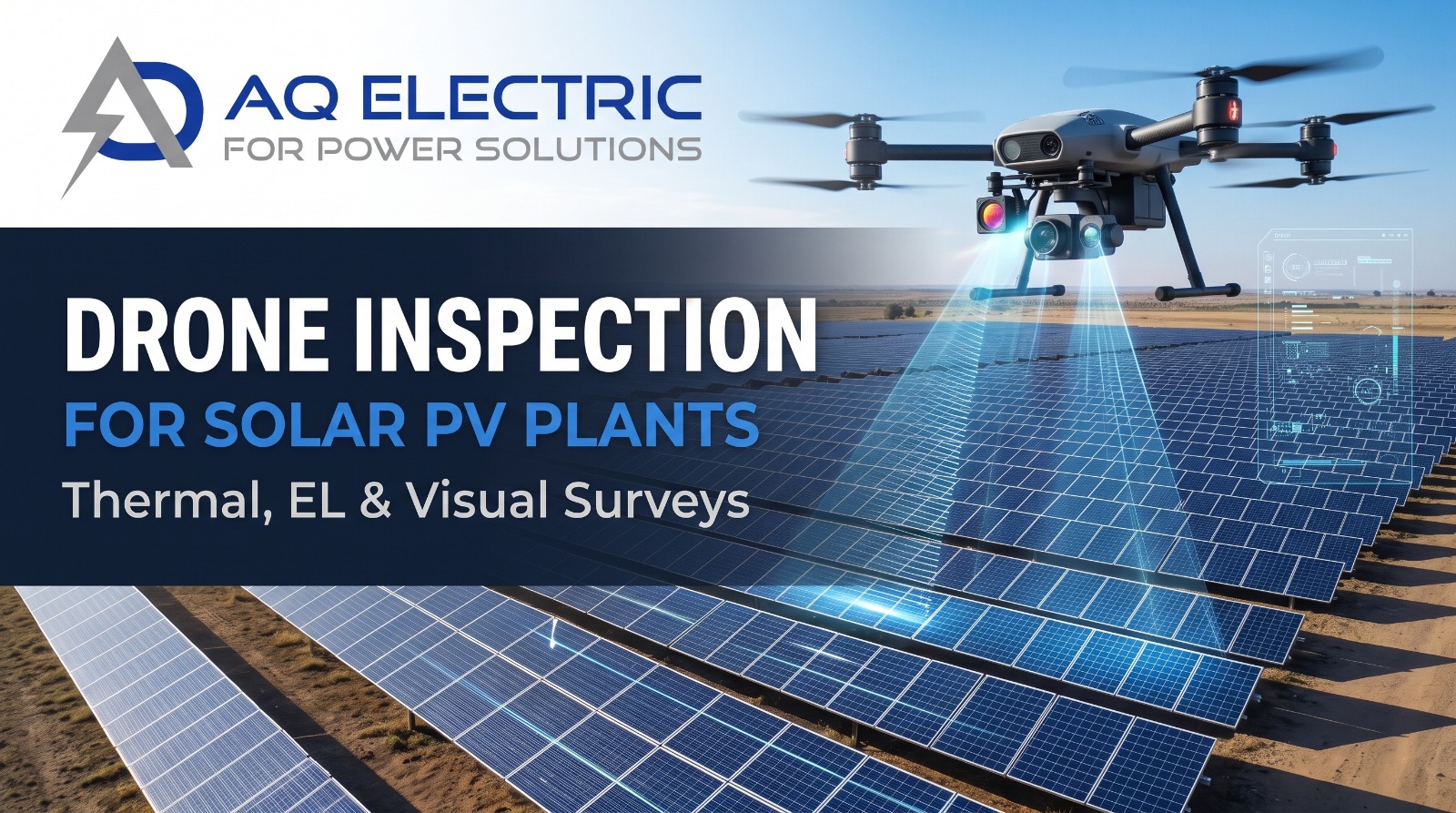
AQ Electric delivers drone inspection for solar PV plants across the MENA region — including thermal drone inspection for ACWA Power and NOMAC on utility-scale plants in Aswan, Egypt — and the question owners ask us most is not whether to fly, but what a drone inspection should actually deliver. A drone can photograph a plant in hours. Turning those images into a list of faults, each one located, classified, and prioritised for repair, is the part that protects revenue. This article explains what drone inspection for solar PV covers, how a professional campaign is planned and flown, what it finds and what it misses, when to schedule it, and what owners and EPC contractors should expect to receive.
Key takeaways
Drone inspection for solar PV uses unmanned aircraft carrying thermal, visual (RGB), and sometimes electroluminescence cameras to survey every module, string, and connection in a plant while it operates. Thermal drone inspection finds hot spots, bypass-diode faults, open strings, and offline modules; visual imagery finds physical damage, soiling, and vegetation; and aerial EL, flown at night, reveals cell cracks. Professional campaigns follow IEC TS 62446-3 conditions — including at least 600 W/m² irradiance and a ground resolution no coarser than 3 cm per pixel — and deliver a georeferenced fault register with severity and repair priority. Industry data shows that plants inspected more often lose less energy, which makes regular drone inspection one of the most cost-effective tools in solar asset management.
What Is Drone Inspection for Solar PV?
Drone inspection for solar PV is the use of unmanned aerial vehicles fitted with thermal, visual, or electroluminescence cameras to inspect a solar plant from the air. The drone flies a pre-programmed route over the array, captures overlapping images of every module, and the images are processed into maps and a fault register that tells the operator exactly where problems are and how serious they are.
The most common form is thermal drone inspection. Because faulty cells, modules, diodes, and connections dissipate energy as heat while the plant is operating, they show up as temperature anomalies in infrared images. A thermal camera on a drone can capture those anomalies across an entire utility-scale plant without stopping production. AQ Electric explains the physics and the anomaly classes in depth in its article on infrared thermography for solar PV; this article focuses on the service itself — what drone inspection for solar PV covers and how to get value from it.
A drone inspection is not a flight; it is a process. The flight produces raw data. The value comes from qualified analysis that separates real faults from reflections and soiling, links each fault to its string and module position, and turns the result into a repair plan.
Average power loss across 373 GW of inspected sites (Raptor Maps 2026)
Annualised revenue loss per MW at that average
Improvement in power loss at sites inspected quarterly (Raptor Maps 2026)
Minimum irradiance for IEC TS 62446-3 thermography
Why Solar Plants Need Aerial Inspection
Solar plants lose energy in ways that monitoring systems do not always reveal, and the losses are growing.
Losses Are Rising and Spreading Out
Raptor Maps’ 2026 Global Solar Report, covering 373 GW of utility-scale and commercial sites, found an average power loss of 5.08%, equal to up to $5,070 per MW of annualised revenue. The report also found that losses are shifting away from large, obvious inverter failures towards distributed problems: string issues accounted for 26.89% of observed power loss, combiner faults for 21.51%, and trackers for just under 14%, while small module defects rose 17.4% year on year. Distributed faults are exactly the kind that are hard to see from SCADA data and easy to see from the air.
Monitoring Sees Symptoms, Not Locations
A monitoring system can tell an operator that an inverter or a combiner is producing less than its neighbours. It usually cannot tell the operator which module, which diode, or which connector is responsible. Drone inspection for solar PV closes that gap by locating faults at module level.
Fewer Technicians per Megawatt
The same report found that the average technician is now responsible for about 70% more megawatts than five years ago. With O&M teams stretched, walking every row of a utility-scale plant is no longer realistic. Drones let a small team inspect the whole plant and send technicians only where repairs are needed.
Inspection Frequency Pays
Raptor Maps reported that sites inspected twice in 2025 showed 7% lower power loss than sites inspected once, and sites inspected quarterly showed a 36% improvement. Sites using autonomous drone technology averaged 3% power loss against the 5.08% dataset average. The data points in one direction: the more often a plant is inspected, the less energy it loses.
The Five Types of Solar Drone Inspection
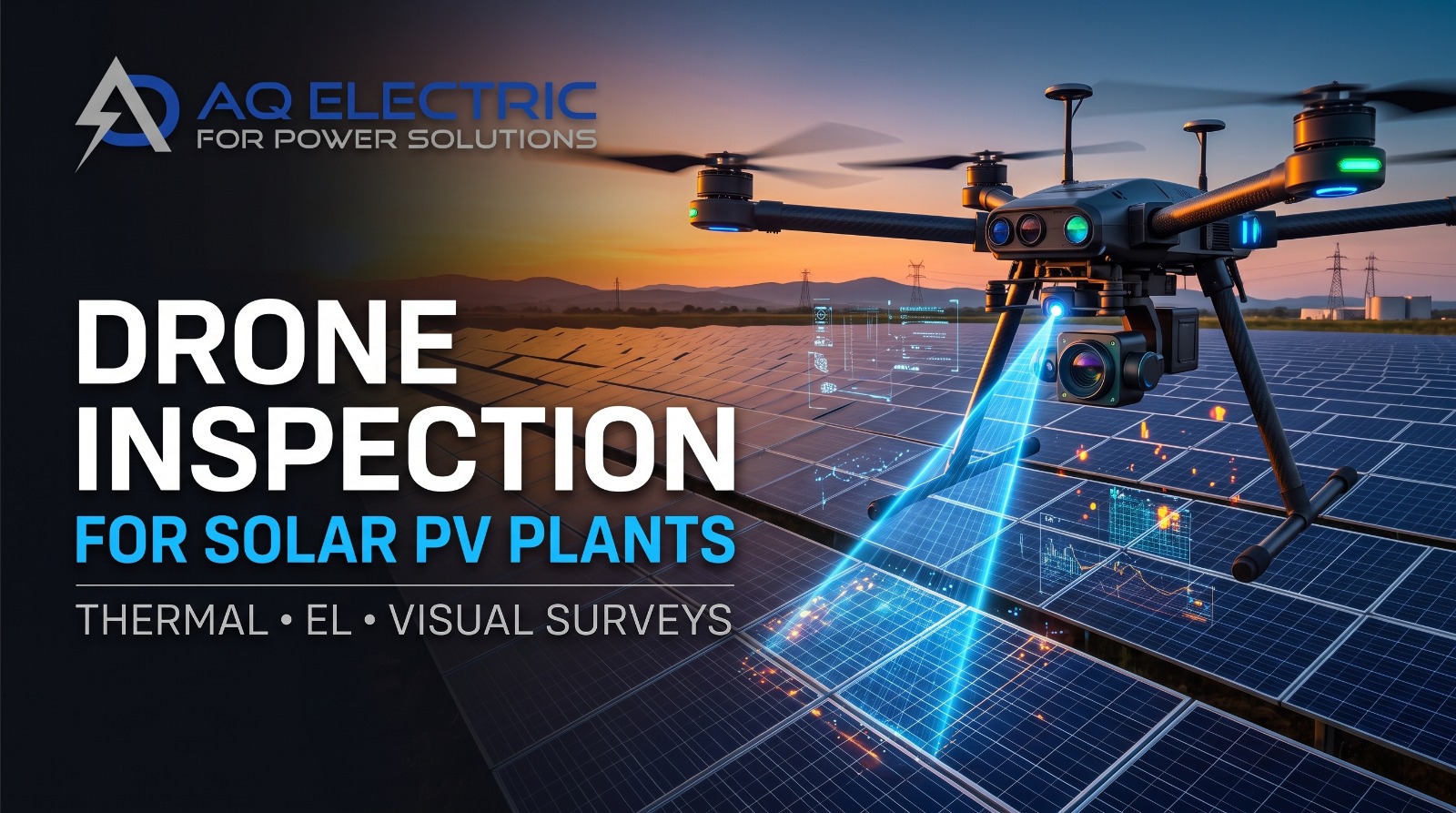
Solar drone inspection is often equated with thermal imaging, but a full aerial programme covers more. AQ Electric’s drone services are built around five inspection types.
| Inspection type | Sensor | What it finds | Typical use |
|---|---|---|---|
| Thermal scanning of PV modules | Radiometric infrared camera | Hot spots, diode faults, open strings, offline modules, connection faults | Commissioning, periodic O&M, warranty claims |
| EL scanning of PV modules | EL-sensitive camera, strings energised by power supply | Cell cracks, broken interconnections, inactive cell areas | Transport damage, hail or storm damage, warranty evidence |
| Substation inspection | Thermal and high-zoom visual | Overheated terminations, insulator and bushing defects, physical damage | Periodic inspection without outages |
| Overhead line inspection | Thermal and high-zoom visual | Hot joints and clamps, damaged insulators, conductor and tower defects | Export lines and plant interconnections |
| Construction progress monitoring | RGB mapping and photogrammetry | Progress against schedule, layout deviations, site conditions | Owners, lenders, and EPC project controls |
Thermal Drone Inspection
Thermal drone inspection is the workhorse of solar O&M. It covers the whole array, works while the plant is producing, and finds the faults responsible for most avoidable energy loss. Visual RGB images are usually captured at the same time, so every thermal anomaly can be checked against a photo of the module surface.
Aerial EL Inspection
Electroluminescence imaging shows the inside of a module: cracked cells, broken fingers, and disconnected areas that may not yet produce heat. Conventional EL requires darkness and strings energised with an external power supply, which is why aerial EL is flown at night. Commercial night-time drone EL has been demonstrated at utility scale; in Australia, PV Lab and Quantified Energy Labs reported imaging at about one panel per second. Researchers at the Technical University of Denmark have also demonstrated drone-based daylight EL using short-wave infrared cameras, although they noted that the method needed further development for efficient utility-scale use. AQ Electric explains EL in detail in its article on electroluminescence EL testing for solar PV.
Substations, Lines, and Construction
The plant does not end at the array. Substations and export lines carry all the plant’s energy, and a single overheated termination can take the entire plant offline. Drones can inspect them thermally and visually without outages or climbing. During construction, RGB mapping gives owners and lenders an independent, dated record of progress — a useful tool for the owner’s technical team described in AQ Electric’s article on the owner’s engineer for solar PV projects.
What a Thermal Drone Inspection Finds
A drone thermal inspection of a solar plant typically classifies anomalies by type and severity. The most common findings are:
- Offline strings and combiners — whole strings or groups of strings showing a uniform temperature difference because they are not producing. These are often the largest single source of avoidable loss.
- Offline or short-circuited modules — individual modules running warmer than their neighbours.
- Bypass diode faults — one-third of a module heated in a characteristic pattern when a diode is conducting or failed.
- Hot spots and hot cells — localised heating from cell defects, shading, or soiling that can damage the module and create fire risk.
- Junction box and connector heating — high-resistance connections that can lead to arcing.
- Soiling and shading patterns — bird droppings, dust accumulation along frames, vegetation, and shading from structures.
- Tracker faults — rows parked at the wrong angle, visible as groups of modules with a different thermal signature.
- Physical damage — broken glass, delamination, and displaced modules, confirmed with RGB imagery.
Many of these faults are string-level problems at root. AQ Electric explains why string faults happen and how they are prevented in its article on solar string wiring.
What a Drone Cannot See
Drone inspection for solar PV is powerful, but it is not a complete diagnosis on its own. Understanding its limits is part of using it well.
- Fine cell cracks. Research presented to the IEA PVPS Task 13 group by DTU found that cell cracks were hard to assess in drone thermography at 600 W/m² and could not be identified below that level, with temperature differences of at most about 1 °C. EL imaging is the right tool for cracks.
- Electrical root cause. Thermography shows where a fault is, not always why. Confirming the cause — a failed diode, a degraded module, high series resistance — usually requires ground measurement such as IV curve tracing. AQ Electric explains the method in its article on IV curve tracing for solar PV.
- Faults that do not heat up in the conditions of the flight. Low irradiance, cloud, or wind can hide defects that would be visible on a clear, calm day.
- Hidden equipment. Components inside closed enclosures, such as combiner box internals and inverter components, need handheld thermography or electrical testing at ground level.
The strongest programmes combine aerial screening of 100% of the plant with targeted ground verification of the anomalies that matter. For handheld verification, the choice of thermal camera affects what can be measured reliably; AQ Electric’s sister company EE Electronics explains the selection criteria in its article on thermal imaging cameras for electrical inspection.
Flight Conditions and IEC 62446-3
The international reference for thermography of PV plants is IEC TS 62446-3, part of the IEC 62446 family that also covers commissioning tests in Part 1. AQ Electric explains that part in its IEC 62446-1 article. For aerial thermography, IEC TS 62446-3 sets minimum conditions so that results are reliable and comparable.
| Parameter | Requirement or good practice | Why it matters |
|---|---|---|
| Irradiance | At least 600 W/m², measured on site | Faults need current flowing to heat up |
| Ground resolution | Maximum 3 cm per pixel | Enough pixels per cell to classify anomalies |
| Sky and wind | Low cloud cover, low wind | Changing irradiance and wind cooling distort temperatures |
| Time of day | Stable high-irradiance hours; Raptor Maps’ flight guidance avoids capture within 120 minutes of sunrise or sunset | Low sun angles reduce irradiance and add reflections |
| Plant status | Energised and operating normally | Offline equipment shows no thermal signature of faults |
| Personnel | Certified thermographers and licensed pilots | Classification requires trained judgement, not software alone |
Resolution has a direct cost. Flying lower gives finer resolution but more flight time; one inspection software provider reports that flying at 23 m to reach 3 cm per pixel multiplies flight time by about 2.5 compared with flying at 35 m. Owners should know which resolution they are buying. A quote for a fast, high-altitude flight is not comparable with one designed to meet IEC TS 62446-3, and the report should state whether the standard’s conditions were met.
Ask before you buy
Ask every provider: what ground resolution will you fly, how will you measure irradiance on site, who classifies the anomalies, and will the report state IEC TS 62446-3 conformity? The answers separate an inspection from a photo flight.
How a Professional Campaign Runs
A professional drone inspection for solar PV follows six stages.
1. Scoping and Data Request
The provider agrees the objective (commissioning baseline, periodic O&M, warranty claim, or due diligence), the inspection types, the resolution, and the deliverables. The owner supplies the plant layout, string and inverter numbering, module datasheets, and site access and safety rules. Without the layout and numbering, faults cannot be mapped to the exact string and module the technicians will need to find.
2. Permits and Flight Planning
Commercial drone flights require approval from the national aviation authority, and some sites sit near airports or restricted areas. Flight routes are planned for the required resolution and image overlap, taking account of tracker positions and terrain.
3. On-Site Conditions Check
On the day, the team measures irradiance and weather on site, confirms that the plant is operating normally, and records the conditions that will appear in the report.
4. Flight and Data Capture
The drone flies the planned routes, capturing radiometric thermal and RGB images with the agreed overlap. Data is checked on site for coverage and quality before the team leaves, so gaps can be re-flown immediately.
5. Processing and Analysis
Images are stitched into georeferenced maps. Software can detect candidate anomalies quickly, but each anomaly should be reviewed by a qualified engineer who classifies its type, severity, and probable cause and removes false positives such as reflections.
6. Reporting and Verification
The provider issues the report and fault register, and critical anomalies are verified at ground level. After repairs, a targeted re-flight confirms that faults have been resolved.
AQ Electric flies IEC TS 62446-3 drone inspections across MENA — call +962 79 51 54 126.
What You Should Receive
The output of a drone inspection for solar PV should be usable by the O&M team the next morning. A complete deliverable includes:
- An executive summary — total anomalies by type and severity, and the estimated energy impact.
- A georeferenced fault register — every anomaly with its block, inverter, string, and module position, coordinates, thermal and RGB image, temperature difference, severity class, probable cause, and recommended action.
- Defect maps — orthomosaic maps showing where faults cluster.
- Repair prioritisation — what to fix first, based on safety risk and energy loss.
- Inspection conditions — irradiance, weather, resolution, equipment, and a statement of conformity with IEC TS 62446-3.
- Warranty support — evidence packages for modules that qualify for manufacturer claims.
- Raw data — radiometric images that can be re-analysed and compared with future inspections.
When to Schedule a Drone Inspection
Drone inspection for solar PV delivers the most value at specific points in a plant’s life.
| Moment | Purpose |
|---|---|
| Commissioning | Find construction and transport defects before acceptance; create the thermal baseline |
| Before EPC warranty expiry | Document defects while the contractor is still responsible |
| Periodic O&M | Find and fix developing faults; at least annually, more often for large or ageing plants |
| After extreme weather | Assess damage from storms, hail, sandstorms, or flooding |
| Underperformance investigation | Locate the cause when monitoring shows unexplained losses |
| Acquisition or refinancing | Give buyers and lenders an independent view of asset condition |
Two of these moments deserve emphasis. At commissioning, Raptor Maps found that new sites already show an average power loss of 4.46%; a full-plant thermal survey before acceptance is one of the most effective ways to find it while the EPC still has to fix it. AQ Electric covers the full acceptance sequence in its article on the solar PV commissioning process. Near warranty expiry, the same report found that losses rose 55% between years two and three of operation, coinciding with the lapse of EPC warranties that often end after one to two years. An end-of-warranty drone inspection documents the defects that should be claimed before that window closes.
For operating plants, drone surveys belong inside a structured maintenance programme; see AQ Electric’s article on solar PV plant operation and maintenance. For acquisitions, they form part of a wider asset review described in AQ Electric’s article on solar PV technical due diligence.
Drone vs Ground Inspection
Drone and ground inspection are not competitors; they do different jobs. The comparison below shows where each fits.
| Factor | Drone inspection | Ground inspection |
|---|---|---|
| Coverage | 100% of modules on utility-scale plants | Usually a sample on large plants |
| Speed | Tens of megawatts per day are typical for aerial screening | Far slower; limited by walking distance and crew size |
| Production impact | None; plant must be operating | None for thermography; some electrical tests require isolation |
| Fault location | Module-level, georeferenced | Precise, but only where the crew goes |
| Root-cause diagnosis | Indicative | Confirmatory (IV curves, handheld IR, electrical tests) |
| Enclosed equipment | Not visible | Accessible |
| Safety | Less time near live equipment and in heat | More exposure for technicians |
The efficient approach is aerial screening of the whole plant, followed by ground verification of the faults that matter. That way, ground crews spend their time fixing problems rather than searching for them.
Drone Inspection in the Gulf and MENA
The Gulf and wider MENA region combine some of the world’s largest solar plants with some of the harshest operating conditions. Both make drone inspection for solar PV more valuable, and both shape how it must be done.
Scale
Plants of hundreds of megawatts to gigawatts cannot be inspected at module level on foot within a practical timeframe. Aerial screening is the only realistic way to inspect every module.
Heat
High irradiance makes it easy to meet the 600 W/m² threshold, but high ambient and module temperatures affect drone batteries, electronics, and crews. Flight windows have to be planned around both the standard’s requirements and safe operating limits for equipment and people.
Dust and Soiling
Heavy soiling creates thermal patterns of its own. Analysts must be able to distinguish soiling from genuine module faults, and the inspection can also be used to assess where cleaning is most needed. Dust also affects drone equipment and requires disciplined maintenance in the field.
Aviation Rules
Each country regulates commercial drone flights through its civil aviation authority. In Jordan, the Civil Aviation Regulatory Commission (CARC) issued the country’s first commercial drone operator licence in August 2025 and has said further licences will follow; in Saudi Arabia, drone operations are regulated by the General Authority of Civil Aviation (GACA). Providers must hold the approvals required in each country where they fly. AQ Electric’s work in those markets is covered in its articles on solar PV testing services in Jordan and solar PV testing services in Saudi Arabia.
Substations in Remote Locations
Many regional plants are far from cities, and their substations and export lines are critical single points of failure. Drone thermography of substation equipment reduces the need for outages and climbing. AQ Electric explains the transformer side of the substation in its article on solar power plant transformers.
Choosing a Drone Inspection Provider
The drone itself is the least important part of the decision. When choosing a provider for drone inspection for solar PV, look for:
- Solar engineering expertise — analysts who understand PV electrical behaviour, not only aerial imaging.
- IEC TS 62446-3 conformity — a stated resolution, on-site irradiance measurement, and a conformity statement in the report.
- Radiometric thermal cameras — so temperatures can be measured and re-analysed, not just viewed.
- Engineer-reviewed classification — software detection checked by qualified people.
- Ground verification capability — IV curve tracing, EL, and handheld thermography to confirm what the drone finds.
- Aviation approvals — licensed pilots and permits in the country of operation.
- Utility-scale references — named plants of comparable size and climate.
- Sample reports — a real fault register, showing exactly what your O&M team will receive.
Many of the same criteria apply to any testing partner; AQ Electric sets them out in its article on how to choose a solar testing and commissioning partner.
AQ Electric’s Drone Inspection Services
AQ Electric for Power Solutions, founded in Jordan in 2019 and expanded to Egypt in 2021, provides drone inspection for solar PV plants and power infrastructure across the MENA region. Its aerial services cover thermal image scanning for PV panels, electroluminescence scanning for PV panels, overhead transmission line inspection, electrical substation inspection, and construction progress monitoring. Full details are on AQ Electric’s solar PV drone inspection services page.
Thermal Drone Inspection for ACWA Power and NOMAC
AQ Electric has delivered thermal drone inspection for ACWA Power and its operating company NOMAC on utility-scale solar plants in Aswan, Egypt — one of the hottest and dustiest solar environments in the region, and exactly the conditions in which disciplined flight planning and engineer-led analysis make the difference between a usable fault register and a folder of images. For more on AQ Electric’s work in the country, see its article on solar testing services in Egypt.
What makes AQ Electric’s drone inspection different is what happens after the flight. Because the same company performs commissioning testing, IV curve tracing, EL imaging, and handheld thermography in-house, every critical aerial finding can be verified on the ground and turned into a repair or a warranty claim. Ground verification is delivered through AQ Electric’s IV curve tracing services and EL testing services, and ongoing inspection can be built into AQ Electric’s solar O&M services.
AQ Electric operates under an ISO 9001, ISO 14001, and ISO 45001-certified management system from offices in Amman, Jordan and New Cairo, Egypt, with more than 1.0 GW of PV project experience alongside clients including ACWA Power, NOMAC, CEEC, SEPCO, and Power China. The full portfolio is on AQ Electric’s projects page.
From Aerial Screening to Repair
AQ Electric’s inspection and testing services across the MENA region.
🚁Drone Inspection📊IV Curve Tracing🔬EL Testing⚡Testing & Commissioning🔧Operation & Maintenance🔍Third-Party Inspection✉Speak to an Engineer
Frequently Asked Questions
What is drone inspection for solar PV?
Drone inspection for solar PV uses unmanned aircraft with thermal, visual, or electroluminescence cameras to inspect every module, string, and connection in a solar plant from the air, then turns the images into a georeferenced fault register with severity and repair priority.
What can a drone thermal inspection detect on a solar plant?
A drone thermal inspection detects offline strings and combiners, offline or short-circuited modules, bypass diode faults, hot spots and hot cells, junction box and connector heating, soiling and shading patterns, tracker misalignment, and, with RGB imagery, physical damage such as broken glass.
Can a drone detect cracked solar cells?
Not reliably with thermography alone. Research shows that cell cracks produce very small temperature differences and are hard to identify in drone thermal images. Electroluminescence imaging, from the ground or by drone at night, is the right method for cracks.
What conditions does IEC TS 62446-3 require for drone thermography?
IEC TS 62446-3 requires irradiance of at least 600 W/m², measured on site, and a ground resolution of no more than 3 cm per pixel, along with stable weather, low cloud, low wind, and an operating plant. The report should state whether these conditions were met.
How often should a solar plant be inspected by drone?
At least once a year, plus at commissioning, before EPC warranty expiry, and after extreme weather. Raptor Maps’ 2026 data shows sites inspected twice a year had 7% lower power loss than sites inspected once, and sites inspected quarterly showed a 36% improvement.
Does drone inspection replace ground testing?
No. Drone inspection screens 100% of the plant quickly and locates faults, while ground testing such as IV curve tracing, EL, and handheld thermography confirms root causes and covers equipment inside enclosures. The two work best together.
Does the plant need to shut down for a drone inspection?
No. For thermal inspection the plant must be operating normally, because faults only heat up when current flows. Night-time aerial EL requires strings to be energised with a power supply, which is planned outside generation hours.
Does AQ Electric provide drone inspection for solar PV in MENA?
Yes. AQ Electric provides thermal and EL drone scanning of PV modules, substation and overhead line inspection, and construction progress monitoring across Jordan, Egypt, Saudi Arabia, and the wider Gulf and MENA region, including thermal drone inspection for ACWA Power and NOMAC in Aswan, Egypt.
See Every Fault in Your Plant
AQ Electric delivers drone inspection for solar PV plants across the MENA region — thermal and EL scanning, substation and line inspection, and engineer-reviewed fault registers backed by in-house ground verification. ISO-certified, with 1.0 GW of project experience alongside ACWA Power, NOMAC, CEEC, SEPCO, and Power China.
PV projects supported
MENA countries covered
ISO certifications9001 · 14001 · 45001
Founded in Jordan