

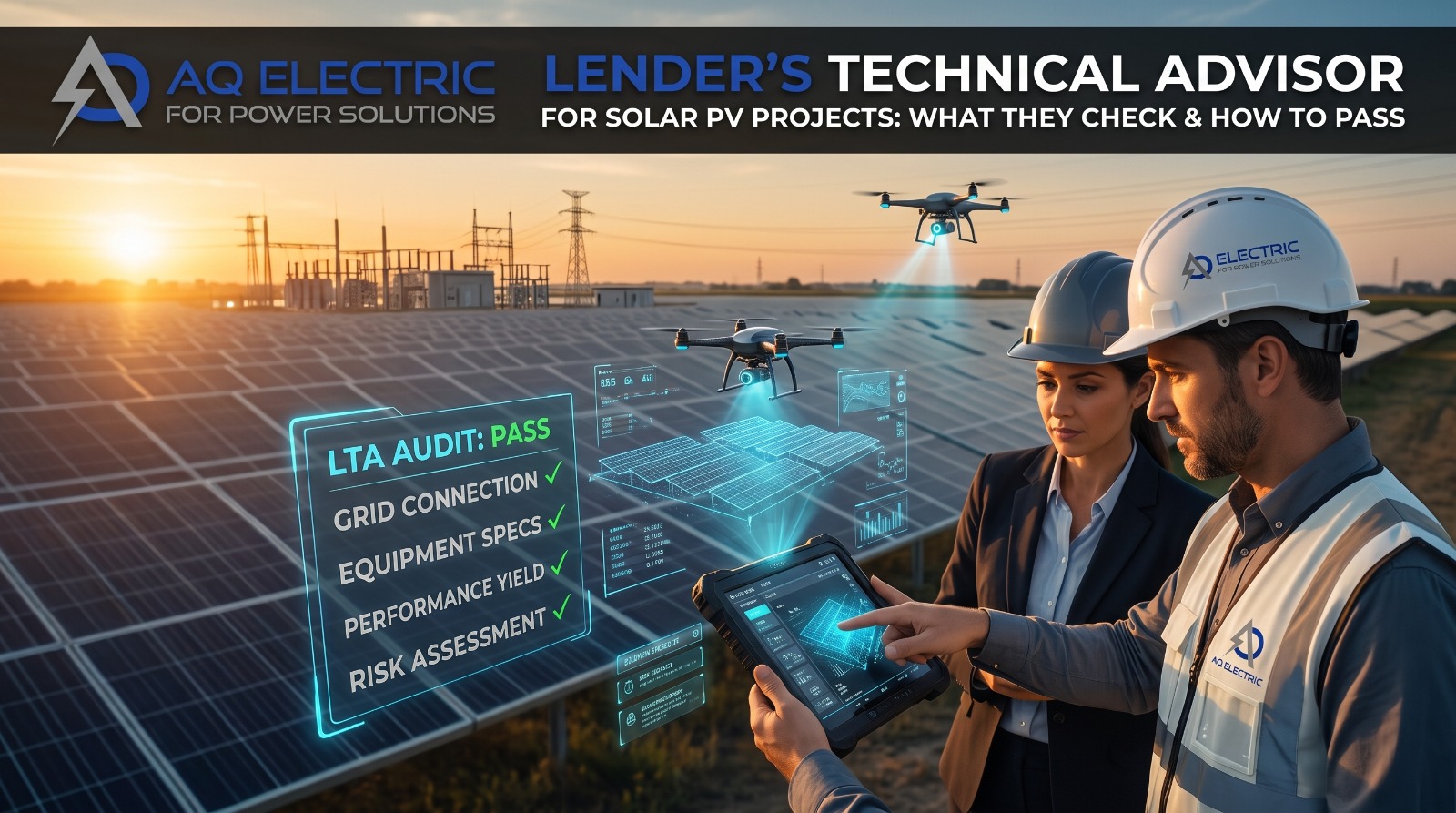
AQ Electric has spent more than 1.0 GW of PV project experience producing exactly the kind of testing evidence that a lender’s technical advisor scrutinises before a solar project can be financed. On lender-backed projects across the MENA region — from the Wadi Ad Dawasir 120 MWp plant in Saudi Arabia to the utility-scale developments of Aswan, Egypt — AQ Electric’s IEC 62446-compliant commissioning and testing documentation has formed part of the technical package that a lender’s technical advisor reviews. This article explains what a lender’s technical advisor for solar PV actually does, what they check, and — most importantly — how to make sure your project passes their scrutiny the first time.
If your solar project is financed by a bank or institutional lender — as most utility-scale projects are — then a lender’s technical advisor stands between your project and its funding. Understanding this role is essential for any developer, EPC contractor, or IPP owner, because a weak technical package doesn’t just cause delay: it can compress your debt sizing, worsen your financing terms, or sink the deal entirely. This article demystifies the lender’s technical advisor for solar PV projects, walks through the four pillars they assess, and shows how disciplined testing and commissioning — the kind AQ Electric delivers — is the foundation of a technical package that survives due diligence.
What Is a Lender’s Technical Advisor?
A lender’s technical advisor for a solar PV project is an independent engineering firm hired by a bank or institutional lender to assess whether a project is technically sound and financially realistic before the lender commits capital. When a lender considers a solar loan — often tens or hundreds of millions of dollars — it does not have the in-house expertise to judge whether the plant will actually produce the energy, and therefore the cash flow, needed to repay the debt. So it hires a lender’s technical advisor to be its technical eyes and ears.
The role sits precisely at the intersection of engineering and finance. A lender’s technical advisor reads single-line diagrams, checks energy yield models, inspects sites, reviews equipment datasheets, examines commissioning test records, and stress-tests the financial assumptions underpinning the loan. Their deliverable is an independent engineering report that confirms — or challenges — whether the project is likely to generate the cash flows required to repay debt and meet equity returns. Crucially, the lender’s technical advisor is not on the developer’s payroll in spirit: although the developer usually pays the fee, the advisor is selected by and answers to the lender. That independence is the entire point.
LTA, Lender’s Engineer, Independent Engineer: The Same Role
One source of confusion is that the lender’s technical advisor for solar PV goes by several interchangeable names. Understanding them prevents misunderstanding during a financing process:
- Lender’s Technical Advisor (LTA) — the most common term in the Middle East, Europe, and Asia.
- Lender’s Engineer (LE) — a shorter, widely-used equivalent.
- Independent Engineer (IE) — the dominant term in North America and increasingly global.
- Independent Technical Advisor (ITA) — used in some markets, notably India.
All four refer to the same function: an independent technical authority representing the lender’s interests throughout the project lifecycle. Whichever term appears in your financing documents, the substance is identical — an impartial engineering firm whose sign-off the lender requires before releasing funds. Throughout this article we use “lender’s technical advisor” and “independent engineer” interchangeably, as the industry does.
Lender’s Technical Advisor vs Owner’s Engineer
A frequent point of confusion is the difference between a lender’s technical advisor and an owner’s engineer. Both are independent technical roles, but they represent different parties and serve different purposes:
| Aspect | Lender’s Technical Advisor | Owner’s Engineer |
|---|---|---|
| Represents | The lender / financier | The project owner / developer |
| Primary goal | Protect the lender’s capital | Protect the owner’s interests vs the EPC |
| Focus | Bankability, risk, financial-model validation | Design quality, construction oversight, defect prevention |
| Key relationship | Deals with lenders and legal counsel | Deals with the EPC and construction teams |
The two roles often work in parallel on the same project. What they share is a reliance on independent, standards-based technical evidence — the testing and commissioning documentation that proves the plant is what the paperwork claims. This is where a specialist testing partner becomes valuable to both roles at once.
Why the LTA Matters: The Gatekeeper of Bankability
In solar project finance, the lender’s technical advisor is the gatekeeper of bankability. Without their sign-off, projects have a very difficult time securing funding. Their rigorous due diligence gives lenders and investors the confidence that the asset will deliver reliable returns over time — and their independence is what makes that confidence credible.
The consequences of a poor LTA review are severe and concrete. When a lender’s technical advisor finds problems — aggressive energy yield assumptions, unverified data, weak commissioning documentation, non-compliance with standards — the report comes back with qualifications or outright rejection. In practice this translates into compressed debt sizing (the lender lends less), wider credit spreads (the loan costs more), capital holdbacks, or in the worst case a collapsed deal. Every one of these outcomes directly erodes the developer’s returns.
This is why the technical package is, in a very real sense, the asset before construction is even complete. A project with excellent physical hardware but a weak technical and testing package will struggle to finance; a well-documented, properly-tested project sails through. The single most effective way to influence the LTA’s verdict is to ensure the underlying testing and commissioning evidence is complete, standards-compliant, and defensible — long before the advisor ever opens the file.
The core insight
You cannot control the lender’s technical advisor — they are independent by design. But you can control the quality of the technical evidence they review. Strong, IEC-compliant testing and commissioning documentation is the developer’s most powerful lever over the outcome.
The Four Pillars an LTA Checks
Every independent engineering review rests on four pillars. Miss one, and the report comes back with qualifications. Understanding them tells a developer exactly where to focus preparation.
1. Design and Engineering
The lender’s technical advisor checks whether the plant is designed to produce the claimed energy safely and reliably — module layout, string configuration, inverter sizing, electrical protection, grounding, structural loading, and code compliance. Reviews reference standards including IEC 61730 for module safety and IEC 62446 for commissioning.
2. Energy Yield
The yield report is the heart of the independent engineering review. The advisor validates the meteorological data source, the simulation model (commonly PVsyst), loss assumptions, shading analysis, and the uncertainty budget. The key outputs are the P50, P75, P90, and sometimes P99 annual energy estimates — discussed in detail below.
3. Equipment and Bankability
Lenders want field-proven, bankable equipment. The lender’s technical advisor assesses module and inverter manufacturers, product track records, warranties, and certifications. Equipment without a proven reliability history raises the risk profile and can trigger qualifications in the report.
4. Construction, Commissioning, and Contracts
The advisor reviews the EPC contract, construction quality, the commissioning programme, and the long-term O&M arrangements. This is where the commissioning and testing evidence — the IEC 62446 test records, the IV curve tracing results, the thermographic inspection reports — is examined directly. Weak or incomplete testing documentation here undermines confidence across the whole review.
Where Commissioning and Testing Fit
Of the four pillars, the one a developer can most directly strengthen through the right testing partner is construction and commissioning. A lender’s technical advisor does not simply take the developer’s word that the plant was built correctly — they examine the documented evidence, and the quality of that evidence shapes their entire impression of the project.
The commissioning evidence a lender’s technical advisor expects to see includes the full IEC 62446-1 test record: continuity of protective earthing, polarity verification, open-circuit voltage and operating current measurements against expected values, insulation resistance testing, and functional testing — the mandatory Category 1 tests for every grid-connected system. For utility-scale and bankable projects, the advisor also expects Category 2 evidence: IV curve tracing across the array and infrared thermographic inspection. On the highest-value projects, Category 3 diagnostics such as electroluminescence imaging may be expected. For a full walkthrough of these categories, see AQ Electric’s IEC 62446-1 article.
The critical point for developers is this: the lender’s technical advisor is reviewing testing evidence that was produced weeks or months earlier, during commissioning. By the time the advisor opens the file, it is too late to improve it. The quality of that evidence is determined entirely by the competence of the testing and commissioning partner engaged during construction — which is why the choice of that partner is, in effect, a financing decision. This is the same principle explored in AQ Electric’s article on choosing a solar testing and commissioning partner.
AQ Electric produces the IEC-compliant testing evidence LTAs trust — call +962 79 51 54 126.
P50, P90, and the Yield Question
No concept matters more in an independent engineering review than the probability-of-exceedance energy estimates — P50 and P90. Understanding them helps developers see the world through the lender’s technical advisor’s eyes.
A P50 estimate is the annual energy yield the plant is expected to exceed 50% of the time — the best-estimate, central case. A P90 estimate is the yield the plant is expected to exceed 90% of the time — a conservative case that accounts for uncertainty in weather, degradation, and performance. Lenders size debt against the conservative P90 (or sometimes P75) rather than the optimistic P50, because they need confidence the plant will generate enough cash to service the loan even in a bad year.
The gap between P50 and P90 is driven by uncertainty — and uncertainty is where testing quality directly affects financing. A plant with rigorous, well-documented commissioning testing carries lower performance uncertainty, which narrows the gap between P50 and P90, which allows the lender to size more debt against the project. In other words, better testing evidence can literally increase the amount a project can borrow. Conversely, a lender’s technical advisor faced with weak or missing test data will widen the uncertainty budget defensively — penalising the project’s debt capacity. This is the concrete financial mechanism by which good testing pays for itself many times over.
How to Pass the LTA Review
A developer cannot control the lender’s technical advisor’s independence — but can control the preparation. Projects that pass LTA review smoothly share a consistent set of practices:
- Engage a competent testing and commissioning partner early. The testing evidence the LTA reviews is created during construction. A capable partner produces IEC-compliant, complete, defensible documentation from the start.
- Test to the right category. For utility-scale and bankable projects, deliver full IEC 62446 Category 2 evidence — IV curve tracing and thermography — not just the Category 1 minimum.
- Record environmental conditions rigorously. Measurements without irradiance and temperature data cannot be compared to expected values, and an LTA will discount them.
- Use realistic, defensible yield assumptions. Aggressive P50 assumptions are the most common cause of LTA qualifications. Build the model on validated data.
- Apply region-correct loss assumptions. In the MENA region especially, soiling and temperature assumptions must reflect local reality, or the LTA will reject them.
- Keep documentation complete and traceable. Every test result should map to specific hardware, with calibration certificates and clear pass/fail determinations.
- Choose bankable equipment. Field-proven modules and inverters from established manufacturers reduce the risk profile the LTA assesses.
The LTA in the MENA Context
The role of the lender’s technical advisor for solar PV has become standard practice across the MENA region as international development finance institutions — the IFC, EBRD, AfDB, and their commercial co-lenders — fund the region’s solar build-out. Anyone financing a utility-scale project in Saudi Arabia, Egypt, Jordan, the UAE, or Oman will encounter an LTA process.
The Soiling Assumption Trap
The single most common way MENA projects stumble in LTA review is the soiling assumption. A lender’s technical advisor familiar with the region knows that dust accumulation can reduce output by 0.5% to 1% per day if modules are not cleaned. A yield report that applies standard European soiling losses of around 2% per year will be flagged as technically flawed — and the project’s credibility with it. Testing and commissioning documentation that reflects genuine regional conditions is essential.
Multi-Lender Documentation
MENA projects are frequently financed by consortia, each lender bringing its own technical advisor with its own reporting conventions. Testing documentation must be structured to satisfy multiple advisors simultaneously — a discipline that comes only from experience on lender-financed regional projects.
Extreme-Climate Evidence
An LTA reviewing a Gulf or North African project expects to see testing and commissioning evidence that accounts for extreme heat — temperature-corrected expected values, thermal inspection under representative conditions, and equipment selected with adequate derating. Evidence produced by a partner without regional experience often lacks these adaptations.
How AQ Electric Helps You Pass
AQ Electric for Power Solutions, founded in Jordan in 2019 and expanded to Egypt in 2021, is not a lender’s technical advisor — and that distinction matters. AQ Electric is the specialist testing and commissioning partner that produces the independent, standards-based evidence a lender’s technical advisor reviews. With more than 1.0 GW of PV project experience and an ISO 9001, ISO 14001, and ISO 45001-certified management system, AQ Electric delivers the testing package that helps a project pass due diligence.
On lender-financed projects across the region — including work with SEPCO – Power China, CEEC, ACWA Power, and NOMAC — AQ Electric has produced IEC 62446-compliant commissioning documentation structured for exactly the scrutiny an independent engineer applies. Our field engineers deliver the full evidentiary scope: commissioning testing, IV curve tracing, thermographic drone inspection, and quality assurance, all documented to the standard that survives due diligence. For the operational phase that an LTA also assesses, our solar operation and maintenance services provide the ongoing verification lenders expect.
The practical value AQ Electric offers a developer facing an LTA review is straightforward: we produce testing evidence that reflects genuine regional conditions, is complete and traceable, and is structured to satisfy the independent engineer the first time — reducing the qualifications, uncertainty penalties, and delays that erode financing. When your project’s bankability depends on the quality of its technical package, that evidence is one of the highest-return investments you can make. To discuss how AQ Electric can strengthen your project’s technical package, contact our engineering team.
The Evidence an LTA Reviews — Delivered by AQ Electric
Bankable testing and commissioning documentation, in-house across MENA.
⚡Testing & Commissioning📊IV Curve Tracing🔬EL Testing🚁Drone Inspection✓Quality Assurance (FAT & SAT)🔍Third-Party Inspection🔧Operation & Maintenance✉Speak to an Engineer
Frequently Asked Questions
What does a lender’s technical advisor do for a solar PV project?
A lender’s technical advisor is an independent engineering firm hired by a lender to assess whether a solar project is technically sound and financially realistic before funding. They review design, energy yield, equipment, and commissioning evidence, and produce an independent engineering report that confirms or challenges the project’s bankability.
Is a lender’s technical advisor the same as an independent engineer?
Yes. Lender’s Technical Advisor (LTA), Lender’s Engineer (LE), Independent Engineer (IE), and Independent Technical Advisor (ITA) all refer to the same role — an independent technical authority representing the lender’s interests. The terminology varies by region but the function is identical.
What is the difference between a lender’s technical advisor and an owner’s engineer?
A lender’s technical advisor represents the lender and focuses on bankability and protecting the lender’s capital. An owner’s engineer represents the developer and focuses on design quality and construction oversight versus the EPC. Both are independent, and they often work in parallel on the same project.
How does testing quality affect the lender’s technical advisor review?
Strong, IEC 62446-compliant testing evidence lowers performance uncertainty, which narrows the gap between P50 and P90 yield estimates and can increase the debt a project can raise. Weak or missing test data forces the advisor to widen the uncertainty budget, penalising the project’s financing terms.
What are P50 and P90 in a solar financing context?
P50 is the annual energy yield a plant is expected to exceed 50% of the time (best estimate). P90 is the yield it exceeds 90% of the time (conservative case). Lenders size debt against the conservative P90 to ensure the plant generates enough cash to repay the loan even in a poor year.
Is AQ Electric a lender’s technical advisor?
No. AQ Electric is a specialist testing and commissioning partner that produces the independent, IEC-compliant evidence a lender’s technical advisor reviews. We help developers and EPCs build a technical package strong enough to pass due diligence, rather than performing the LTA’s independent assessment role.
How can I prepare my MENA solar project for LTA review?
Engage a competent testing partner early, test to IEC 62446 Category 2, record environmental conditions rigorously, use realistic region-correct yield and soiling assumptions, and keep documentation complete and traceable. AQ Electric’s testing and commissioning services are built to deliver exactly this.
Build a Technical Package That Passes Due Diligence
A lender’s technical advisor decides whether your solar project gets funded on the terms you need. AQ Electric produces the IEC 62446-compliant testing and commissioning evidence that survives their scrutiny — backed by 1.0 GW of MENA project experience with SEPCO, Power China, CEEC, ACWA Power, and NOMAC, and ISO-certified end to end.
PV projects supported
MENA countries covered
ISO certifications9001 · 14001 · 45001
Founded in Jordan