

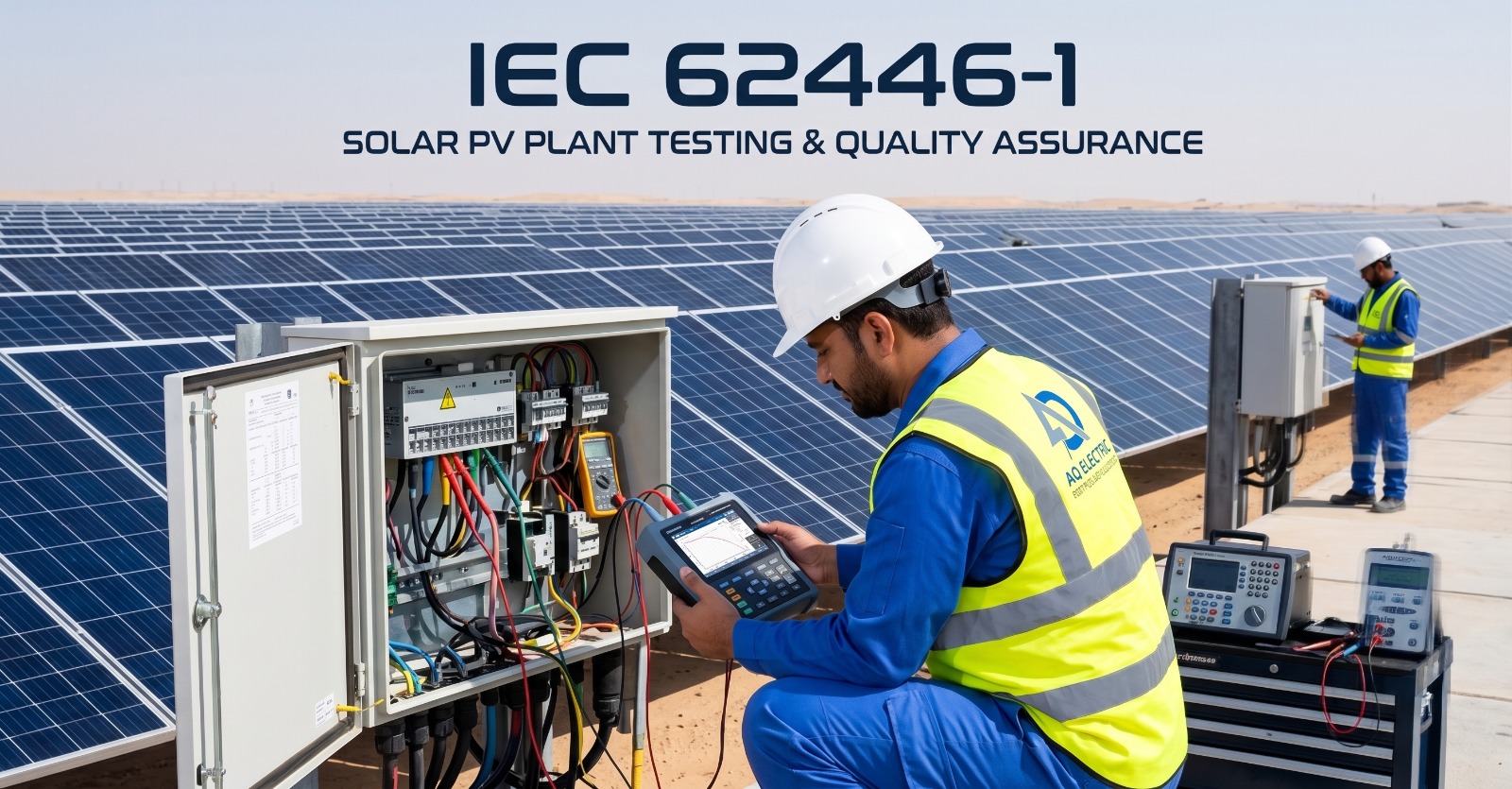
Every serious solar photovoltaic project handed over in the world today is expected to comply with one particular international standard: IEC 62446-1. It is the document that tells EPC contractors how to prove a plant is safe, functional, and performing to specification — and the document that tells asset owners, lenders, and O&M teams what evidence they should be receiving before they sign off on commissioning.
Yet despite its central role in the industry, IEC 62446-1 remains widely misunderstood. Many EPCs treat it as a formality; many buyers do not know what to demand; and many field engineers apply Category 1 tests when Category 2 or 3 would have caught a defect worth millions. This guide walks through the standard from the ground up: what it covers, who it applies to, what testing it mandates at each category level, what documentation it requires, and how it fits alongside other IEC standards that govern PV performance and safety.
What is IEC 62446-1?
IEC 62446-1 is the international standard published by the International Electrotechnical Commission that specifies the minimum requirements for testing, documentation, and commissioning of grid-connected photovoltaic systems. Its full formal title is: “Photovoltaic (PV) systems — Requirements for testing, documentation and maintenance — Part 1: Grid connected systems — Documentation, commissioning tests and inspection”.
First published as IEC 62446 in 2009, the standard was extensively revised and republished as IEC 62446-1 in 2016, followed by a second edition in 2018 that added a great deal more detail on category-based testing regimes and thermographic inspection. The current text is the reference used by essentially every serious solar EPC, O&M provider, and independent engineer working on grid-connected systems today.
Its purpose is straightforward: to define a common, internationally-recognised body of evidence that a PV system has been built to the design intent, is electrically safe, is functioning within its expected parameters, and can be handed over to its owner with confidence. Before IEC 62446-1, every EPC used its own commissioning protocol and every inspector applied its own criteria — a situation that was neither bankable nor scalable as the industry moved into utility-scale deployment.
Why the standard matters commercially
IEC 62446-1 is now referenced by name in project financing agreements, EPC contracts, and O&M scopes of work across the MENA region and globally. A commissioning test report that is not IEC 62446-1-compliant is, for many lenders and IPPs, simply not accepted.
Who Needs to Comply with IEC 62446-1?
The standard applies to five distinct roles across the solar PV project lifecycle, and every role has a different set of obligations under it.
- EPC contractors use IEC 62446-1 to structure their commissioning protocol and produce the handover test report that transfers the plant to its owner.
- O&M providers use it as the reference for periodic inspection and re-testing during the operational life of the plant.
- Third-party inspectors use it as the objective basis for independent verification, either at commissioning or during periodic audits.
- Independent engineers and lender’s technical advisors use it to evaluate whether the plant they are underwriting has been properly tested and documented.
- PV system designers apply it in reverse — ensuring their designs can be verified against its test requirements once installed.
Notably, the standard applies to any grid-connected PV system regardless of size — from a small rooftop installation to a multi-gigawatt utility plant. What changes with system size is not whether IEC 62446-1 applies, but which category of testing is appropriate.
AQ Electric delivers full IEC 62446-1-compliant testing across the MENA region — or call +962 79 51 54 126.
Structure of the Standard: Parts 1, 2, and 3
Although we speak most often about IEC 62446-1, the family of standards actually spans three parts, each covering a different aspect of the PV system lifecycle.
| Standard | Scope | Primary users |
|---|---|---|
| IEC 62446-1 | Grid-connected systems — documentation, commissioning tests, and inspection | EPC contractors, commissioning engineers, third-party inspectors |
| IEC 62446-2 | Grid-connected systems — maintenance of PV systems (operational-phase testing) | O&M providers, asset managers |
| IEC 62446-3 | Outdoor infrared thermography of PV modules and plants | Thermographic inspection teams, drone survey providers |
In practice, IEC 62446-1 is the anchor document because it defines the commissioning phase — the point at which the plant transitions from construction to operation. The other two parts extend the same testing philosophy into ongoing operation (Part 2) and into the specific discipline of infrared inspection (Part 3), which has become critical for utility-scale plants where thousands of modules need to be assessed quickly.
Category 1: Basic Testing Requirements
Category 1 defines the minimum set of tests that every grid-connected PV system must undergo before it is commissioned. These tests are non-negotiable and form the compliance floor for handover.
Visual Inspection
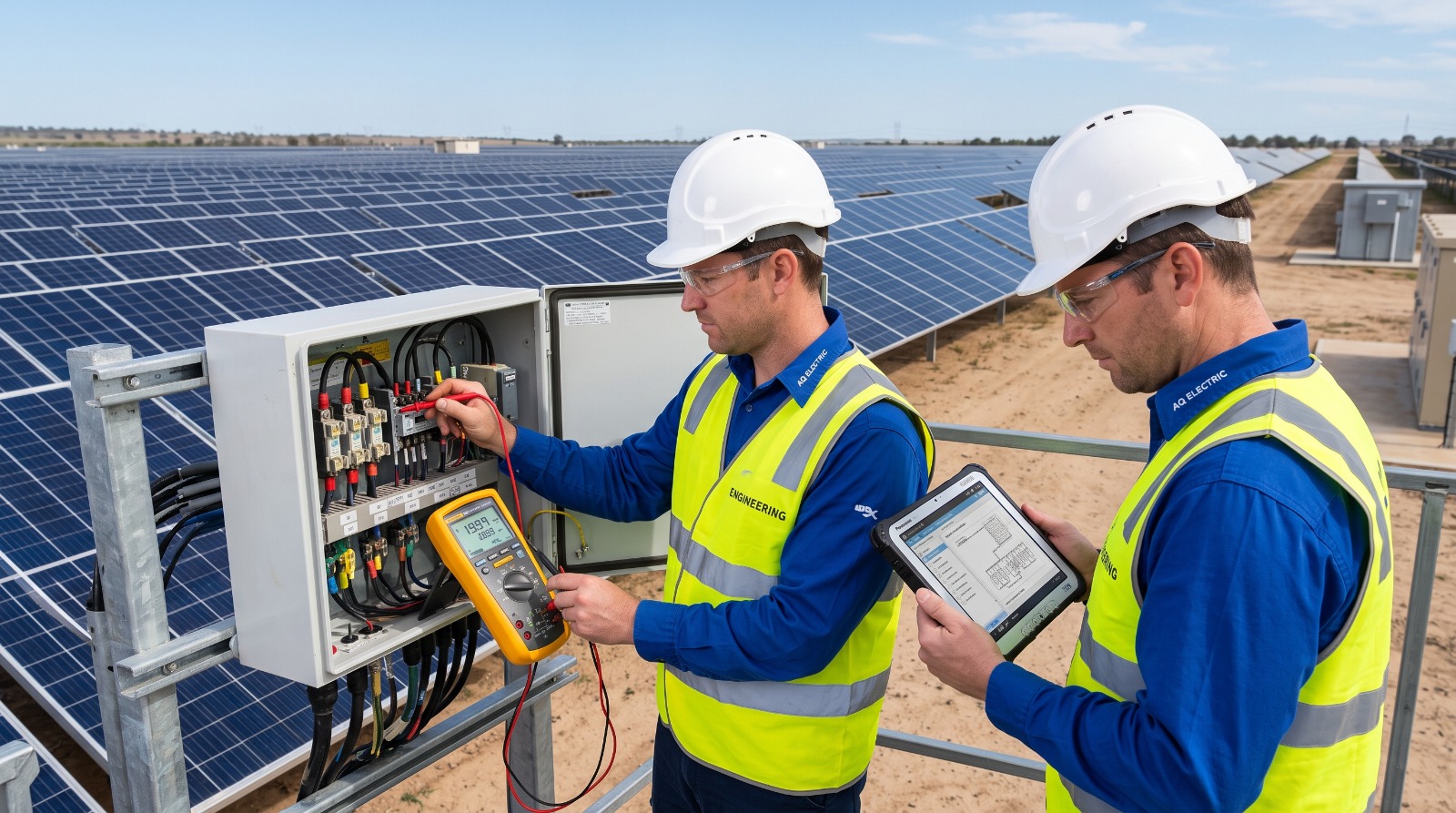
A structured visual inspection covers module condition (no cracks, no soiling, no discolouration), correct wiring, correct labelling, cable management, structural integrity, earthing continuity, and enclosure IP ratings. It sounds trivial, but a significant percentage of commissioning issues are caught here before any electrical test is run.
Continuity of Protective Earthing and Equipotential Bonding
Every metallic component that could become live under fault conditions must be connected to earth via a continuous path of low resistance. Testing confirms that this path exists and meets the design specification.
Polarity Check
All DC circuits must be verified for correct polarity before energisation. A reversed polarity connection can damage inverters, blow fuses, or create a fire risk. The polarity check is fast but essential.
String Open-Circuit Voltage (VOC) Test
Each PV string is measured at open circuit under the prevailing irradiance and temperature conditions. The result is compared against the expected value calculated from module datasheet parameters. Significant deviation indicates a wiring fault, a bypass diode failure, or a mismatched string configuration.
String Short-Circuit Current (ISC) or Operating Current Test
Similarly, each string’s short-circuit current (or operating current, at the discretion of the commissioning team) is measured and compared against expected values. Deviations often reveal shading, soiling, or connector faults.
Insulation Resistance Test
The insulation resistance of the DC array (module frames to earth, and array positive/negative to earth) is measured with an insulation tester at the voltage specified by the standard. Low insulation resistance indicates a compromised cable, wet enclosure, or damaged module — all safety-critical findings.
AC System Testing
The AC side of the system (inverter output to grid connection point) must also be tested for correct operation, protection settings, and functional grid interaction. The exact tests depend on national wiring regulations, which IEC 62446-1 explicitly references.
Category 2: Enhanced Testing
Category 2 adds two significant tests to the Category 1 baseline, and is strongly recommended for commercial and utility-scale systems where the value at risk justifies deeper inspection.
String I-V Curve Measurement
Every string is characterised by its complete current-voltage (I-V) curve under known irradiance and temperature. The measured curve is compared against the modelled curve for the string. The shape and position of any deviation reveals the type of fault: shading, soiling, module mismatch, degradation, bypass diode issues, or resistive losses in wiring. I-V curve tracing is the single most powerful diagnostic tool available at commissioning.
Infrared Thermographic Inspection
An infrared thermographic scan of all modules under operating conditions reveals hot spots, cell cracks, bypass diode failures, connector heating, and string-level issues that are invisible to any electrical test. Thermography is now typically performed by UAV for utility-scale plants, allowing a 100 MW plant to be inspected in a matter of days.
Category 2 is the new commercial baseline
For any plant above roughly 1 MWp, Category 2 is now considered the market baseline. Owners and lenders increasingly write Category 2 into EPC contracts as a specific requirement, not an optional extra.
Category 3: Advanced Diagnostic Testing
Category 3 introduces advanced diagnostic techniques for high-value plants, bankable projects, and warranty-claim investigation. It is not universally applied but is increasingly expected on any project above 50 MWp or on any plant where the module quality is being independently validated.
Electroluminescence (EL) Imaging
Electroluminescence imaging applies a forward current to modules in darkness and captures the near-infrared light they emit. Cell-level defects — micro-cracks, broken interconnects, PID (potential-induced degradation) — that are undetectable by any other means are made visible with striking clarity. EL is the definitive diagnostic for module condition.
Advanced Thermal Analysis
Beyond a routine thermographic scan, Category 3 may include detailed thermal analysis at multiple irradiance levels, correlation with electrical performance data, and identification of specific defect signatures such as PID temperature patterns or bypass diode failure modes.
Wet Insulation Resistance Testing
A wet insulation resistance test simulates the effect of moisture ingress and is particularly relevant for plants in humid or coastal climates. It is more demanding than the dry insulation test in Category 1 and can reveal cable damage or enclosure failures long before they cause safety incidents.
Documentation Requirements
Testing is only half of IEC 62446-1’s scope. The other half — and the part most often neglected — is documentation. The standard requires that a comprehensive documentation package accompany the commissioned system and be handed over to the operator. This package typically includes:
- System description and design data — array configuration, string layout, module and inverter datasheets, single-line diagrams, and structural drawings.
- Commissioning test report — the complete record of every test performed under IEC 62446-1, including measured values, expected values, environmental conditions at the time of measurement, and pass/fail determinations.
- As-built documentation — final drawings reflecting any changes made during construction, along with equipment identification, string mapping, and network topology.
- Warranty documents — module, inverter, and system warranties, with clear conditions and claim procedures.
- Operation and maintenance manual — procedures for routine inspection, cleaning, fault diagnosis, and safe isolation.
- Emergency procedures — safe shutdown, fire response, and first-response protocols.
A weak documentation package is the single most common finding of independent audits of MENA solar projects. When AQ Electric is engaged as a third-party inspector, the documentation review often uncovers more compliance gaps than the electrical testing does.
When to Apply Each Category
The standard does not force a specific category on any project size — that decision is left to the client, EPC, and any lender or regulator involved. But industry practice has coalesced around a fairly clear guidance:
| System type | Minimum category | Recommended category |
|---|---|---|
| Residential (<10 kWp) | Category 1 | Category 1 |
| Small commercial (10 kWp – 500 kWp) | Category 1 | Category 1 + selected Category 2 (thermography) |
| Large commercial (500 kWp – 5 MWp) | Category 2 | Category 2 (full) |
| Utility-scale (>5 MWp) | Category 2 | Category 2 + selected Category 3 (EL sampling) |
| Bankable / lender-financed projects | Category 2 | Category 3 |
Common Compliance Mistakes
After more than a decade of commissioning solar plants across Jordan, Egypt, Saudi Arabia, and the wider MENA region, five compliance mistakes appear again and again in IEC 62446-1 audits.
1. Sampling Instead of Testing All Strings
Some EPCs test a representative sample of strings and extrapolate. The standard requires testing of every string at commissioning. Sampling is acceptable only for periodic maintenance re-testing, not for handover.
2. Poor Recording of Environmental Conditions
VOC and ISC measurements are meaningless without a record of the irradiance, module temperature, and ambient temperature at the moment of the measurement. Many reports omit this data or record it approximately, making expected-value comparison impossible.
3. Skipping Thermography at Commissioning
Thermal imaging catches manufacturing defects and installation faults that no electrical test can find. Skipping it at commissioning is a false economy that often surfaces as warranty disputes 12 months later.
4. Weak Documentation Handover
A commissioning test report is only useful if it forms part of a complete, indexed, accessible documentation package. A stack of PDFs on a USB drive is not compliance.
5. Not Comparing Against Expected Values
Recording a measurement is not testing. IEC 62446-1 requires each measurement to be compared against an expected value derived from the design. Reports that list measurements without the corresponding expected values fail the intent of the standard.
Related Standards for Solar PV
IEC 62446-1 does not stand alone. A properly commissioned and operated PV plant sits within an ecosystem of complementary international standards that any credible testing provider should be familiar with:
- IEC 61724 — PV system performance monitoring. Defines how monitoring systems should be designed and how performance ratio (PR) should be calculated.
- IEC 61215 — Terrestrial PV module design qualification and type approval. The standard modules must meet before they can be considered credible for utility deployment.
- IEC 61730 — PV module safety qualification. Covers construction requirements and testing to ensure safe long-term operation.
- IEC 60364-7-712 — Low-voltage electrical installations, PV supply systems. National wiring regulations typically reference this.
- ISO 9001, ISO 14001, ISO 45001 — Quality, environmental, and occupational health & safety management systems that any serious testing provider should hold.
How AQ Electric Applies IEC 62446-1
Since its founding in Jordan in 2019, AQ Electric has delivered IEC 62446-1-compliant testing and commissioning on over 1.0 GW of solar PV projects across the MENA region — from the Komombo 230 MWp plant in Egypt to the Wadi Ad Dawasir 120 MWp project in Saudi Arabia with SEPCO, alongside major Jordanian sites in Amman, Aqaba, Karak, and Irbid.
The AQ Electric commissioning protocol is built directly on IEC 62446-1 Categories 1 and 2 as the default, with Category 3 diagnostics (EL imaging, wet insulation testing, advanced thermography) added for bankable and lender-financed projects on request. Every field engineer works from a standardised test protocol and reports through a common templated system that produces auditable, IEC-conformant test reports every time.
Our ISO 9001, ISO 14001, and ISO 45001 certifications underpin the quality, environmental, and safety systems inside which our IEC 62446-1 testing sits — giving clients and lenders a coherent, internationally-benchmarked assurance package.
Related AQ Electric Services
Explore our full portfolio — each service on its own page.
⚡Testing & Commissioning🔧Operation & Maintenance🔍Third-Party Inspection✓Quality Assurance (FAT & SAT)📐Engineering Services🚁Drone Inspection🎓Training Services✉Speak to an Engineer
Need IEC 62446-1 Commissioning or Inspection Support?
AQ Electric’s engineering team delivers Category 1, 2, and 3 testing across MENA — with lender-ready reports, ISO-certified processes, and 1.0 GW+ of project experience.
Frequently Asked Questions
What is the current edition of IEC 62446-1?
The current widely-used version is IEC 62446-1:2016 with amendments incorporated through 2018. Some regions have adopted the standard as a national or regional norm (for example, EN 62446-1 in Europe).
Is IEC 62446-1 mandatory in Jordan, KSA, Egypt, and the UAE?
National regulation varies, but in practice IEC 62446-1 compliance is required in nearly all bankable projects across the MENA region because it is written into EPC contracts and lender due-diligence checklists.
What is the difference between IEC 62446-1 and IEC 62446-2?
Part 1 covers commissioning and initial documentation of grid-connected systems. Part 2 covers periodic maintenance testing after the plant has been handed over — the same testing philosophy applied to ongoing O&M.
Can O&M teams perform Category 3 testing in-house?
In principle yes, but the equipment (EL cameras, calibrated I-V tracers, thermographic drones) is expensive enough that most operators outsource Category 3 to specialist providers who spread that cost across many projects.
How often should IEC 62446 tests be repeated during operation?
A common schedule is annual visual and thermographic inspection, three-yearly I-V curve tracing on all strings, and Category 3 diagnostics only in response to specific concerns. The plant’s O&M contract should specify the exact schedule.
What certifications should my IEC 62446 testing provider hold?
Look for ISO 9001 (quality), ISO 14001 (environmental), and ISO 45001 (safety) at a minimum. Ask for a sample IEC 62446-1 report — its structure and completeness will tell you more than any brochure.
Deliver IEC 62446-1 Testing With Confidence
AQ Electric provides ISO-certified solar PV testing, commissioning, and inspection services across Jordan, Egypt, Saudi Arabia, the UAE, Oman, Kuwait, and Qatar — delivered by engineers with over 1.0 GW of PV project experience with ACWA Power, NOMAC, Wärtsilä, SEPCO, Belectric, and Philadelphia Solar.
PV projects supported
MENA countries covered
ISO certifications9001 · 14001 · 45001
Founded in Jordan