

AQ Electric has commissioned more than 500 MW of solar capacity for developers, operators, and EPC contractors across the MENA region, and every one of those projects taught the same lesson: solar PV commissioning is the last point at which a construction defect is cheap to fix. Once the plant is accepted, every reversed string, damaged module, loose termination, and mis-set inverter becomes the owner’s problem for the next 25 years. This article explains how to commission a solar PV plant properly, step by step, from the first cold checks on the DC side to energisation, performance testing, and final acceptance, and it shows what an independent commissioning team should deliver at each stage.
Key takeaways
Solar PV commissioning is the structured process of inspecting, testing, energising, and verifying a new PV plant to prove it is safe, built to design, compliant with the grid code, and performing as guaranteed before the owner accepts it. It runs in phases: planning, mechanical completion, cold commissioning (tests before energisation, led by the IEC 62446-1 test sequence), energisation and grid connection, hot commissioning (inverters, trackers, SCADA, and thermography under load), performance and acceptance tests (performance ratio, capacity or power performance index, and availability), and finally handover through provisional and final acceptance. Industry inspection data shows that a measurable share of lifetime losses already exists on the day a plant is commissioned, which is why the depth and independence of solar PV commissioning matter so much.
What Is Solar PV Commissioning?
Solar PV commissioning is the process of verifying, through inspection and testing, that a newly built photovoltaic plant is safe, installed as designed, compliant with applicable standards and the grid code, and able to deliver the performance the owner paid for. It turns a construction site into an operating power plant, and it produces the evidence — test records, reports, and certificates — on which the owner, the lender, and the grid operator base their acceptance.
Several terms are used around solar PV commissioning, and they are not interchangeable:
- Pre-commissioning covers the checks made as construction finishes and before any testing under voltage: mechanical completion, visual inspection, and documentation review.
- Cold commissioning covers the electrical tests carried out before the plant is energised from the grid, mainly on the DC side and on de-energised AC equipment.
- Hot commissioning covers the tests carried out once the plant is energised and exporting: inverter start-up, tracker and SCADA functions, protection, and thermography under load.
- Acceptance testing covers the contractual performance tests — performance ratio, capacity, and availability — that decide whether the EPC contractor has met its guarantees.
Together, these stages form a complete solar PV commissioning programme. A plant that has only been “switched on” has been energised, not commissioned.
Average power loss already present at commissioning (Raptor Maps 2026)
Category 1 tests required by IEC 62446-1 for every PV system
Typical duration of the IEC TS 61724-2 power performance test
Solar capacity commissioned by AQ Electric
Why Commissioning Decides 25 Years of Performance
Solar PV commissioning matters because it is the only moment when every party is still on site, every contract still has money retained, and every defect can still be corrected at the contractor’s cost.
Losses Are Built In Before Day One
Raptor Maps’ 2026 Global Solar Report, based on inspection data from 373 GW of solar assets, found an average power loss of 4.46% already present at commissioning. That figure represents energy lost to defects created during manufacturing, transport, installation, and construction — not to ageing. A rigorous solar PV commissioning programme is how those defects are found and fixed before they become permanent.
Commissioning Sets the Baseline
The measurements taken during commissioning become the reference for the life of the plant. When a string underperforms in year five, the operator compares it with its commissioning IV curve. When a module warranty claim is filed, the commissioning records help show the defect was not caused by the operator. A plant commissioned with thin or incomplete records starts its life without a reliable baseline.
Acceptance Releases Money
Under most EPC contracts, completion milestones trigger payments and the release of retentions, and they start the defects liability period. Once the owner signs acceptance, its leverage over the contractor falls sharply. Solar PV commissioning is therefore not only a technical exercise; it is the owner’s main commercial checkpoint.
How to Commission a Solar PV Plant: The Process at a Glance
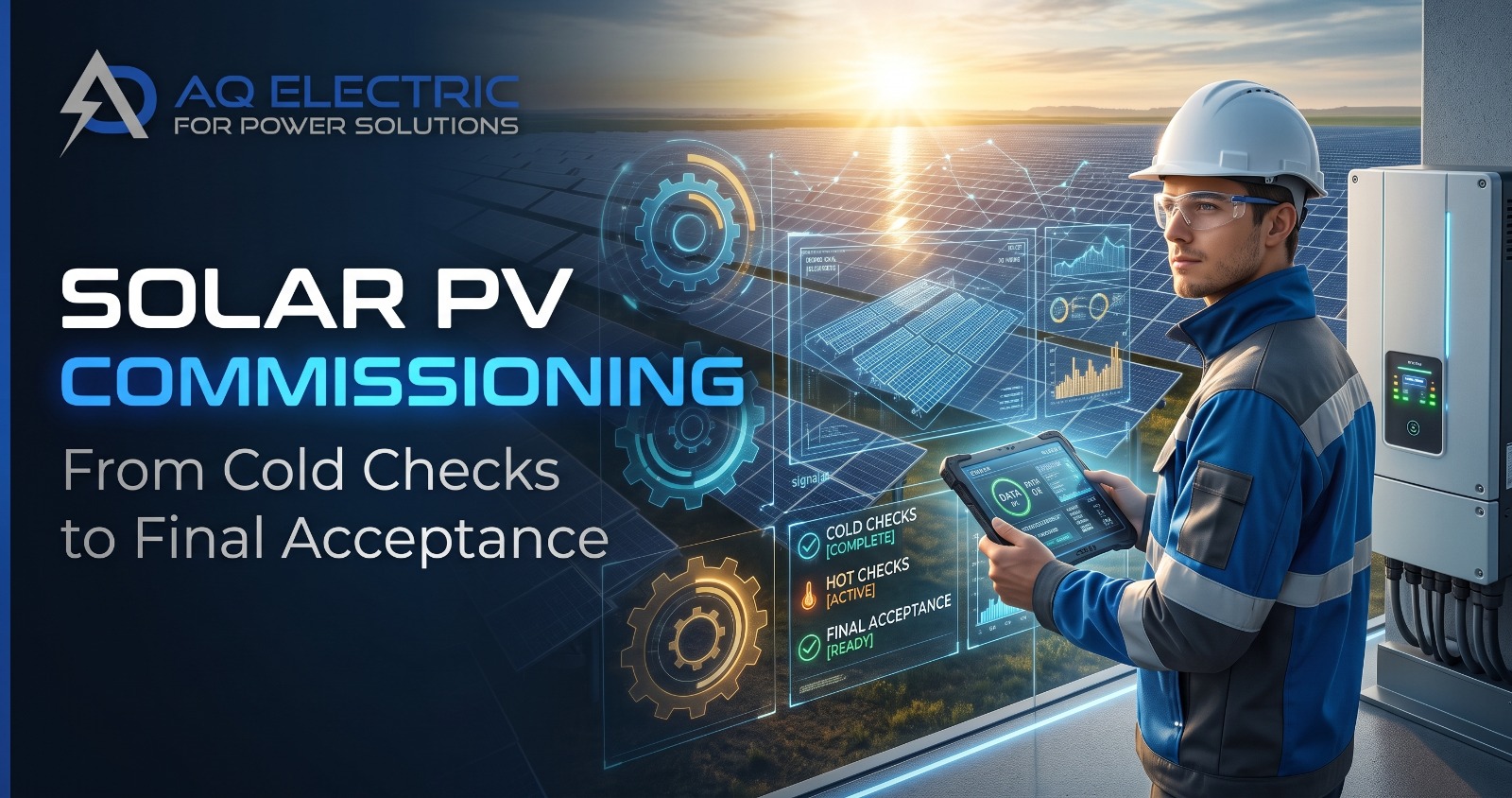
How do you commission a solar PV plant? In practice, utility-scale commissioning follows seven stages. The exact names differ between contracts and regions, but the sequence is consistent.
| Stage | Plant status | Main activities | Key output |
|---|---|---|---|
| 1. Planning | Under construction | Commissioning plan, test procedures, inspection and test plans, acceptance criteria, calibrated equipment | Approved procedures |
| 2. Mechanical completion | Built, de-energised | Visual and mechanical inspection, torque checks, earthing, labelling, punch list | Mechanical completion certificate |
| 3. Cold commissioning | De-energised from grid | IEC 62446-1 DC tests, AC verification, MV cable and transformer tests, protection checks | Cold test records |
| 4. Energisation | Connecting to grid | Grid operator approvals, protection settings, back-energisation of substation and MV network | Permission to connect |
| 5. Hot commissioning | Energised, exporting | Inverter start-up, trackers, SCADA and plant controller, IV curves and thermography under load | Hot test records, punch list |
| 6. Acceptance tests | Operating | Performance ratio, capacity or power performance index, availability, grid compliance | Test reports against guarantees |
| 7. Handover | Commercial operation | Handover pack, provisional acceptance, defects period, final acceptance | PAC, then FAC |
The sections below take each stage in turn and explain what a competent solar PV commissioning team actually checks.
Step 1: Commissioning Plan and Procedures
Good commissioning starts months before the first test. The commissioning plan defines what will be tested, in what order, by whom, with which equipment, and against which acceptance criteria. Without it, testing becomes a race against the construction schedule in which steps are skipped and results cannot be compared.
A complete planning package typically includes:
- The commissioning plan and schedule, aligned with construction sequencing so blocks can be tested as they are completed.
- Test procedures and method statements for each test, including safety isolation and lock-out/tag-out steps.
- Inspection and test plans (ITPs) defining hold points and witness points for the owner, the owner’s engineer, and the lender’s advisor.
- Test sheets and data templates, so results from tens of thousands of strings can be recorded, compared, and traced.
- Acceptance criteria — expected values with tolerances, agreed in advance rather than argued about afterwards.
- Calibrated test equipment, with valid calibration certificates for insulation testers, IV curve tracers, irradiance references, and thermal cameras.
- The performance test methodology, including irradiance sensors, data filtering, temperature correction, and test duration.
The last point deserves emphasis. Natural Power’s guidance on solar commissioning and acceptance warns that tests with poor methodology or short durations can carry high uncertainty, and recommends agreeing the methodology and duration with the EPC contractor from the outset. Reviewing those terms is one of the most valuable things an owner can do before construction ends.
Step 2: Mechanical Completion and Visual Inspection
Before any electrical test, the plant is inspected to confirm it has been built as designed. Mechanical completion is the point at which construction is declared finished and the plant is ready for testing. It is also the first formal checkpoint in solar PV commissioning.
A thorough visual and mechanical inspection covers:
- Structures and foundations — alignment, bolt torque, corrosion protection, and tracker mechanical limits.
- Modules — correct model and layout, clamping positions, visible damage such as cracked glass or broken frames.
- DC cabling — routing, support, protection from sharp edges and UV, bending radius, and connector mating.
- Combiner boxes and inverters — terminations, fuses, surge protection, ingress protection, and labelling.
- Earthing and bonding — connections to structures, fences, and equipment.
- Signage and documentation — warning labels, string identification, and single-line diagrams on site.
Every deviation is recorded in a punch list with a location, photo, severity, and responsible party. The punch list becomes the backbone of commissioning: items are opened, corrected, re-inspected, and closed, and none should remain open on safety-critical matters before energisation.
Step 3: Cold Commissioning Before Energisation
Cold commissioning is the set of electrical tests carried out before the plant is energised from the grid. Its purpose is to prove that the installation is safe to energise and correctly connected. On the DC side, the reference is IEC 62446-1, the international standard for testing, documentation, and maintenance of grid-connected PV systems.
The IEC 62446-1 Category 1 Test Sequence
IEC 62446-1 defines a Category 1 test regime that applies to every PV system, regardless of size. These tests form the core of cold commissioning on the DC side:
| Test | What it verifies | Typical defects found |
|---|---|---|
| Protective earthing / equipotential bonding continuity | Exposed metal parts are reliably bonded to earth | Missing or loose bonding jumpers, painted contact surfaces |
| Polarity test | Every string is connected with the correct polarity | Reversed strings that can damage equipment when paralleled |
| Combiner box test | Strings in a combiner are connected correctly before fuses are closed | Wrong string count, reversed strings, mixed strings |
| String open-circuit voltage (Voc) | Each string has the expected number of modules, working as expected | Missing or extra modules, bypass diode faults, wiring errors |
| String current (short-circuit or operational) | Each string produces current consistent with irradiance | Open connectors, damaged modules, shading, high series resistance |
| Functional tests | Switchgear, isolators, and protective devices operate correctly | Faulty isolators, incorrect protection operation |
| Insulation resistance | DC circuits are adequately insulated from earth | Damaged cable insulation, water ingress, pinched cables |
For larger or more complex systems, IEC 62446-1 adds a Category 2 regime — IV curve testing and infrared thermography — and a set of additional tests, including the voltage-to-ground test for resistively earthed systems, blocking diode tests, wet insulation testing, and shade evaluation. For utility-scale plants, Category 2 should be treated as the practical baseline rather than an optional extra. AQ Electric explains the categories in detail in its IEC 62446-1 article.
Reading the Results Correctly
A test result only means something when it is compared with an expected value. Open-circuit voltage depends on cell temperature, so measured Voc must be compared with the value expected at the measured module temperature, not with the datasheet value at standard test conditions. String current depends on irradiance, so it must be compared with strings measured under the same conditions or normalised with a reference sensor. Insulation resistance readings are affected by moisture and temperature, so the conditions should be recorded alongside every reading. Experienced commissioning engineers look for outliers within a block rather than simply checking that each value clears a minimum.
AC, MV, and Substation Tests
Cold commissioning also covers the AC side. Low-voltage installations are verified under IEC 60364-6, which sets the requirements for initial verification by inspection and testing. Medium-voltage cables, switchgear, protection relays, and power transformers are tested before energisation according to their own standards and the manufacturer’s requirements — including insulation tests, protection relay injection tests, and transformer ratio and winding tests. AQ Electric covers transformer testing in its article on solar power plant transformers.
Module Integrity Before Energisation
Modules can be damaged in transport and installation without visible signs. Electroluminescence (EL) imaging on a sample of modules, or on suspect strings, reveals microcracks, broken fingers, and inactive cell areas that no electrical test at string level can isolate. When transport damage is suspected, EL evidence collected before acceptance is the strongest basis for a claim. AQ Electric explains the method in its article on electroluminescence EL testing for solar PV.
Step 4: Energisation and Grid Connection
Energisation is the moment the plant is connected to the grid for the first time. It is controlled by the grid operator, not only by the contractor, and it requires the plant to demonstrate that it is safe and compliant before the breaker is closed.
Typical energisation requirements include approved protection settings, completed substation and MV test records, a switching programme agreed with the grid operator, and a statement that the plant is ready to connect. The Saudi Arabian Grid Code (2021) offers a clear example of the formal sequence: before the commissioning date, the user submits commissioning test procedures, site test reports, and proposed protection settings; it then submits a statement of readiness to connect with the commissioning test reports; and the transmission service provider issues a technical completion certificate within 15 days if the reports are acceptable, or may require further tests. AQ Electric’s work in the Kingdom is covered in its article on solar PV testing services in Saudi Arabia.
Grid codes across the region are becoming more demanding. In Egypt, the Egyptian Electricity Transmission Company (EETC) updated its guidelines in 2024, adding sequential submission of studies, mandatory dynamic studies using vendor models, and insulation coordination within electromagnetic transient studies. In May 2026, the 1.1 GW Obelisk solar and 200 MWh storage project became the first to receive full approval of its grid code compliance study under those updated guidelines. For a wider view of the Egyptian market, see AQ Electric’s article on solar testing services in Egypt.
Practical point
Grid-code requirements such as reactive power capability, fault ride-through, frequency response, and power quality are proven partly through studies before connection and partly through tests after energisation. Solar PV commissioning plans should include the grid compliance tests the operator will require, so they do not delay commercial operation at the last moment.
Step 5: Hot Commissioning Under Load
Hot commissioning starts once the plant is energised and producing power. It verifies that every system works as an integrated plant, not just as individual components.
Inverter Commissioning
Each string or central inverter is started up following the manufacturer’s procedure. Commissioning engineers verify DC input voltages and currents, AC output, grid synchronisation, parameter and protection settings, communication with the monitoring system, and alarm handling. AQ Electric’s article on solar inverters in utility-scale PV plants explains the inverter technologies and their failure modes.
Trackers, SCADA, and the Power Plant Controller
On single-axis tracker plants, the tracking angle, backtracking, wind stow, and communication of each tracker row are checked and adjusted. The SCADA system is verified point by point: every inverter, meter, weather station, and alarm must report correctly. The power plant controller is tested for active power limitation, reactive power and voltage control, and responses to grid operator setpoints — the functions that the grid code compliance tests will rely on.
IV Curve Tracing
IV curve tracing measures the full current-voltage characteristic of each string under real operating conditions and compares it with the expected curve. It reveals problems that Voc and current measurements alone miss: high series resistance, mismatch, partial shading, degraded bypass diodes, and underperforming modules. For utility-scale plants, a full string-level IV dataset at commissioning is the most valuable baseline the owner can receive. AQ Electric details the method in its article on IV curve tracing for solar PV.
Thermography Under Load
Infrared thermography must be performed while the plant is operating at sufficient irradiance, because defects only heat up when current flows. Aerial thermography under IEC TS 62446-3 identifies hot spots, bypass diode failures, open strings, and inactive modules across the array, while handheld thermography of combiner boxes, inverters, MV terminations, and switchgear identifies loose or overheated connections. AQ Electric explains how this works in its article on infrared thermography for solar PV, and delivers it at utility scale through its drone inspection services.
Step 6: Performance and Acceptance Tests
Once the plant is operating, the acceptance tests decide whether the EPC contractor has delivered the performance it guaranteed. These are the most commercially sensitive tests in solar PV commissioning, and their methodology deserves as much attention as their results.
| Test | What it measures | Typical reference | Typical duration |
|---|---|---|---|
| Performance ratio (PR) | Actual energy versus the energy theoretically available from the measured irradiance | IEC 61724-1 definition; contract-specific corrections | Short test at completion; longer PR tests over one or two years |
| Power performance index / capacity | Measured power versus power expected from the design model under the same conditions | IEC TS 61724-2:2025; ASTM E2848 in the US | Typically three to five days (IEC) |
| Energy evaluation | Measured energy versus energy expected under actual weather, during operating periods | IEC TS 61724-3 | Longer period, defined in contract |
| Availability | Share of time the plant is able to produce when irradiance allows | Contract definition | Defined in contract |
The Performance Ratio Test
The performance ratio compares the energy a plant actually produces with the energy it could theoretically produce given the irradiance measured in the plane of the array. It is widely used because it is simple and familiar. Its weakness is sensitivity to temperature and measurement: a PR test run during cool weather looks better than one run in summer, which is why contracts commonly apply a temperature correction. Natural Power also notes that irradiance measurement uncertainty feeds directly into the result, and recommends verifying that pyranometers are correctly installed, calibrated, and unshaded.
The Power Performance Index and Capacity Test
The second edition of IEC TS 61724-2, published in September 2025, defines a power performance index test that compares measured power with the power expected from the design model under the same conditions. The IEC states that the test is intended to be performed over a short period of typically three to five days and is often used to verify a contractual performance guarantee at final completion. In the US, ASTM E2848 uses a regression of plane-of-array irradiance, ambient temperature, and wind speed to compare measured and modelled capacity at agreed reporting conditions.
When Capacity Tests Get Difficult
Modern plant designs make capacity testing harder. Engineering firm Burns & McDonnell has documented that inverter or point-of-interconnection clipping can remove most midday data on tracking plants, especially with DC-to-AC ratios above roughly 1.3–1.4 and bifacial modules. Mitigations include stowing trackers flat during the test, using one-minute data, widening the irradiance range, or temporarily reducing DC capacity in a controlled way — each of which must be agreed and modelled in advance. These details are exactly why acceptance test terms deserve independent review during solar PV technical due diligence.
Put an independent commissioning team on site — call +962 79 51 54 126.
Step 7: Handover, PAC, and FAC
Solar PV commissioning ends with handover: the formal transfer of the plant from the contractor to the owner and its operator.
Acceptance Milestones
Contracts in Europe and many international markets commonly use a provisional acceptance certificate (PAC) at commercial operation, sometimes an intermediate acceptance (IAC) after one year, and a final acceptance certificate (FAC) after two years of operation. US contracts more often use mechanical completion, substantial completion, and final completion. According to Natural Power, the performance tests at PAC or substantial completion are typically short, around three to ten days, giving an early indication of output against the guarantees; the one-year and two-year acceptance stages are then tied to PR tests covering a full year or two years of operation.
The Handover Pack
The handover documentation is part of the deliverable, not an afterthought. It should include permits and grid approvals, as-built drawings, equipment datasheets and manuals, module flash test data, inspection and test records, commissioning reports, warranties, health and safety documentation, and the open punch list with agreed close-out dates. Natural Power recommends ensuring that all outstanding items are closed before final payments are released.
Into Operation
The commissioning dataset becomes the operator’s starting point. The IV curves, thermography, insulation values, and performance test results are the reference against which every future inspection is compared. AQ Electric explains how a strong operational programme builds on that baseline in its article on solar PV plant operation and maintenance.
Solar PV Commissioning Checklist
The checklist below summarises what a complete solar PV commissioning programme should cover and the evidence each stage should produce. It is a starting point; the project specification and the EPC contract define the final scope.
| Area | Key checks | Evidence |
|---|---|---|
| Documentation | Approved drawings, procedures, ITPs, calibration certificates | Document register |
| Mechanical | Structures, torque, module mounting, cable management, labelling | Inspection checklists, photos, punch list |
| Earthing | Continuity of protective earthing and bonding; earth resistance | Test sheets |
| DC strings | Polarity, Voc, current, insulation resistance, combiner boxes | IEC 62446-1 test records per string |
| Modules | EL sampling or targeted EL, visual defects | EL images and classification |
| AC and MV | LV verification, MV cables, switchgear, transformers, protection relays | Test reports, relay settings |
| Energisation | Grid operator approvals, switching programme, protection settings | Permission to connect |
| Inverters | Start-up, parameters, protection, communication, alarms | Start-up reports |
| Trackers and SCADA | Tracking, backtracking, stow; SCADA points; plant controller | Functional test records, point-to-point list |
| Under-load diagnostics | String IV curves, aerial and handheld thermography | IV dataset, thermography report |
| Performance | PR, capacity or PPI, availability, grid compliance tests | Test reports against guarantees |
| Handover | Handover pack, closed punch items, warranties | PAC, later FAC |
Common Commissioning Failures
Most commissioning problems are not exotic. They come from compressed schedules, missing methodology, and an assumption that the contractor’s own testing is enough. The most common failures AQ Electric sees in the field are:
- Testing compressed into the last weeks. When commissioning starts only after construction is complete, the schedule pressure leads to sampling instead of full testing and to skipped retests.
- Results recorded without expected values. A Voc reading without a temperature-corrected expected value cannot reveal a missing module.
- String and wiring errors found late. Reversed polarity, mixed strings, and wrong string counts are easy to find before energisation and expensive afterwards. AQ Electric’s article on solar string wiring explains why these errors happen.
- Uncalibrated or poorly installed irradiance sensors. Every performance test depends on irradiance measurement; a misaligned or soiled sensor distorts the result.
- Performance tests too short or poorly defined. A test methodology negotiated after the plant is built tends to favour whoever drafts it.
- No under-load diagnostics. Skipping IV curve tracing and thermography leaves hot spots, diode failures, and damaged modules undiscovered until the first operational inspection.
- Acceptance with open punch items. Once the plant is accepted and retentions are released, closing remaining items becomes much harder.
- Incomplete handover documentation. Missing flash data, test records, or as-built drawings weaken warranty claims for years.
Commissioning in the Gulf and MENA
Solar PV commissioning in the Gulf and wider MENA region follows the same international standards as elsewhere, but local conditions shape how the work is done.
Heat and Test Timing
High module temperatures depress voltage and power, and they change what the expected test values should be. Commissioning teams need temperature-corrected expected values and a test schedule that accounts for the conditions in which each test is valid — thermography and IV curve tracing need adequate irradiance, while long outdoor working hours in summer require careful planning for crew safety.
Dust and Soiling
Soiling affects both the array and the irradiance sensors used for performance testing. Modules and reference sensors should be cleaned in a controlled way before performance tests, and the cleaning should be recorded, so results reflect the plant rather than the dust.
Scale and Remote Sites
Regional plants are large and often remote. Commissioning tens of thousands of strings requires systematic data handling, enough calibrated equipment, and field teams that can sustain the programme without becoming the bottleneck.
Standards and Grid Operators
International standards are widely adopted in the region; IEC 60364-6, for example, has been adopted by the GCC Standardization Organization as GSO IEC 60364-6. Grid connection, however, is governed by each country’s transmission operator — such as NEPCO in Jordan, EETC in Egypt, and the transmission service provider under the Saudi Arabian Grid Code — each with its own approval sequence. AQ Electric’s home market is covered in its article on solar PV testing services in Jordan.
Who Should Commission Your Plant?
On most projects, the EPC contractor is contractually responsible for commissioning. The question is whether the owner relies only on the contractor’s own testing or brings in an independent solar PV commissioning company to test, witness, or verify the results.
| Model | How it works | Best suited to |
|---|---|---|
| EPC self-commissioning | The contractor tests its own work and reports results | Small projects with low financial exposure |
| Independent commissioning | A specialist firm performs the testing on behalf of the EPC or owner | EPCs needing capacity and expertise; owners wanting independent data |
| Witness and supervision | An independent team embeds with the EPC’s commissioning team and witnesses key tests | Owners and lenders who need assurance without duplicating all testing |
Independent witnessing is usually organised by the owner’s technical team. AQ Electric explains that role in its article on the owner’s engineer for solar PV projects. On financed projects, the bank’s advisor will also review commissioning results before certifying completion; see AQ Electric’s article on the lender’s technical advisor for solar PV projects. Independent verification at defined stages can also be delivered through AQ Electric’s third-party inspection services.
When selecting a solar PV commissioning company, look for named utility-scale projects, in-house diagnostic capability, calibrated equipment, and sample reports that show how findings are evidenced. AQ Electric sets out the full selection criteria in its article on how to choose a solar testing and commissioning partner.
AQ Electric’s Solar Farm Commissioning Services
AQ Electric for Power Solutions, founded in Jordan in 2019 and expanded to Egypt in 2021, provides independent solar farm commissioning services across the MENA region in three forms: cold commissioning (pre-energisation testing), hot commissioning (testing of the live system), and supervision, in which AQ Electric’s engineers embed with the client’s commissioning team to witness and verify the work.
AQ Electric’s commissioning scope covers testing to IEC 60364-6 and IEC 62446 (all parts); installation testing and verification; electroluminescence testing; IV curve tracing and analysis; insulation and earth resistance testing; thermal imaging and analysis; string and central inverter commissioning; review of commissioning plans and procedures; supervision and witnessing of tests; SCADA system support; solar tracker commissioning and adjustment; and workmanship, code compliance, and punch-list generation and verification. Full details are on AQ Electric’s solar PV testing and commissioning services page.
Komombo: Testing and Commissioning for CEEC
AQ Electric supported China Energy Engineering Group (CEEC) with testing and commissioning on the 230 MWp Komombo solar plant in Aswan, Egypt. In Saudi Arabia, AQ Electric supported SEPCO – Power China with testing and commissioning on the 120 MWp Wadi Ad Dawasir plant, and it has delivered thermal drone inspection for ACWA Power and NOMAC on utility-scale plants in Aswan.
Because commissioning often begins with equipment arriving on site, AQ Electric also verifies equipment quality before installation through its FAT and SAT quality assurance services, and it prepares site teams through its training services for engineers. AQ Electric operates under an ISO 9001, ISO 14001, and ISO 45001-certified management system from offices in Amman, Jordan and New Cairo, Egypt, with more than 1.0 GW of PV project experience. The full portfolio is on AQ Electric’s projects page.
From Cold Checks to Final Acceptance
AQ Electric’s commissioning and quality services across the MENA region.
⚡Testing & Commissioning📊IV Curve Tracing🔬EL Testing🚁Drone Inspection✓Quality Assurance (FAT & SAT)🔧Operation & Maintenance✉Speak to an Engineer
Frequently Asked Questions
What is solar PV commissioning?
Solar PV commissioning is the process of inspecting, testing, energising, and verifying a new photovoltaic plant to prove it is safe, built to design, compliant with standards and the grid code, and performing as guaranteed before the owner accepts it from the contractor.
What is the difference between cold and hot commissioning?
Cold commissioning covers inspections and electrical tests carried out before the plant is energised from the grid, such as earthing continuity, polarity, open-circuit voltage, and insulation resistance. Hot commissioning covers tests after energisation, such as inverter start-up, tracker and SCADA functions, IV curve tracing, and thermography under load.
Which standard applies to solar PV commissioning tests?
IEC 62446-1 is the main international standard for testing and documenting grid-connected PV systems, with Category 1 tests for all systems and Category 2 tests (IV curves and thermography) for larger systems. IEC 60364-6 covers verification of low-voltage installations, and the IEC 61724 series covers performance monitoring and testing.
How long does solar PV commissioning take?
It depends on plant size, design, and how well testing is integrated into construction. Individual acceptance tests have defined durations — the IEC TS 61724-2 power performance test, for example, is typically three to five days — but the full commissioning programme for a utility-scale plant runs over weeks to months, with final acceptance often following after a defects period.
What is the difference between PAC and FAC?
The provisional acceptance certificate (PAC) is issued when the plant is complete, commissioned, and has passed its initial performance tests, and it typically marks commercial operation. The final acceptance certificate (FAC) is issued at the end of the defects or warranty period — commonly two years — once longer-term performance tests are passed and outstanding items are closed.
Is the EPC contractor’s own commissioning enough?
For small, low-risk projects it may be. For utility-scale plants, owners and lenders usually want independent testing or witnessing, because the contractor is effectively checking its own work and acceptance releases payments and retentions.
What should a solar commissioning report include?
A commissioning report should include the test procedures and equipment used with calibration details, results for every tested item compared with expected values, findings with location, evidence, and severity, the punch list and its close-out status, performance test results against guarantees, and a clear recommendation on acceptance.
Does AQ Electric provide solar farm commissioning services in MENA?
Yes. AQ Electric provides cold commissioning, hot commissioning, and commissioning supervision for solar plants across Jordan, Egypt, Saudi Arabia, and the wider Gulf and MENA region, with more than 500 MW commissioned and projects including the 230 MWp Komombo plant and the 120 MWp Wadi Ad Dawasir plant.
Commission It Right the First Time
AQ Electric delivers independent solar PV commissioning across the MENA region — cold and hot commissioning to IEC 62446, IV curve tracing, EL, thermography, and acceptance test support — with more than 500 MW commissioned alongside CEEC, SEPCO, Power China, ACWA Power, and NOMAC.
PV projects supported
MENA countries covered
ISO certifications9001 · 14001 · 45001
Founded in Jordan