
AQ Electric has inspected and tested operating solar plants across the MENA region — from utility-scale assets in Aswan, Egypt to commercial installations in Amman and Aqaba, Jordan — and that field work has taught us a simple truth about solar PV technical due diligence: a plant is only worth what it can be proven to produce. Documents describe what a solar plant was designed to do. Only independent inspection and testing reveal what it is actually doing. With more than 1.0 GW of PV project experience, AQ Electric delivers the on-site testing evidence and engineering review that turn a data room full of claims into a verified, defensible investment decision.
Solar PV technical due diligence has become one of the most consequential steps in the solar investment cycle. As operating solar assets change hands, get refinanced, and move into the portfolios of infrastructure funds and strategic buyers, every transaction depends on an independent answer to one question: does this plant perform as the seller says, and will it keep doing so? This article explains what solar PV technical due diligence covers, when it is required, how a red flag review differs from a full assessment, how production data and performance ratio are analysed, why on-site testing is indispensable for operating assets, the red flags that most often change a deal, and what the MENA context adds — together with how AQ Electric supports buyers, lenders, and sellers through the process.
What Is Solar PV Technical Due Diligence?
Solar PV technical due diligence is an independent technical review of a solar project, portfolio, or operating plant, carried out to support an investment, financing, acquisition, or refinancing decision. Its purpose is to validate the assumptions behind the asset’s value — energy yield, design quality, equipment condition, contractual protections, and operating performance — and to identify technical risks or hidden liabilities before capital is committed.
Technical due diligence is one strand of a broader due diligence process that also covers legal, financial, regulatory, and environmental questions. But for a solar asset, the technical strand carries unusual weight. The entire value of a solar plant rests on a single technical promise — that it will convert sunlight into a predictable volume of electricity for 25 years or more. If that promise is overstated, everything built on top of it, from the purchase price to the debt sizing, is overstated too. Solar PV technical due diligence exists to test that promise independently.
The core output is a technical due diligence report that confirms the asset’s characteristics, quantifies uncertainties and risks affecting expected production, and translates technical findings into the questions that matter to the transaction: revenue, cost, schedule, contractual exposure, and long-term performance. In the best cases, those findings feed directly into price negotiation, warranty and indemnity terms, and conditions precedent in the sale and purchase agreement.
The core principle
Solar PV technical due diligence is not about confirming that a plant exists. It is about confirming that the plant performs as claimed, has no hidden defects that will erode future revenue, and is protected by contracts and warranties that actually work.
When Technical Due Diligence Is Required
Solar PV technical due diligence is carried out at several decision points across an asset’s life. Each has a slightly different emphasis:
- Acquisition of an operating plant — the buyer needs to know whether the asset is worth the asking price, what defects it carries, and how its future production compares with the seller’s projections. This is where on-site testing matters most.
- Acquisition of a development or construction project — the focus shifts to design, yield assessment, permits, grid connection, EPC contracts, and construction risk.
- Financial close and lender due diligence — lenders require an independent review before committing debt, typically through a lender’s technical advisor or independent engineer.
- Refinancing — when an operating asset is refinanced, lenders want an updated independent baseline of actual performance and condition.
- Sell-side preparation — owners preparing an asset for sale commission their own review to find and fix issues before buyers do, protecting the sale price.
- Periodic independent review — asset owners and investment committees use independent technical reviews to benchmark operating assets over time.
Across all of these, the common thread is independence. A technical review commissioned and performed by parties with no stake in the outcome is what gives buyers, lenders, and investment committees the confidence to act.
Red Flag Review vs Full Technical Due Diligence
Solar PV technical due diligence is commonly delivered at two levels of depth, and choosing the right one depends on where a transaction stands.
| Aspect | Red Flag Review | Full Technical Due Diligence |
|---|---|---|
| Purpose | Identify deal-breaking issues quickly | Comprehensive assessment to support valuation and contracts |
| Stage | Early, before committing to exclusivity | After exclusivity, ahead of signing or financial close |
| Depth | Focused on material risks only | Detailed review of every technical area |
| On-site work | Limited or none | Site inspection and targeted testing |
| Output | Short list of red flags and their severity | Full report with quantified risks and recommendations |
Industry glossaries commonly describe technical due diligence on a utility-scale project as taking roughly 30 to 60 days and costing a fraction of a percent of project value. Against the size of the capital at stake, it is among the cheapest insurance an investor can buy — and skipping or rushing it is one of the fastest routes to an overvalued, underperforming asset.
What a Technical Due Diligence Examines
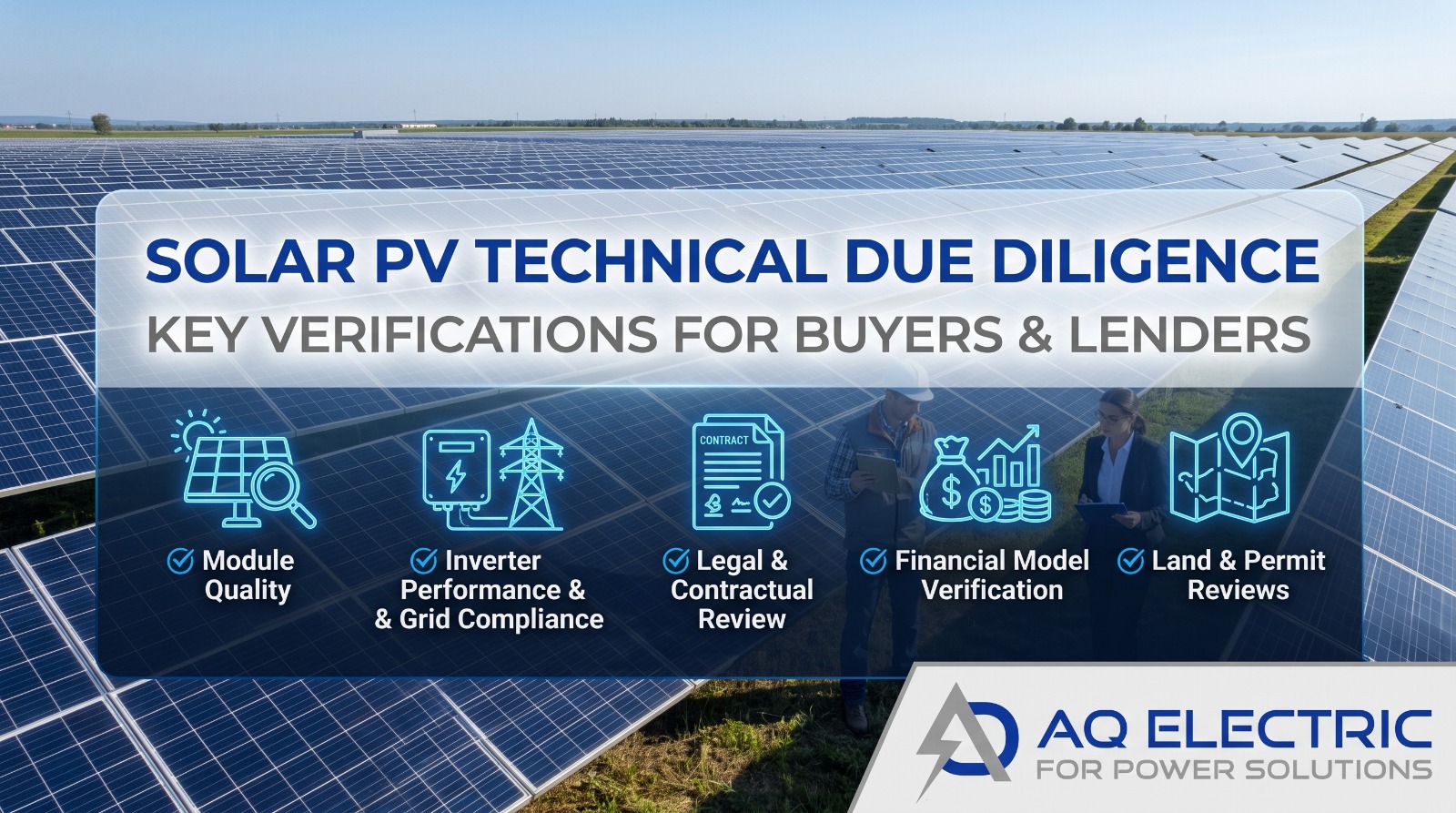
A thorough solar PV technical due diligence review covers a defined set of technical areas. Missing any of them leaves a blind spot that can surface after the transaction closes.
Resource and Energy Yield
The reviewer validates the solar resource data, the simulation model, loss assumptions, and the uncertainty budget behind the P50 and P90 yield estimates. For an operating asset, the original yield assessment is compared with what the plant has actually produced.
Design and Engineering
Electrical design, string configuration, inverter sizing, protection, earthing, cabling, and structural design are reviewed for soundness and code compliance. Design weaknesses that were tolerable in a financial model can become chronic losses in operation.
Equipment and Technology
Module, inverter, tracker, and transformer selections are assessed for bankability, track record, certification, and warranty strength. Equipment from manufacturers with weak reliability histories or uncertain warranty backing raises the risk profile.
Construction and Commissioning Records
The reviewer examines construction quality records and the commissioning test documentation. A complete IEC 62446-1 commissioning record — with string-level measurements compared against expected values — is strong evidence of a well-built plant. Missing or incomplete commissioning data is itself a finding. For the standard behind these records, see AQ Electric’s IEC 62446-1 article.
Grid Connection and Contracts
Grid connection agreements, the power purchase agreement, the EPC contract, and the O&M contract are reviewed for technical obligations, performance guarantees, availability commitments, and liability caps that affect the asset’s risk.
Operating Records and O&M Quality
For operating assets, monitoring data, availability records, fault and ticket logs, corrective maintenance history, spare-parts inventory, and warranty claims reveal how well the plant has been run. A plant with poor operation and maintenance history often carries degradation that is not yet visible in headline production numbers.
Data Room Completeness
Finally, the reviewer assesses whether the documentation provided is complete and consistent. Gaps in the data room — missing as-built drawings, absent test reports, incomplete monitoring history — are themselves a risk signal that should influence price or contract terms.
AQ Electric delivers the on-site inspection and testing that technical due diligence relies on — call +962 79 51 54 126.
Reading the Production History: PR and P50
For an operating asset, the most revealing part of solar PV technical due diligence is the analysis of historical production. The question is straightforward: has the plant produced what it was expected to produce, and if not, why?
Performance Ratio
The performance ratio (PR) is the standard measure of how efficiently a plant converts available sunlight into delivered energy, independent of how sunny a given year was. In simple terms, it is the energy the plant actually delivered divided by the energy it would have delivered if it had converted the measured plane-of-array irradiance at its rated capacity with no losses:
PR = Actual energy delivered (kWh) ÷ [Plane-of-array irradiation (kWh/m²) × Installed DC capacity (kWp) ÷ 1 kW/m²]
Because PR normalises for weather, it isolates the plant’s own technical performance. A stable PR over time indicates a healthy plant; a PR that declines year after year without explanation is one of the clearest warning signs a buyer can find. The calculation is only as reliable as the irradiance data behind it, so reviewers also check the quality and calibration of the plant’s irradiance sensors.
Comparison With the Modelled P50
The seller’s original yield assessment provides a P50 estimate — the production the plant was expected to exceed half the time. Technical due diligence compares actual weather-corrected production against that P50, year by year. Small deviations are normal. A sustained shortfall — commonly cited as anything beyond about 5% — is treated as a serious red flag, because it suggests either that the original model was optimistic or that the plant has a technical problem that is costing energy every day.
Availability and Degradation
Availability records show how much of the time the plant was actually able to generate, separating grid-related outages from plant-related ones. Degradation analysis estimates how fast the plant’s output is declining year on year. Both directly affect the forecast cash flows that underpin the asset’s value.
Why Documents Are Not Enough: On-Site Testing
Production data tells you that something is wrong. It rarely tells you what, where, or how expensive it will be to fix. That is why, for operating assets, a credible solar PV technical due diligence includes on-site inspection and targeted testing — the part of the process where AQ Electric’s field capability makes the decisive difference.
Visual and Mechanical Inspection
A structured site inspection checks module condition, structures and fasteners, cable management, combiner boxes, inverter stations, transformers, earthing, and signs of corrosion, water ingress, or thermal damage. Many expensive problems are visible to a trained eye before any instrument is connected.
Thermographic Survey
An aerial infrared survey scans the whole plant for hotspots, failed modules, disconnected strings, bypass-diode faults, and connection problems in a day or two, with every anomaly classified and mapped. For acquisitions, it is the fastest way to quantify the scale of module and connection defects across the entire asset. AQ Electric explains the technique in detail in its article on infrared thermography for solar PV.
IV Curve Tracing
String-level IV curve tracing measures the actual electrical performance of strings against expected values and diagnoses the cause of any shortfall — mismatch, degradation, soiling, resistance, or bypass-diode failure. It turns a vague production gap into specific, quantified findings that a buyer can price. AQ Electric provides this through its IV curve tracing services.
Electroluminescence Sampling
Electroluminescence imaging of a statistically meaningful module sample reveals microcracks, cell breaks, and potential-induced degradation that will drive future losses but are invisible today. For buyers, this is critical: it shows whether the module fleet carries latent damage that the current production numbers do not yet reflect, and it provides the evidence base for any warranty claim. AQ Electric delivers this through its EL testing services.
Electrical Safety and Insulation Testing
Targeted re-testing of insulation resistance, earthing continuity, and protection settings confirms that the plant remains electrically safe — findings that carry both safety and liability implications for a new owner.
Crucially, independent testing at commissioning creates the baseline that later due diligence relies on. Plants with high-quality commissioning records — IV curve measurements, thermal surveys, and performance ratio verification — are far easier and cheaper to diligence, and they tend to command more confidence and better terms from buyers and lenders.
The Red Flags That Change a Deal
Solar PV technical due diligence repeatedly surfaces the same categories of findings. Some are negotiable; others can stop a transaction outright.
- Sustained production below the modelled P50. A persistent weather-corrected shortfall points to optimistic modelling or an unresolved technical problem.
- Declining performance ratio without explanation. A steady drop in PR suggests accelerating degradation, growing soiling losses, or deteriorating equipment.
- Widespread module defects. High rates of microcracks, hotspots, or potential-induced degradation found through thermography and EL sampling signal future losses and possible replacement costs.
- Inverter reliability problems. Frequent faults, derating, or unavailability point to a major source of ongoing lost energy and repair cost.
- Weak or missing commissioning records. Without a credible baseline, the buyer cannot tell whether problems were built in or developed later — weakening warranty and indemnity positions.
- Unenforceable or expiring warranties. Warranties from manufacturers with uncertain financial standing, or exclusions triggered by poor installation, reduce the protection the buyer is paying for.
- Poor O&M history. Inadequate cleaning, slow corrective response, and thin maintenance records often mean hidden degradation.
- Safety and compliance issues. Insulation faults, earthing defects, or protection non-compliance create liability that transfers with the asset.
Solar Due Diligence in the MENA Context
The MENA region is becoming one of the most active arenas for solar due diligence. Regional solar additions are expected to reach around 18 GW in 2026, with renewable investment in the region running at roughly US$22 billion a year. At the same time, Gulf developers have become major buyers of operating renewable assets: in June 2026, Masdar agreed to acquire a 49.99% stake in Repsol’s 705 MW operational portfolio in Spain, valuing it at €849 million, while ACWA Power has brought large operating portfolios online at home, including a 2.7 GW group of Saudi PV plants in which it holds a majority stake. Every acquisition, stake sale, and refinancing of this kind depends on technical due diligence.
Closer to home, the region’s first generation of utility-scale plants — in Jordan, Egypt’s Benban complex, and elsewhere — is now well into operation. As these assets are refinanced or change ownership, buyers need independent evidence of how they have actually performed in desert conditions. Several factors make MENA due diligence distinctive.
Heat-Driven Losses
Crystalline silicon modules lose roughly 0.4% of output for every degree Celsius of operating temperature increase. In a region where module temperatures routinely exceed 65–70 °C, thermal losses are large, and a yield model that underestimates them will overstate value. Reviewers must check that temperature assumptions reflect real site conditions.
Soiling Assumptions
Dust can reduce output dramatically between cleaning cycles in the region. A seller’s model built on temperate-climate soiling assumptions, or an O&M history with inadequate cleaning, can hide a significant performance gap. Due diligence must test both the assumption and the actual cleaning record.
Accelerated Equipment Stress
Extreme heat and thermal cycling accelerate inverter, transformer, and cable aging. In MENA, the condition of balance-of-system equipment deserves particular scrutiny, and on-site thermography of inverter stations and transformers is especially valuable.
Multi-Lender Documentation
Many MENA assets were financed by consortia of development finance institutions and commercial banks, each with its own reporting requirements. Due diligence must reconcile documentation produced for multiple advisors and confirm that commitments made to lenders are being met.
Preparing an Asset for Sale or Refinancing
Owners preparing to sell or refinance a solar asset can protect their valuation by running their own technical review before buyers or lenders do. Problems discovered by the buyer become price reductions; problems discovered and fixed by the seller become a clean report.
- Commission a pre-sale field audit. Independent thermography, IV curve tracing, and EL sampling identify defects while the seller still controls the remedy.
- Fix what can be fixed. Replacing failed modules, repairing connections, and restoring inverter availability before the sale process removes red flags from the buyer’s report.
- Complete the data room. As-built drawings, commissioning records, monitoring history, O&M logs, and warranty documents should be complete and consistent.
- Establish a fresh performance baseline. An independent, standards-based measurement of current performance gives buyers and lenders confidence and shortens their own diligence.
- Document the O&M history. A well-documented maintenance record supports the case that the plant has been properly run.
How AQ Electric Supports Technical Due Diligence
AQ Electric for Power Solutions, founded in Jordan in 2019 and expanded to Egypt in 2021, supports solar PV technical due diligence by delivering what document review alone cannot: independent, standards-based evidence of how a plant is actually performing and what condition it is really in. With more than 1.0 GW of PV project experience and an ISO 9001, ISO 14001, and ISO 45001-certified management system, AQ Electric provides the field inspection, testing, and engineering review that buyers, lenders, and sellers rely on.
Our operating-asset experience is directly relevant to due diligence work. AQ Electric has delivered thermal drone inspection for ACWA Power and NOMAC on the ACWA, ALCOM, and TK plants in Aswan, Egypt; operation and maintenance support on the 115 MWp SECI projects; and IV curve tracing on the King Hussein Park installation in Amman and the Fountain Mall installation in Aqaba, Jordan. This is exactly the kind of independent field evidence — collected on real operating plants, in real MENA conditions — that a technical due diligence needs. The full list is on our projects page.
For a transaction, AQ Electric can deliver site inspection, aerial thermography, string-level IV curve tracing, EL sampling, electrical safety re-testing, and engineering review of commissioning records and operating data, documented to a standard that supports buyers, lenders, and their technical advisors. Our engineering services provide the technical review and consultation, and our third-party inspection services provide independent verification. For the operational context that due diligence assesses, see our solar O&M article.
The Field Evidence Behind Technical Due Diligence
Independent inspection and testing, delivered in-house across MENA.
🔍Third-Party Inspection📐Engineering Services🚁Drone Inspection📊IV Curve Tracing🔬EL Testing⚡Testing & Commissioning🔧Operation & Maintenance✉Speak to an Engineer
Frequently Asked Questions
What is solar PV technical due diligence?
Solar PV technical due diligence is an independent technical review of a solar project or operating plant before an investment, financing, acquisition, or refinancing decision. It validates energy yield, design, equipment, contracts, and operating performance, and identifies technical risks and hidden liabilities before capital is committed.
What is the difference between a red flag review and full technical due diligence?
A red flag review is a fast, focused assessment that identifies deal-breaking issues early in a transaction. Full technical due diligence is a comprehensive review of every technical area, usually including site inspection and testing, that supports valuation, contract terms, and financial close.
Why is on-site testing needed if the data room is complete?
Documents and monitoring data show that a plant is underperforming but rarely show why or where. On-site thermography, IV curve tracing, and EL sampling locate and quantify defects — including latent damage such as microcracks that has not yet appeared in production numbers — so buyers can price risk accurately.
How is performance ratio used in solar due diligence?
Performance ratio compares the energy a plant actually delivered with the energy it should have delivered given the measured sunlight. Because it normalises for weather, it isolates technical performance. A stable PR indicates a healthy plant; an unexplained decline is a major red flag.
What are the most common red flags in solar technical due diligence?
Sustained production below the modelled P50, declining performance ratio, widespread module defects, inverter reliability problems, weak commissioning records, unenforceable warranties, poor O&M history, and electrical safety or compliance issues.
What makes solar due diligence different in the MENA region?
Extreme heat increases thermal losses, heavy soiling can hide large performance gaps, thermal cycling accelerates equipment aging, and many assets carry multi-lender documentation. Reviewers must test yield assumptions, cleaning history, and balance-of-system condition against real desert operating conditions.
How does AQ Electric support solar PV technical due diligence?
AQ Electric delivers the independent field evidence that due diligence relies on: site inspection, aerial thermography, IV curve tracing, EL sampling, electrical safety re-testing, and engineering review of commissioning and operating records — backed by 1.0 GW of MENA project experience and ISO-certified processes.
Know What You Are Buying Before You Sign
AQ Electric delivers the independent inspection and testing evidence that solar PV technical due diligence depends on — thermography, IV curve tracing, EL sampling, and engineering review on real operating plants across MENA. Over 1.0 GW of project experience, ISO-certified, and trusted by ACWA Power, NOMAC, SEPCO, Power China, and CEEC.
PV projects supported
MENA countries covered
ISO certifications9001 · 14001 · 45001
Founded in Jordan