

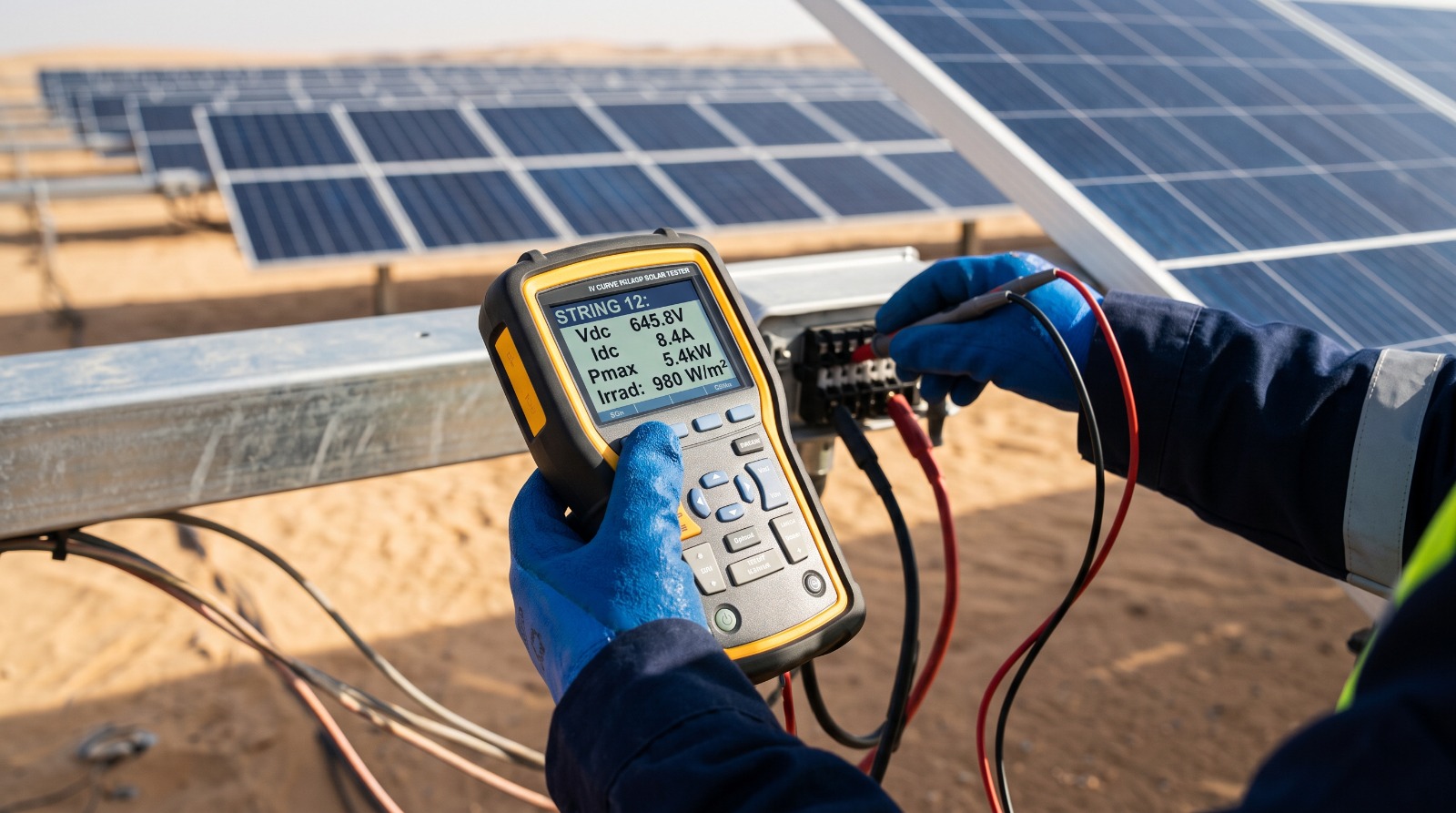
Jordan has quietly become one of the Middle East’s most consistent solar success stories. Since the Kingdom’s first large-scale Independent Power Producer (IPP) rounds opened in 2013, Jordan has built a solar sector that now approaches 2 GW of installed grid-connected capacity — a remarkable figure for a country of its size, and one that reflects a mature regulatory framework, a stable investment climate, and some of the best solar irradiance anywhere in the region.
For engineers, EPCs, IPPs, developers, and lenders operating in Jordan today, one question consistently determines whether a solar investment delivers on its financial promise: is the plant properly tested, commissioned, and maintained? A well-designed plant with weak testing and O&M underperforms a modestly-designed plant with excellent testing and O&M within a few years — and Jordan’s desert climate makes that gap even more visible. This guide covers what solar testing services in Jordan actually involve, what the local market looks like, what regulations and standards apply, and how to choose a competent local testing and commissioning partner.
Jordan’s Solar Market Today
Jordan’s solar journey began in earnest in 2013 with the launch of the country’s first competitive solar IPP round — a programme that quickly established the Kingdom as a regional pioneer. By 2020, direct proposal and second-round IPP schemes had brought hundreds of megawatts online; today Jordan’s installed grid-connected solar capacity sits at roughly 2 GW, with additional projects in various stages of development and construction.
Several factors made Jordan a natural early mover. The country has among the highest solar irradiance in the Middle East, with Direct Normal Irradiance (DNI) values in the south of the Kingdom that rank globally competitive. Jordan is also energy-import-dependent and has strong policy motivation to diversify its power mix — the government has publicly targeted renewable energy to make up a substantial share of national electricity generation by 2030, with solar as the primary contributor.
Beyond utility-scale IPPs, Jordan operates one of the region’s more developed net metering and wheeling frameworks. Commercial and industrial off-takers can install solar PV either behind the meter or at a remote site with the electricity wheeled through the national grid — a mechanism that has enabled hundreds of C&I installations across banks, factories, hotels, and universities.
The Regulatory and Institutional Landscape
Anyone commissioning or maintaining a solar plant in Jordan interacts with a handful of institutions whose remit is worth knowing.
- MEMR — the Ministry of Energy and Mineral Resources sets national energy policy, including renewable-energy targets and strategic direction for the sector.
- EMRC — the Energy and Minerals Regulatory Commission is the independent regulator responsible for licensing, tariff approvals, and technical standards enforcement.
- NEPCO — the National Electric Power Company operates the transmission grid and is the counterparty for grid-connection and power-purchase agreements for utility-scale IPPs.
- JREEEF — the Jordan Renewable Energy and Energy Efficiency Fund supports smaller-scale renewable projects, particularly in the residential and public sectors.
- Distribution companies — JEPCO, IDECO, and EDCO handle the low- and medium-voltage distribution network and are the direct interface for C&I net metering and wheeling installations.
Technical standards for grid connection, protection settings, and metering are set by EMRC in coordination with NEPCO. In practice, EPCs delivering projects into Jordan must satisfy both the international standards (IEC family) and the national grid code — and testing services provided locally must be documented in a format acceptable to both the regulator and the offtaker.
Where Solar Is Concentrated in Jordan
Jordan’s solar capacity is not evenly distributed across the Kingdom. Utility-scale plants have clustered in specific regions where irradiance, land availability, and grid capacity converge.
- Ma’an governorate (south) — the heart of Jordan’s utility-scale solar sector. The Ma’an Development Area hosts multiple large IPP projects, benefiting from exceptional irradiance, flat land, and dedicated grid infrastructure.
- Mafraq governorate (northeast) — another concentration of utility-scale capacity, closer to the transmission corridors serving the industrial belt.
- Aqaba (south) — solar deployment associated with the Aqaba Special Economic Zone and coastal industrial and logistics facilities.
- Amman and greater Amman — the majority of C&I rooftop and wheeled installations, serving banks, manufacturers, hospitals, and universities.
- Karak and Irbid — a mix of C&I and smaller utility installations that AQ Electric has supported since our founding.
Each of these regions presents its own operating environment. Ma’an and Mafraq experience the hottest days and largest dust storms; Aqaba adds coastal humidity and salt exposure; the northern highlands see cold winter mornings and occasional snow. A single national testing approach does not fit every site — local familiarity matters.
Why Testing Expertise Matters More in Jordan’s Climate
The generic global playbook for solar PV testing was written primarily around European and Chinese operating environments. Applying it directly to Jordan without adaptation leaves several risks unmanaged.
Extreme Diurnal Temperature Swings
A summer day in Ma’an sees module temperatures well above 65 °C, but a winter night can bring the same modules close to 0 °C. This 60+ °C daily swing accelerates thermal cycling stress on cell interconnects, junction boxes, and cable insulation. A commissioning test regime that captures VOC only at one moderate temperature misses the extremes the plant will actually see.
Dust and Soiling
Soiling in the south of Jordan can reduce module output by 15% or more within a few weeks in the dry season. Soiling ratio measurement, cleaning schedule optimisation, and post-cleaning performance verification become critical — and none of these are one-off commissioning tasks; they are ongoing testing activities that link directly to O&M cost economics.
Coastal and Salt Exposure at Aqaba
Plants located near the Gulf of Aqaba face aggressive salt-spray corrosion on structures, junction boxes, and combiner enclosures. Corrosion inspection of PV structures is not an optional annual activity here; it is a survival requirement.
Remote Sites and Response Times
Utility-scale plants in Ma’an and Mafraq are hours from Amman. A testing or O&M provider without genuine regional presence — local technicians, local warehouses, local calibrated equipment — either delivers late or subcontracts the actual work, both of which erode the value proposition.
AQ Electric’s home-market team delivers testing, commissioning, and O&M across Amman, Aqaba, Ma’an, and beyond — call +962 79 51 54 126.
IEC 62446-1 and International Standards in the Jordanian Context
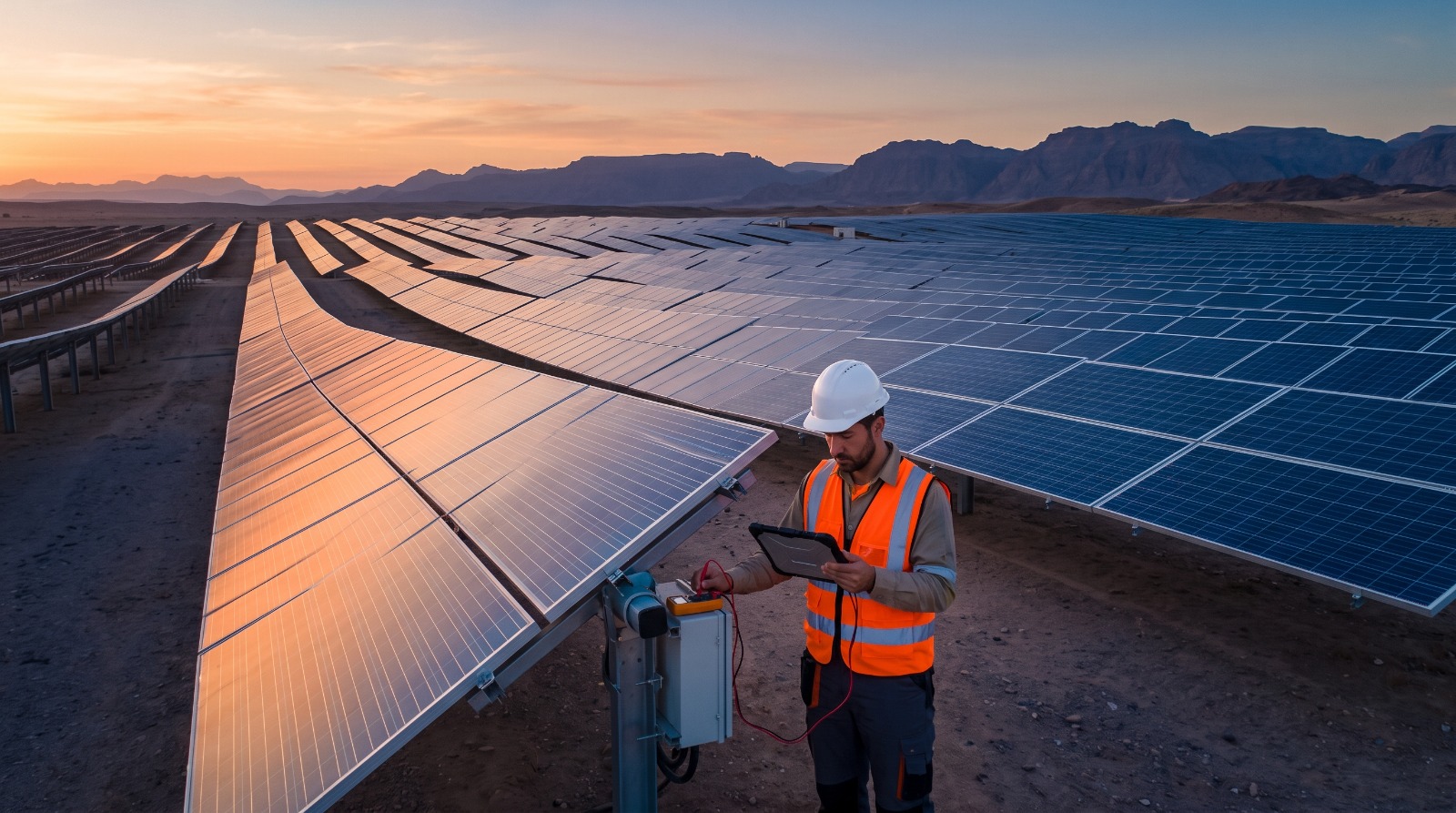
Solar testing services in Jordan — whether at commissioning or during ongoing operation — anchor on the international standard IEC 62446-1. The standard specifies the minimum body of testing, documentation, and inspection required for grid-connected PV systems, and it is now the reference used across Jordan’s utility-scale IPPs and bankable C&I projects.
For a full walkthrough of IEC 62446-1 and its Category 1, 2, and 3 test regimes, see our complete IEC 62446-1 guide. In the Jordanian context, three additional considerations shape how the standard is actually applied:
- Lender expectations — international project-finance lenders active in Jordan (EBRD, IFC, and their commercial co-lenders) require IEC-conformant commissioning documentation as a condition of drawdown.
- Grid-code alignment — NEPCO’s technical requirements for grid connection must be tested alongside IEC compliance, and the resulting reports must satisfy both.
- Environmental adaptation — test schedules and expected-value calculations need to reflect Jordan’s specific irradiance profile and temperature range, not the STC-only assumptions that suffice in cooler markets.
Testing Categories for Jordanian Solar Projects
IEC 62446-1 defines three progressive categories of testing. In Jordan, industry practice has settled roughly as follows:
| Project type | Common location | Typical testing scope |
|---|---|---|
| Residential rooftop | Amman, urban centres | Category 1 (mandatory basic tests) |
| Small C&I (up to 500 kWp) | All regions | Category 1 + selected thermography |
| Large C&I (500 kWp – 5 MWp) | Industrial belts, wheeling | Category 2 (adds I-V curve tracing) |
| Utility-scale IPP | Ma’an, Mafraq | Category 2 (full) + selected Category 3 |
| Lender-financed bankable project | Any | Category 3 (EL imaging, wet insulation) |
See our solar O&M guide for how these categories extend into periodic testing during the operational life of the plant.
Common Testing Findings on Jordanian Sites
Across a decade of testing and inspection work on Jordanian solar plants, a consistent pattern of findings emerges. These are not universal to every site, but they appear often enough that any competent local testing team knows to look for them specifically.
String Voltage Deviations from Design
Between installer variability and occasional mismatched module batches, a meaningful minority of strings on any newly-commissioned plant show VOC outside the expected tolerance. IEC 62446-1 Category 1 testing catches these before they become fault-current or MPPT-tracking issues in operation.
Thermal Anomalies at Combiner and Cable Terminations
Infrared thermography of newly-commissioned plants routinely identifies hot connections at combiner-box terminals and inverter DC inputs — typically the result of undertorqued lugs or slightly-out-of-spec crimped connectors. In Jordan’s summer, these become fault-current sources far faster than in cooler climates.
Module-Level Hotspots from Shipping Damage
Long overland shipping into Jordan means modules occasionally arrive with sub-visible micro-cracks that only surface under load. EL imaging is the definitive tool for detecting this before warranty windows close.
Water Ingress in DC Junction Boxes and Combiners
Winter rain in northern Jordan and occasional flash-flood events across the country can compromise IP ratings. Insulation resistance tests at each maintenance cycle catch this before it becomes a safety issue.
Cable UV Degradation at Exposed Runs
Where installers used cable ratings below EN 50618 spec, UV exposure at Jordan’s irradiance levels accelerates jacket cracking. Periodic visual inspection remains the first line of defence.
AQ Electric in Jordan: A Local Track Record
AQ Electric was founded in Jordan in 2019, and Jordan remains our home market and core anchor for regional operations. Our Jordan branch is based in Shmeisani, Amman — and our engineering team’s footprint reaches from Amman rooftops to the utility-scale plants of the south, from Aqaba on the Red Sea to the northern highlands of Irbid and Karak.
Since 2019, AQ Electric has delivered testing, commissioning, third-party inspection, and technical services on a portfolio of 7 solar projects in Jordan totalling approximately 124 MWp, spanning small commercial rooftops through to utility-scale plants. This home-market portfolio has been the foundation for the wider 1.0 GW of PV project experience the company has since built across the MENA region.
Jordan Portfolio
Selected AQ Electric Jordan Projects
A representative view of the Jordanian sites AQ Electric has supported since our founding:
| Project | Location | Capacity | Year |
|---|---|---|---|
| Al Manakher | Amman | 51.94 MWp | 2020 |
| South Amman | Amman | 46.6 MWp | 2019 |
| Almadunah | Amman | 12.0 MWp | 2020 |
| Eagle-Taibeh | Irbid | 5.74 MWp | 2021 |
| Eagle-Karak | Karak | 5.48 MWp | 2020 |
| King Hussein Park | Amman | 1.165 MWp | 2024 |
| Fountain Mall | Aqaba | 0.744 MWp | 2024 |
Alongside our Jordanian portfolio, AQ Electric’s engineering team has delivered testing and technical services across the wider MENA region — including the Wadi Ad Dawasir 120 MWp plant in Saudi Arabia with SEPCO, the Komombo 230 MWp and multiple ACWA and ALCOM plants in Aswan, Egypt, and the pioneering Shabwa 53 MWp project in Yemen. See our full project portfolio for the complete list.
Our field engineers operate under an ISO 9001, ISO 14001, and ISO 45001-certified management system and work to IEC 62446-1 as the standard commissioning framework. We have supported projects for a client base that includes ACWA Power, NOMAC, Wärtsilä, Belectric, SEPCO, Philadelphia Solar, and Power China — the same names that dominate utility-scale delivery across the wider Middle East.
Where We Add Value on Jordan Projects
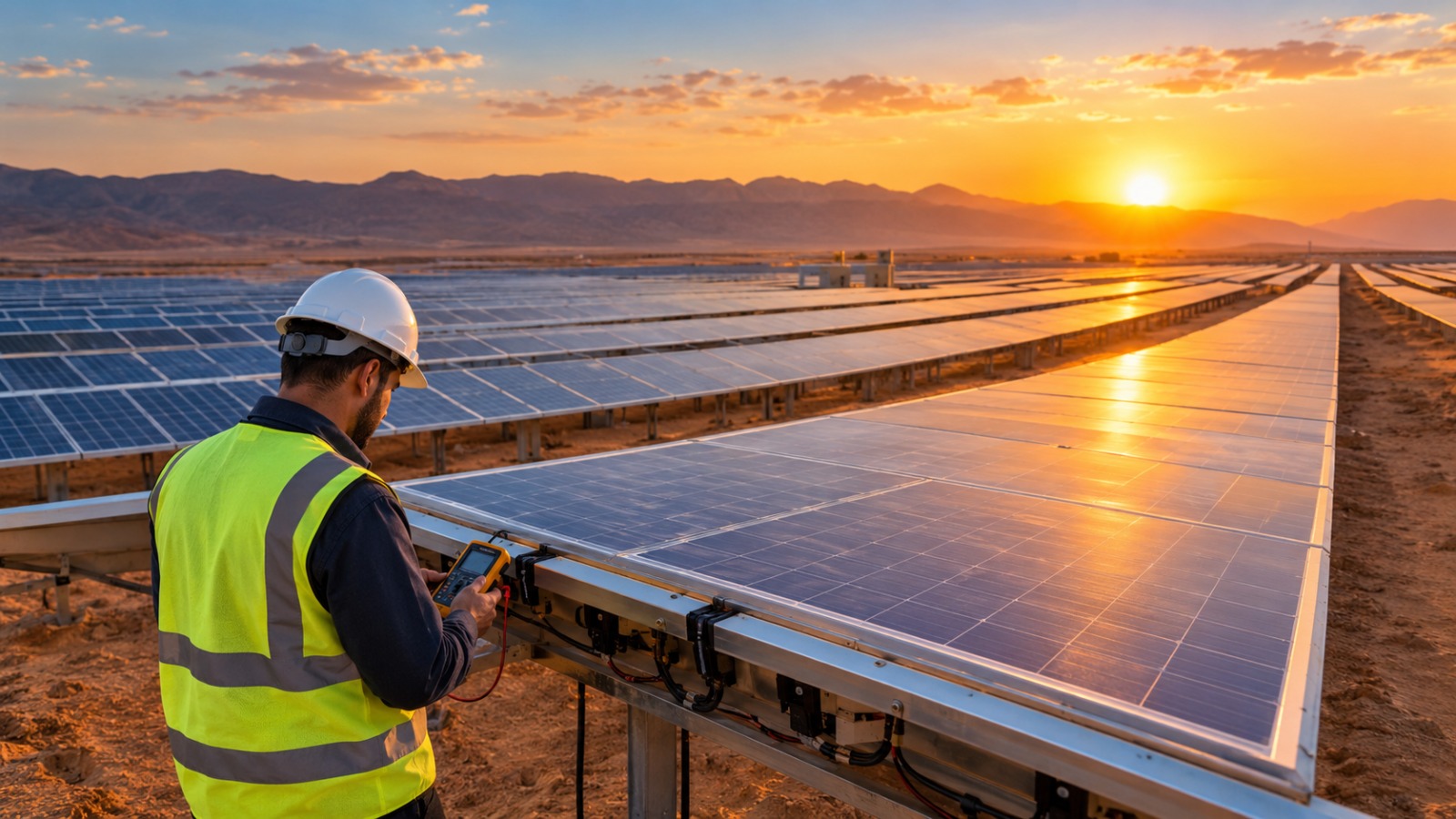
Because we operate as a home-market team rather than a fly-in provider, three practical advantages tend to matter more than the marketing:
- Faster mobilisation. A calibrated field team can reach any Jordanian site within hours, not days — the difference between a same-week commissioning slot and a two-week delay.
- Local documentation fluency. Reports written to satisfy both IEC standards and NEPCO / EMRC formatting are prepared correctly the first time.
- Site-specific field knowledge. Our engineers know which combiner boxes fail early in Aqaba humidity, which structure suppliers use undersized fasteners, and which module batches showed early-life micro-cracks — the sort of field pattern-recognition that only comes from working the same sites for years.
Choosing a Local Testing and O&M Partner in Jordan
Not every provider offering solar testing services in Jordan is a serious local operator. When evaluating a shortlist, six criteria consistently separate genuine local expertise from a rebadged fly-in operation.
- Local base and local team. Physical presence in Jordan, not a subcontractor arrangement with a global brand.
- ISO certifications held under the local entity — ISO 9001, ISO 14001, ISO 45001 as a minimum.
- Documented Jordan project references — not logos on a slide, but named projects and named contact people willing to speak to prospective clients.
- IEC 62446-1 sample reports in the exact format the provider will deliver. Ask before signing anything.
- Calibrated equipment held in country — I-V tracers, EL cameras, thermographic drones, VLF sets, insulation testers, and torque tools with current calibration certificates.
- Reporting SLAs in the contract — not vague “prompt reporting” language, but specific hours-to-report and days-to-commission commitments.
AQ Electric Services in Jordan
Delivered locally by our home-market engineering team.
⚡Testing & Commissioning🔧Operation & Maintenance🔍Third-Party Inspection✓Quality Assurance (FAT & SAT)📐Engineering Services🚁Drone Inspection🎓Training Services✉Speak to an Engineer
Solar Project in Jordan? Talk to Our Home-Market Team.
AQ Electric’s Jordan engineering team delivers IEC 62446-1 testing, commissioning, third-party inspection, and O&M — from Amman rooftops to the utility-scale plants of Ma’an.
Frequently Asked Questions
Do Jordan solar projects legally require IEC 62446-1 testing?
There is no single national law explicitly naming IEC 62446-1, but in practice the standard is required by EMRC-recognised commissioning protocols and by every international lender financing solar projects in Jordan. Compliance is effectively mandatory for any bankable project.
How much do solar testing services cost in Jordan?
For utility-scale plants, commissioning testing typically runs at a modest single-digit percentage of total EPC cost. Periodic O&M testing is priced per kWp per year, in the range of USD 5–12 depending on plant size and scope inclusions.
Can a Jordan-based testing team support projects in Saudi Arabia and Egypt?
Yes. AQ Electric’s engineering team based in Jordan and Egypt has delivered testing and commissioning on projects across Saudi Arabia, the UAE, Oman, and Kuwait — using the same processes and standards as at home.
What is the typical timeline for solar plant commissioning testing in Jordan?
For a 20–50 MWp utility plant, Category 1 and Category 2 testing typically completes within 2–4 weeks depending on site logistics. Full Category 3 diagnostics on a bankable project add another 1–2 weeks.
What ongoing testing does a solar plant in Jordan need after commissioning?
A common schedule is monthly visual inspection, annual thermographic inspection, three-yearly string I-V curve tracing, and event-triggered advanced diagnostics. See our solar O&M guide for a detailed schedule.
Does AQ Electric provide training for in-house O&M teams in Jordan?
Yes — both on-site and online technical training for solar operations, testing, and safety is available through our training services for developers and IPPs building internal capability.
Delivered Locally. Trusted Regionally.
AQ Electric has been the local partner of choice for solar PV testing, commissioning, and O&M in Jordan since 2019 — with over 1.0 GW of PV project experience across the MENA region and ISO-certified processes end to end.
PV projects supported
MENA countries covered
ISO certifications9001 · 14001 · 45001
Founded in Jordan