

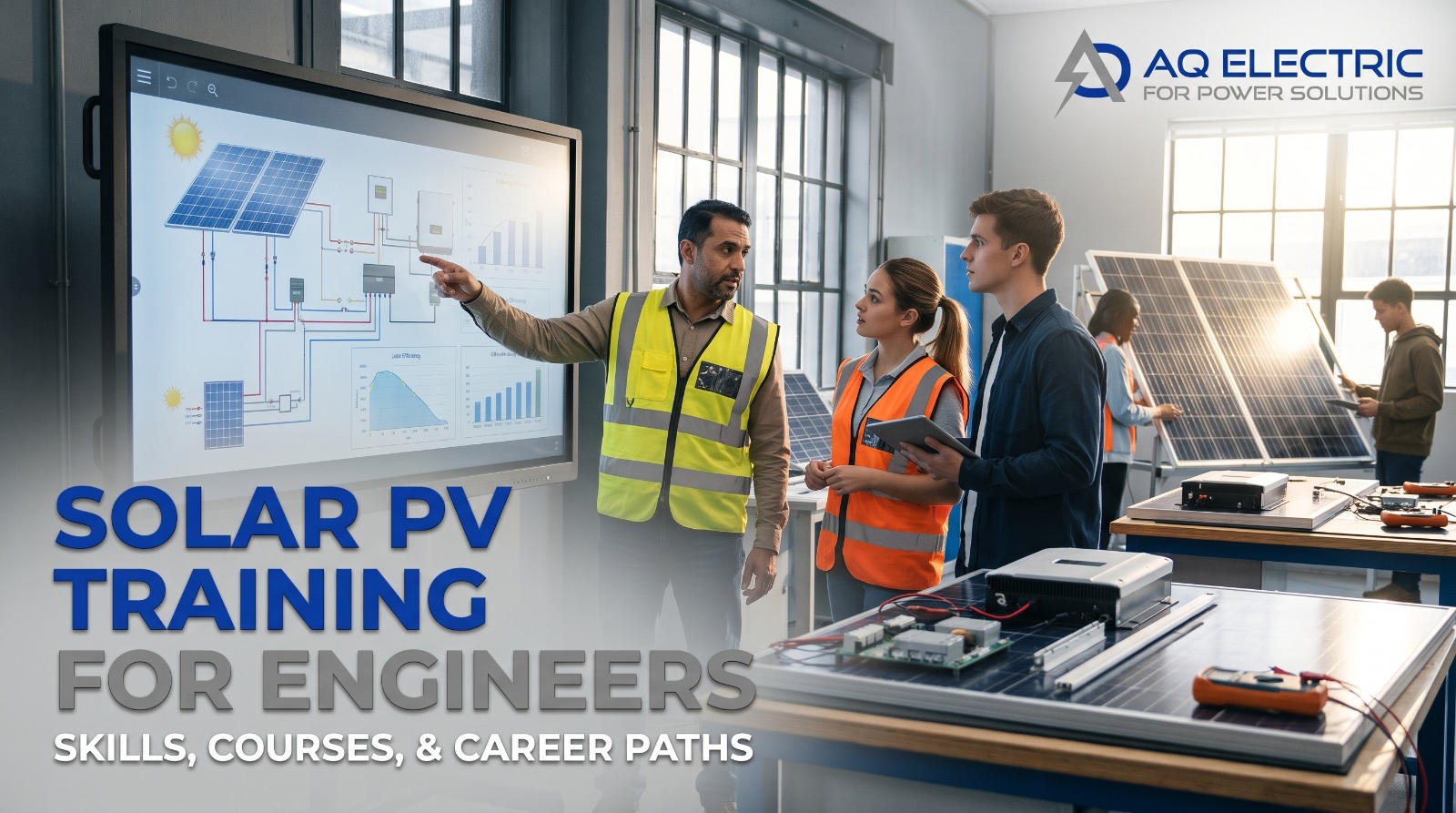
AQ Electric trains engineers and technicians across the MENA region in the same work our own teams carry out every day on utility-scale solar plants: testing, commissioning, thermography, electroluminescence imaging, and operation and maintenance. We see the same pattern on almost every project. The plants are getting larger, the technology is changing faster, and the most expensive mistakes — a missed reversed string, a misread thermogram, a performance test run the wrong way — are skills problems, not equipment problems. This article explains what solar PV training for engineers should cover, which roles need which skills, how hands-on and online training compare, which qualifications matter, and how to choose a training provider that actually changes how your team works in the field.
Key takeaways
Solar PV training for engineers builds the practical skills needed to test, commission, inspect, and maintain PV plants safely and to international standards. The core modules are PV safety on high-voltage DC systems, IEC 62446-1 testing and commissioning, infrared thermography, electroluminescence imaging, IV curve tracing, module defect recognition, operation and maintenance, and performance analysis. The global solar workforce now exceeds 7 million people, yet the IEA reports that more than half of the energy organisations it surveyed face critical hiring bottlenecks. The most effective training is delivered by practising field engineers, uses real test equipment, is tailored to the trainees’ roles and plants, and is assessed, so that competence — not attendance — is what gets certified.
What Is Solar PV Training for Engineers?
Solar PV training for engineers is technical training that teaches engineers and technicians how to verify, commission, inspect, maintain, and troubleshoot photovoltaic plants. It differs from general solar awareness courses and from installer training in its focus: instead of how to mount modules or size a rooftop system, it concentrates on the measurements, diagnostics, standards, and decisions that determine whether a utility-scale or large commercial plant is safe, accepted, and productive.
Good solar PV training for engineers combines three elements: the theory behind each test or method, hands-on practice with the instruments used in the field, and interpretation — learning to read an IV curve, a thermogram, or an EL image and decide what it means and what to do next. The third element is where most of the value lies, and it is the hardest to learn from a manual.
Why PV Skills Matter More Than Ever
The Workforce Has Not Kept Pace
Solar is now the largest renewable energy employer. The IRENA–ILO Renewable Energy and Jobs Annual Review 2025 counted 16.6 million renewable energy jobs worldwide in 2024, of which 7.2 million were in solar PV — and noted that job growth slowed to 2.3% despite record capacity additions. The IEA’s World Energy Employment 2025 report found that more than half of the roughly 700 energy companies, unions, and training institutions it surveyed reported critical hiring bottlenecks, and that in advanced economies 2.4 energy workers are nearing retirement for every new entrant under 25. Both organisations call for expanded training, reskilling, and industry involvement in curricula.
Each Engineer Covers More Capacity
Raptor Maps’ 2026 Global Solar Report found that the average technician is now responsible for about 70% more megawatts than five years ago. When each engineer covers more capacity, every hour spent searching for a fault, repeating a test, or misdiagnosing a problem costs more — and the skills to work efficiently become more valuable.
The Technology Keeps Changing
Over a few years, the industry has moved to 1,500 V DC systems, large-format bifacial modules, TOPCon and heterojunction cells, single-axis trackers, and increasingly sophisticated plant controllers. Each change brings new failure modes and new test considerations. Independent testing shows module quality has become more variable: Kiwa PVEL’s 2025 Scorecard found that 83% of manufacturers had at least one test failure. Engineers trained on older technology need updating.
Mistakes Are Built In Early
Raptor Maps also found an average power loss of 4.46% already present at commissioning. Many of those losses are created or missed by people, which is exactly what solar PV training for engineers is meant to address: wiring errors not caught in testing, damaged modules installed, performance tests run without proper methodology. Better-trained commissioning and QA teams are one of the most direct ways to reduce them.
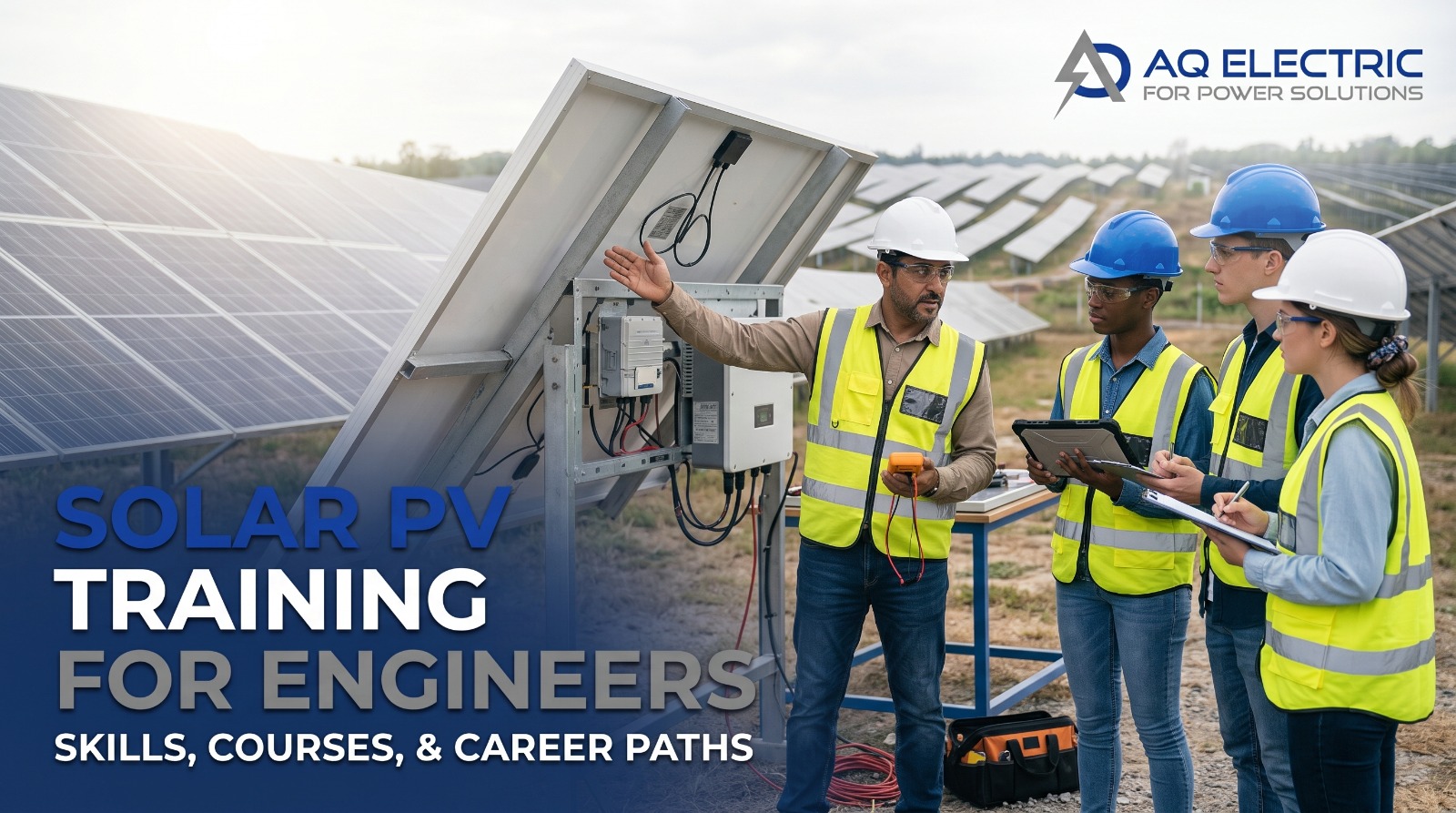
Who Needs Training, and in What
Solar PV training for engineers should be tailored to the role. The table below shows the main focus for each group.
| Role | Main training focus |
|---|---|
| Commissioning engineers | IEC 62446-1 test sequence, cold and hot commissioning, IV curves, acceptance tests, safe isolation |
| O&M engineers and technicians | Preventive and corrective maintenance, fault finding, thermography, IV curves, safety, performance monitoring |
| QA/QC and site engineers (EPC) | Installation quality, module handling, string wiring, inspection checklists, punch lists |
| Inspectors and thermographers | IEC TS 62446-3 thermography, EL imaging, defect classification, reporting |
| Asset managers and owner’s engineers | Reading test reports, performance ratio and availability, acceptance criteria, warranty evidence |
| Utility and grid engineers | PV plant behaviour, inverter and plant controller functions, MV and substation interfaces |
The Core Training Modules
A complete programme of solar PV training for engineers is built from the following modules. Not every team needs all of them; the right mix depends on roles, plant types, and existing experience.
1. PV Safety on High-Voltage DC Systems
Safety comes first. PV arrays generate voltage whenever light falls on them, utility plants now run at up to 1,500 V DC, and DC arcs do not self-extinguish the way AC arcs can. Training should cover safe isolation and lock-out/tag-out, connector handling, PPE, working near energised equipment, and the specific hazards of combiner boxes, inverters, and MV stations.
2. Testing and Commissioning
Commissioning training covers the IEC 62446-1 Category 1 test sequence — earthing continuity, polarity, combiner box tests, open-circuit voltage, string current, functional tests, and insulation resistance — and how to compare results with expected values corrected for temperature and irradiance. It extends to cold and hot commissioning, inverter start-up, and acceptance testing. AQ Electric explains the full process in its articles on the solar PV commissioning process and IEC 62446-1.
3. Infrared Thermography
Thermography training teaches the physics of why faults run hot, the IEC TS 62446-3 conditions for reliable PV thermography, camera settings and emissivity, handheld and aerial techniques, and — most importantly — how to classify anomalies and avoid false positives from reflections and soiling. AQ Electric covers the method in its article on infrared thermography for solar PV, and the aerial side in its article on drone inspection for solar PV plants.
4. Electroluminescence Imaging
EL training covers how modules are biased for imaging, how to capture usable images in the field, and how to recognise and classify cracks, inactive areas, PID patterns, and soldering defects. It is essential for QA teams handling module deliveries and warranty claims. AQ Electric explains the technique in its article on electroluminescence EL testing for solar PV.
5. IV Curve Tracing
IV curve training teaches engineers how to trace strings safely, correct results to standard conditions, and read curve shapes to diagnose shading, mismatch, series resistance, failed bypass diodes, and degradation. AQ Electric explains how to read the curves in its article on IV curve tracing for solar PV. For teams building their own toolkit, AQ Electric’s sister company EE Electronics supplies IV curve tracers in Jordan and explains the wider instrument set in its article on the solar PV tester.
6. Module Defect Recognition
Engineers should be able to recognise the common defects — hot spots, cracks, PID, UV-induced degradation, glass breakage, delamination, snail trails, and junction box faults — and know which test detects each. AQ Electric maps them in its article on common PV module defects.
7. Operation and Maintenance
O&M training covers preventive and corrective maintenance planning, cleaning strategies, inverter and tracker maintenance, spare parts, work orders, and safety on operating plants. AQ Electric describes a full programme in its article on solar PV plant operation and maintenance.
8. Performance Analysis
Engineers responsible for plant output need to calculate and interpret the performance ratio, understand temperature correction, recognise measurement errors, and break down losses. AQ Electric explains the method with a worked example in its article on the solar performance ratio.
9. IEC 62446 Compliance and Documentation
Testing is only useful if it is documented properly. Compliance training covers the documentation and records required by IEC 62446, test report structure, traceability, and handover packages that stand up to scrutiny from owners, lenders, and manufacturers.
10. MV and Substation Awareness
For senior engineers, an introduction to MV cable testing, transformers, switchgear, and protection helps them work effectively with specialist teams. AQ Electric covers these topics in its articles on MV cable testing in solar PV plants and solar power plant transformers.
Hands-On, On-Site, and Online Training
Solar PV training for engineers can be delivered in several formats, and the best programmes combine them.
| Format | Strengths | Limitations | Best for |
|---|---|---|---|
| On-site, at your plant | Real equipment, real faults, your procedures and layout | Needs site access and scheduling around operations | O&M and commissioning teams |
| Hands-on workshop | Supervised practice with test instruments | Less context than a live plant | New engineers, instrument skills |
| Online, instructor-led | Flexible, no travel, good for theory and interpretation | No hands-on practice | Standards, analysis, reporting, refreshers |
| Blended | Theory online, practice on site | Needs coordination | Most corporate programmes |
For most organisations, the best solar PV training for engineers is blended. Interpretation skills — reading thermograms, EL images, and IV curves — can be taught effectively online using real case data. Instrument handling and safe isolation need to be practised in person. A blended programme usually gives the best result for the time invested.
Qualifications That Matter
Formal qualifications vary by discipline and country, but a few are widely recognised and worth building into any programme of solar PV training for engineers:
- Thermography certification — ISO 18436-7 sets out three categories of thermographer competence. Category I personnel capture images to a defined procedure and report against criteria set by others; Category II personnel determine emissivity and reflected temperature, assess severity, diagnose findings, and write reports; Category III personnel design programmes and set the criteria and procedures. Certification is issued to individuals by accredited bodies.
- Manufacturer training — inverter, tracker, and SCADA manufacturers often require their own training before engineers can commission or service their equipment under warranty.
- Electrical authorisations — national or company electrical safety authorisations for working on LV, MV, and DC systems.
- Standards-based competence — documented training against IEC 62446-1, IEC TS 62446-3, and related standards, assessed in practice.
For many employers, demonstrated competence matters more than any single certificate: the ability to run a test sequence safely, interpret results correctly, and write a report that stands up to review.
How to Choose a Solar Training Provider
Not all solar training services for engineers deliver the same value. When choosing a provider, look for:
- Trainers who work in the field — engineers who commission and maintain plants, not only instructors who teach.
- Real instruments and real data — hands-on practice with the testers, cameras, and EL systems your team will use, and case studies from operating plants.
- Standards-based content — programmes aligned with IEC 62446-1, IEC TS 62446-3, and current practice for modern technologies.
- Tailoring — content adapted to your roles, plant types, equipment, and procedures.
- Assessment — practical and written assessment, so you know who is competent rather than who attended.
- Safety emphasis — high-voltage DC safety built into every practical session.
- Follow-up support — the ability to answer questions and review results after the course.
Many of the same principles apply to choosing a testing contractor; AQ Electric sets them out in its article on how to choose a solar testing and commissioning partner.
Measuring the Return on Training
Solar PV training for engineers is an investment, and its return can be measured. Useful indicators include:
- Commissioning quality — fewer defects found after acceptance and fewer retests.
- Fault-finding speed — shorter time from alarm to diagnosis and repair.
- Energy recovered — faults found and fixed earlier, reflected in availability and performance ratio.
- Report quality — findings that owners, lenders, and manufacturers accept without dispute.
- Safety — fewer incidents and near misses.
- Independence — less reliance on external specialists for routine diagnostics.
Measuring a baseline before training and comparing it after three to six months gives a clear picture of whether the programme is working.
Solar Training in the Gulf and MENA
The Gulf and wider MENA region are building some of the largest solar plants in the world, and the demand for skilled engineers is growing with them. Several regional factors shape what solar PV training for engineers should include.
Scale and Speed
Gigawatt-scale projects with tight schedules need commissioning and QA teams that can test tens of thousands of strings systematically. Training in efficient test planning, data handling, and reporting is as important as instrument skills.
Climate-Specific Practice
Heat, dust, and soiling affect test results, thermography interpretation, and safe working hours. Engineers need to understand temperature correction, soiling patterns, and safe scheduling in extreme conditions.
Local Capability
Developers, EPC contractors, and utilities across the region are investing in local engineering teams to operate and maintain their plants over 25 years or more. Practical, field-based training is how those teams gain the confidence to work independently. AQ Electric’s work in its home markets is covered in its articles on solar PV testing services in Jordan, solar testing services in Egypt, and solar PV testing services in Saudi Arabia.
AQ Electric’s Solar Training Services for Engineers
AQ Electric for Power Solutions, founded in Jordan in 2019 and expanded to Egypt in 2021, provides PV technical training for individuals and companies across the MENA region, delivered both online and on-site. Its programmes are designed for engineers, technicians, and solar professionals, and combine theory with hands-on practice. Training covers thermal image scanning for PV panels, electroluminescence scanning for PV panels, testing and commissioning works for PV projects, operation and maintenance for PV projects, and IEC 62446 compliance. Full details are on AQ Electric’s solar PV training services for engineers page.
Trainers from the field
Taught by Engineers Who Do the Work
AQ Electric’s trainers are the same engineers who deliver its testing, commissioning, and inspection services — on projects including the 230 MWp Komombo plant in Aswan, Egypt, with China Energy Engineering Group (CEEC), the 120 MWp Wadi Ad Dawasir plant in Saudi Arabia with SEPCO – Power China, and thermal drone inspection for ACWA Power and NOMAC in Aswan. Trainees learn from real field cases, not textbook examples.
Because AQ Electric also provides testing and commissioning services and solar O&M services, training can be combined with live project work — for example, a client’s engineers working alongside AQ Electric’s team during commissioning or an inspection campaign. AQ Electric operates under an ISO 9001, ISO 14001, and ISO 45001-certified management system from offices in Amman, Jordan and New Cairo, Egypt, with more than 1.0 GW of PV project experience. The project portfolio is on AQ Electric’s projects page.
Skills That Work in the Field
AQ Electric’s training and technical services across the MENA region.
🎓Training Services⚡Testing & Commissioning🔧Operation & Maintenance🚁Drone Inspection🔬EL Testing📊IV Curve Tracing✉Speak to an Engineer
Frequently Asked Questions
What does solar PV training for engineers cover?
Solar PV training for engineers typically covers high-voltage DC safety, IEC 62446-1 testing and commissioning, infrared thermography, electroluminescence imaging, IV curve tracing, module defect recognition, operation and maintenance, performance analysis, and documentation to IEC 62446.
Who should attend solar PV training?
Commissioning engineers, O&M engineers and technicians, EPC site and QA/QC engineers, inspectors and thermographers, asset managers, owner’s engineers, and utility engineers who work with PV plants. The content should be tailored to each role.
Is online solar PV training effective?
Online training is effective for standards, theory, and interpretation skills such as reading thermograms, EL images, and IV curves. Instrument handling and safe isolation need hands-on practice, so a blended programme usually works best.
What certification is needed for PV thermography?
Thermographer competence is commonly certified under ISO 18436-7, which defines Category I, II, and III levels, or equivalent schemes. For PV plants, practical training in the IEC TS 62446-3 conditions and anomaly classification is also essential.
How long does solar PV training take?
It depends on the scope. A focused module, such as IV curve tracing or EL imaging, can be covered in a short course, while a full commissioning or O&M programme for a new team is usually delivered in stages, combining classroom sessions with supervised field practice.
Can training be delivered at our own solar plant?
Yes. On-site training at the client’s plant is often the most effective format, because engineers practise on their own equipment, layout, and procedures, and can work on real faults.
Why is there a shortage of skilled solar engineers?
Solar capacity has grown faster than training systems. The IEA reports that more than half of the energy organisations it surveyed face critical hiring bottlenecks, and IRENA and the ILO call for expanded reskilling and upskilling as technology and automation change job requirements.
Does AQ Electric provide solar training services for engineers in MENA?
Yes. AQ Electric provides online and on-site PV technical training covering thermal and EL scanning, testing and commissioning, O&M, and IEC 62446 compliance for engineers and companies across Jordan, Egypt, Saudi Arabia, and the wider MENA region.
Train Your Team with Engineers Who Do the Work
AQ Electric delivers solar PV training for engineers online and on-site — testing and commissioning, thermography, EL, O&M, and IEC 62446 compliance — taught by field engineers with utility-scale experience alongside CEEC, SEPCO, Power China, ACWA Power, and NOMAC.