

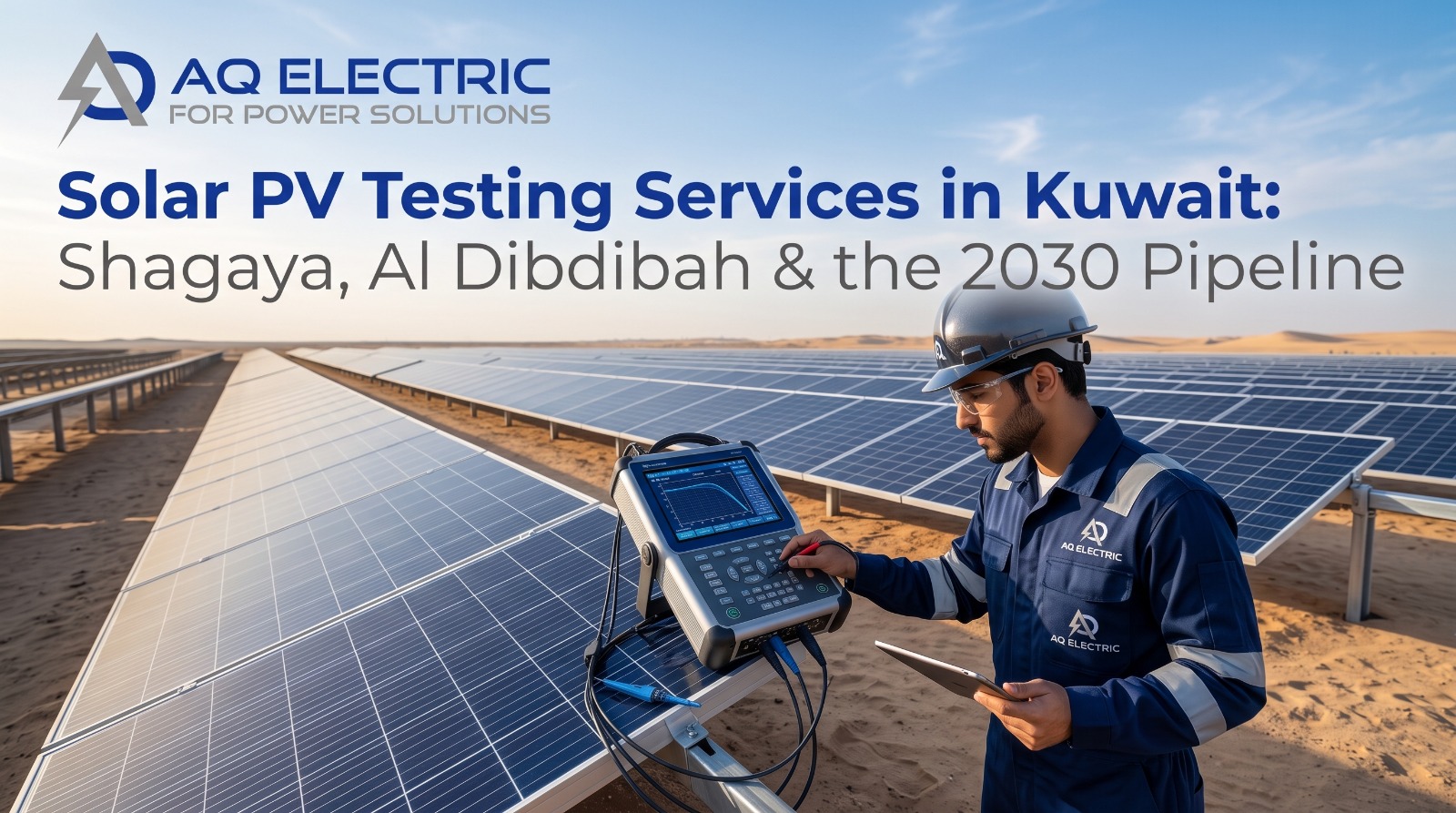
AQ Electric brings specialist solar PV testing services to Kuwait at the moment the country’s solar programme moves from pilot to gigawatt scale. Backed by more than 1.0 GW of PV project experience across the MENA region — including the 120 MWp Wadi Ad Dawasir plant in neighbouring Saudi Arabia and the utility-scale solar clusters of Aswan, Egypt — AQ Electric delivers the commissioning, inspection, and long-term solar power plant operation and maintenance that Kuwait’s new generation of solar plants will need. With the 1.1 GW Shagaya Phase III Zone 1 project approaching award, a further 500 MW in procurement, and a target of 4.5 GW at Shagaya by 2030, demand for rigorous, IEC-compliant solar PV testing services in Kuwait is about to rise sharply.
This article explains what solar PV testing services in Kuwait involve and why they matter more in Kuwait than almost anywhere else: the structure of the Kuwaiti solar market, the institutions and procurement framework behind it, the projects shaping the 2030 pipeline, the extreme climate conditions that test every component, how IEC 62446-1 commissioning applies in the Kuwaiti context, and the role of solar power plant operation and maintenance in protecting long-term yield. Whether you are an EPC contractor preparing for Shagaya, a developer bidding into KAPP’s programme, a lender’s technical advisor, or a facility owner planning PV inspection in Kuwait City, this is the practical reference for getting solar testing right in Kuwait.
Kuwait’s Solar Market: From Pilot to Gigawatt Scale
For more than a decade, Kuwait’s solar story was one of careful preparation rather than rapid deployment. The country set its original renewable energy goal in 2012: 15% of electricity generation from renewable sources by 2030, aligned with its climate commitments. Since then, Kuwait has tested technologies under its own harsh desert conditions, built institutional capacity, and structured a procurement programme designed to attract international developers. That preparation is now converting into large-scale projects — and with them, a structural need for solar PV testing services in Kuwait.
Several factors make solar a natural fit for Kuwait. First, solar PV production aligns closely with the country’s electricity demand profile: Kuwait’s consumption peaks during summer midday hours, driven by air-conditioning load, which is exactly when solar plants generate the most. Second, the country has an exceptional solar resource across its western desert. Third, every megawatt-hour generated from solar frees hydrocarbons that would otherwise be burned domestically for power. Kuwait has also set a long-term goal of reaching net-zero carbon emissions by 2060, with renewable generation at the core of that pathway.
The scale of what is coming is significant. The Shagaya Renewable Energy Park alone is planned to reach around 4,500 MW of capacity by 2030, developed in phases. The 1,100 MW Phase III Zone 1 project has cleared technical evaluation, with a preferred bidder expected in the third quarter of 2026, and the 500 MW Zone 2 project is in procurement behind it. Every one of these plants will require factory and site acceptance testing, full commissioning, and decades of solar power plant operation and maintenance — which is why solar PV testing services in Kuwait are a long-term requirement rather than a one-off opportunity.
Shagaya planned capacity by 2030
Phase III Zone 1 — preferred bidder expected Q3 2026
Renewable generation target by 2030
Kuwait’s net-zero target year
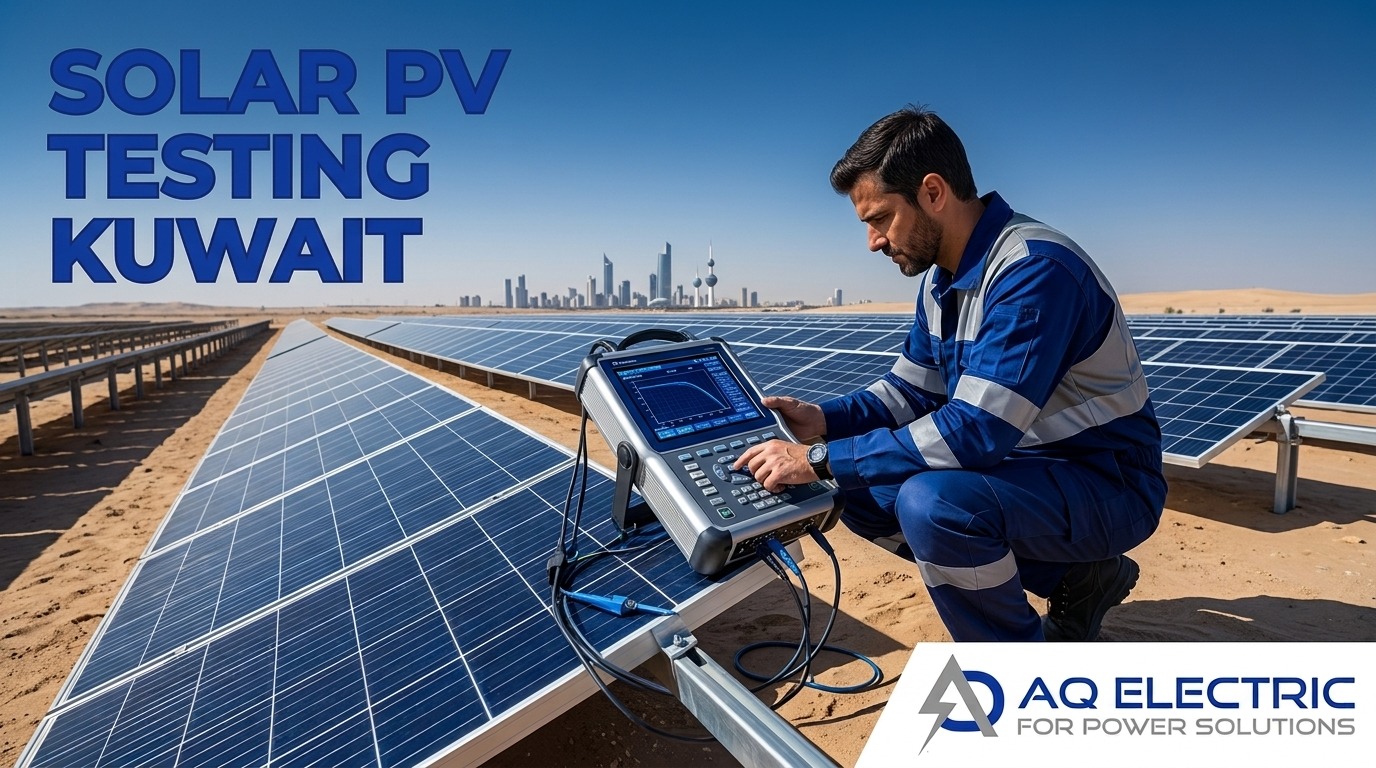
The Shagaya Renewable Energy Park
Any discussion of solar PV testing services in Kuwait begins with Shagaya. Located roughly 100 km west of Kuwait City in Jahra Governorate, near the borders with Saudi Arabia and Iraq, the Shagaya Renewable Energy Park is the centrepiece of the country’s renewable energy strategy and the site of nearly all of its large-scale solar development.
Phase I: Kuwait’s Proving Ground
Shagaya’s first phase, developed by the Kuwait Institute for Scientific Research (KISR) with the Ministry of Electricity and Water, was a deliberate experiment. Rather than commit to a single technology, Kuwait built a 70 MW multi-technology facility to learn what works in its climate: a 50 MW concentrated solar power (CSP) plant with around 10 hours of molten-salt thermal storage, a 10 MW PV plant using both polycrystalline and thin-film modules, and a 10 MW wind farm of five 2 MW turbines. Phase I was officially commissioned in 2018.
The results were instructive. KISR reported that both the PV plant and the wind farm exceeded their generation predictions in operation, and solar PV proved to be among the most cost-effective options because its output aligns so closely with Kuwait’s daytime summer demand. Phase I demonstrated that PV performs well in Kuwait’s harsh desert environment — provided the plants are properly designed, tested, and maintained. That proviso is precisely where professional solar PV testing services in Kuwait become essential.
Why Shagaya’s Environment Demands Rigorous Testing
Shagaya’s location in Kuwait’s western desert means its plants face some of the most demanding conditions on Earth: summer temperatures that can exceed 50 °C, frequent dust storms driven by the seasonal shamal winds, and wide day–night temperature swings. At gigawatt scale, small percentage losses from undetected installation defects, soiling, or heat-driven degradation translate into very large volumes of lost energy over a plant’s 25-to-30-year life. Testing at commissioning, and periodically thereafter, is how those losses are caught.
The Phase III Pipeline: Zone 1 and Zone 2
The projects that will define demand for solar PV testing services in Kuwait over the next several years sit within Shagaya Phase III, combined with the long-planned Al Dibdibah development.
Al Dibdibah Power and Al Shagaya Phase III — Zone 1 (1,100 MW)
The flagship project is the 1,100 MW Al Dibdibah Power and Al Shagaya Renewable Energy Phase III Zone 1 solar PV independent power project, which includes the solar plant and an associated 400 kV transmission substation. The Kuwait Authority for Partnership Projects (KAPP) issued the request for proposals in June 2025; after a deadline extension, technical and commercial bids were received in January 2026, technical evaluation was completed, and financial bids were opened in mid-2026. A preferred bidder is expected in the third quarter of 2026.
Three international consortia remained in contention, including one led by Saudi Arabia’s ACWA Power in partnership with Kuwait’s Alternative Energy Projects Company, and another comprising France’s EDF Renewables, South Korea’s Western Power Company, and Kuwait’s Abdullah Al Hamad Al Sagar and Brothers Company. Whichever consortium wins, a project of this size will require extensive factory and site acceptance testing, string-level commissioning across a vast array, and substation and transformer testing before it can deliver power to the grid.
Phase III — Zone 2 (500 MW)
Behind Zone 1 sits the 500 MW Al Dibdibah Power and Al Shagaya Renewable Energy Phase III Zone 2 solar PV project, also located within the Shagaya park. KAPP issued its request for proposals to prequalified bidders in November 2025, with the submission deadline later extended to the end of April 2026. The project carries a 30-year power purchase agreement with the Ministry of Electricity, Water and Renewable Energy as offtaker — a contract horizon that makes long-term solar power plant operation and maintenance central to the project’s economics.
The Al Dibdibah Legacy
The Al Dibdibah name has a long history in Kuwait’s renewable plans. The project was originally conceived as a large PV development within the Shagaya master plan, with early tender timelines disrupted by the COVID-19 pandemic and regional events. Its incorporation into Phase III reflects how Kuwait has consolidated its renewable programme into a smaller number of larger, more bankable projects.
AQ Electric delivers solar commissioning, inspection, and O&M across the Gulf — call +962 79 51 54 126.
The Regulatory and Procurement Landscape
Delivering solar PV testing services in Kuwait means working within a framework shaped by three core institutions:
- Kuwait Authority for Partnership Projects (KAPP) — the authority that structures and runs Kuwait’s public–private partnership tenders, including the Shagaya Phase III solar IPPs.
- Ministry of Electricity, Water and Renewable Energy (MEWRE) — the ministry responsible for power generation and transmission, and the offtaker under the solar power purchase agreements.
- Kuwait Institute for Scientific Research (KISR) — the research institute that developed Shagaya Phase I and has played a central role in assessing renewable technologies for Kuwait’s climate.
Kuwait’s utility-scale solar is procured through the independent power producer (IPP) model: developers bid to finance, build, own, and operate plants, selling electricity under long-term PPAs. Projects of this kind are typically financed by international and regional lenders, which means their technical documentation must satisfy lenders’ technical advisors as well as the offtaker. In practice, the technical standard for grid-connected PV commissioning converges on IEC 62446-1 — and solar PV testing services in Kuwait must be documented to that bankable standard. For a full explanation of the standard, see AQ Electric’s IEC 62446-1 article.
Why Solar PV Testing Services Matter More in Kuwait
The generic global approach to solar testing was developed around temperate climates. Applied unmodified to Kuwait, it leaves critical risks unmanaged. AQ Electric’s work across the Gulf — particularly on the Wadi Ad Dawasir project in Saudi Arabia, whose desert climate closely mirrors Shagaya’s — has produced a testing approach adapted to exactly these conditions.
Extreme Heat and Temperature Correction
Kuwait is among the hottest inhabited places on Earth, with summer air temperatures that can exceed 50 °C and module operating temperatures well above that of the surrounding air. Crystalline silicon modules lose roughly 0.4% of their output for every degree Celsius of temperature rise, so heat is a major and permanent loss factor. For testing, this means expected values for open-circuit voltage and operating current must be temperature-corrected using real Kuwaiti conditions — otherwise healthy strings can look faulty and faulty strings can look healthy.
Dust Storms and Soiling
Kuwait’s seasonal shamal winds bring frequent dust storms that deposit heavy soiling on modules. Soiling ratio measurement, cleaning-cycle optimisation, and post-cleaning performance verification are therefore core deliverables of solar PV testing services in Kuwait — and central to effective solar power plant operation and maintenance.
Thermal Cycling and Equipment Stress
Large day–night temperature swings drive repeated expansion and contraction of cells, solder joints, connectors, and cable insulation. Over time, this thermal cycling creates microcracks and connection faults that only targeted testing — thermography, IV curve tracing, and electroluminescence imaging — reliably detects. Inverters and transformers face the same stress, which is why AQ Electric’s articles on solar inverters and solar power plant transformers place particular weight on heat-driven failure modes.
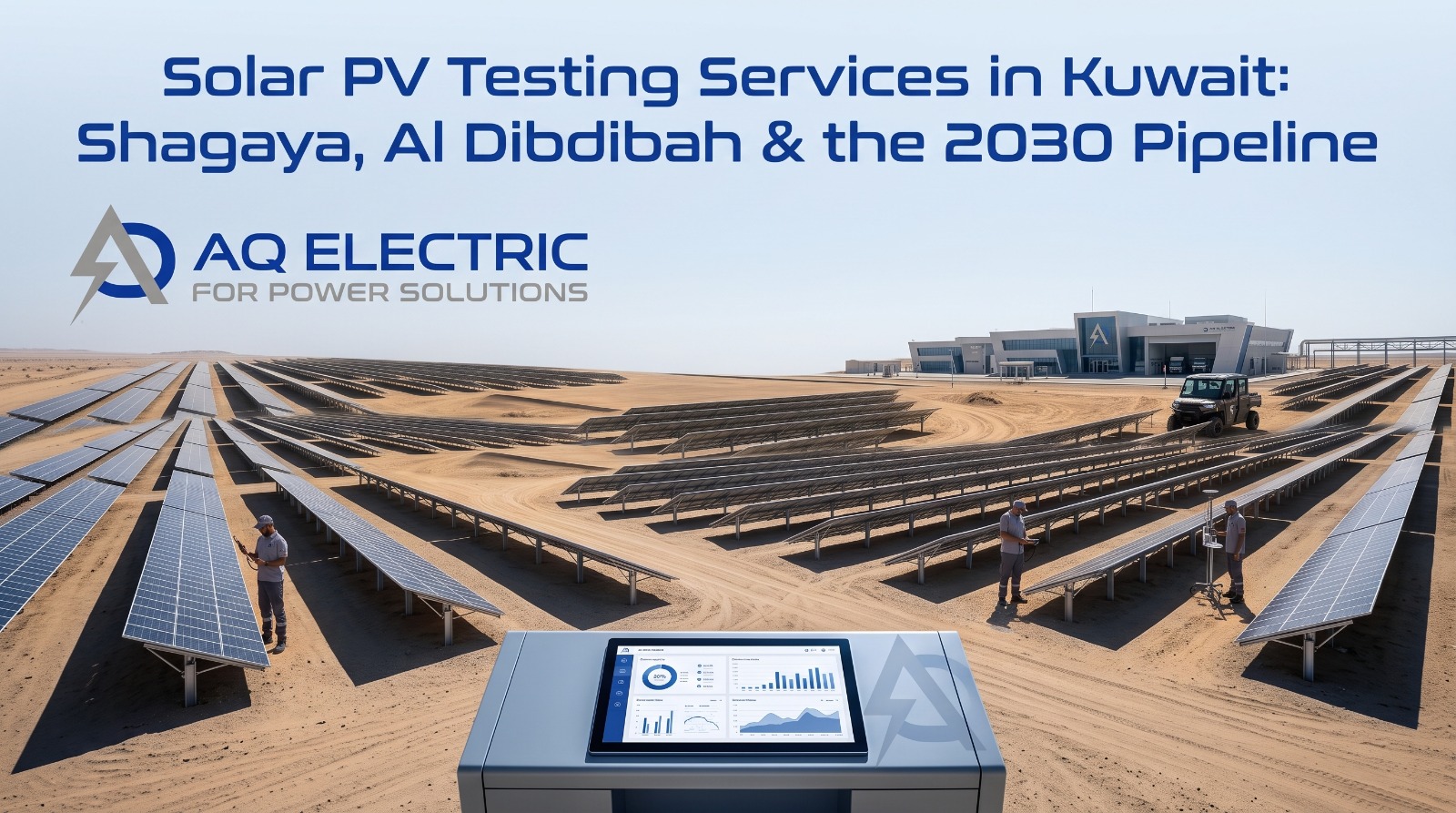
Peak-Demand Criticality
Because Kuwait’s solar output coincides with its summer peak demand, every hour of unplanned downtime during summer middays carries outsized value for the grid. That makes availability — and the testing and maintenance that protect it — especially important in Kuwait.
Solar Commissioning in Kuwait: What It Involves
Solar commissioning in Kuwait is the process that converts a newly-built plant into a verified, bankable, grid-ready asset. For projects on the scale of Shagaya Phase III, it is a major undertaking in its own right, and it is where the quality of solar PV testing services in Kuwait has the most lasting impact.
Pre-Commissioning Inspection
A structured visual and mechanical inspection confirms module condition, structural integrity, cable routing, labelling, earthing, and enclosure sealing — catching transport and installation damage before any equipment is energised.
String-Level Electrical Testing
Every string is tested for earthing continuity, polarity, open-circuit voltage, operating current, and insulation resistance, with measurements compared against temperature-corrected expected values. On a 1.1 GW plant, that means tens of thousands of strings — demanding systematic methodology, calibrated equipment at scale, and rapid reporting.
Category 2 Diagnostics
For utility-scale and lender-financed projects, solar commissioning in Kuwait should include IEC 62446-1 Category 2 testing: string-level IV curve tracing and infrared thermographic inspection. AQ Electric explains these techniques in its articles on IV curve tracing for solar PV and infrared thermography for solar PV.
Inverter, Transformer, and Substation Testing
Inverter functional and grid-interaction testing, transformer acceptance testing, and verification of protection settings ensure the AC side performs correctly — including the 400 kV substation that forms part of the Zone 1 project.
Documentation and Handover
The commissioning record — complete, traceable, and IEC-conformant — is what the owner, lenders, insurers, and future O&M teams will rely on for decades. It is also the baseline against which every future performance question will be measured.
The Full Scope of Solar PV Testing Services in Kuwait
Comprehensive solar PV testing services in Kuwait span the full project lifecycle. AQ Electric delivers the complete scope in-house, drawing on field-proven methodology from across its 1.0 GW of regional experience.
- Factory and site acceptance testing — verifying that modules, inverters, and transformers meet specification before and after delivery, through AQ Electric’s FAT and SAT services.
- Testing and commissioning — the full IEC 62446-1 test regime on every string, delivered through AQ Electric’s testing and commissioning services.
- Aerial thermographic inspection — drone-based infrared surveys that scan entire utility-scale plants for hotspots and faults, through AQ Electric’s drone inspection services.
- IV curve tracing — string-level diagnosis of underperformance and its causes.
- Electroluminescence testing — module-level detection of microcracks and cell defects caused by transport, installation, or thermal cycling; see AQ Electric’s article on EL testing for solar PV.
- Third-party inspection — independent verification for owners, lenders, and insurers through AQ Electric’s third-party inspection services.
- Operational testing — periodic re-testing throughout the plant’s life as part of a structured O&M programme.
Solar Power Plant Operation and Maintenance in Kuwait
Solar PV testing services in Kuwait do not end at commissioning. With power purchase agreements running for up to 30 years, the operational phase is where most of a plant’s value is created or lost — and where solar power plant operation and maintenance becomes decisive. In Kuwait’s climate, effective solar power plant operation and maintenance is the single most important factor in protecting yield over the life of the asset.
Solar power plant operation and maintenance covers preventive maintenance, corrective repairs, and predictive condition-based maintenance driven by monitoring data. In Kuwait, it must contend with heavy dust deposition, extreme heat that stresses inverters and transformers, and thermal cycling that slowly degrades modules and connections. A well-designed O&M programme turns these known risks into managed ones.
Why Solar Power Plant Operation and Maintenance Matters More in Kuwait
Poorly maintained modules degrade faster than well-maintained ones. Dust can erode output significantly between cleaning cycles. Inverter thermal derating during summer middays silently caps output at the very moment Kuwait’s grid needs it most. Each of these losses is preventable through disciplined solar power plant operation and maintenance — and each, left unmanaged, compounds year after year across a plant that may have been perfectly built.
The O&M Activities That Matter Most in Kuwait
A comprehensive solar power plant operation and maintenance programme for a Kuwaiti plant includes cleaning optimisation around dust-storm seasons, periodic infrared thermography, IV curve tracing, inverter cooling-system maintenance, transformer testing, cable testing, and continuous performance monitoring with loss analysis. AQ Electric delivers these through its solar operation and maintenance services; for a detailed breakdown of a best-practice programme, see AQ Electric’s solar PV plant operation and maintenance article.
The same testing disciplines applied at commissioning — IV curve tracing, thermography, insulation testing — are repeated periodically during operation to catch degradation early. That is why AQ Electric integrates testing and solar power plant operation and maintenance into a single continuous assurance service rather than treating them as separate transactions.
Solar Power Plant Operation and Maintenance for Kuwait’s 2030 Pipeline
Protect long-term yield with AQ Electric’s solar power plant operation and maintenance — combining IV curve tracing, thermography, and performance monitoring, delivered by ISO-certified engineers with 1.0 GW of Gulf and MENA experience.
PV Inspection in Kuwait City: Rooftop and C&I Solar
While Shagaya dominates Kuwait’s solar headlines, distributed solar is also part of the country’s energy picture. Kuwait has piloted rooftop solar on homes and government buildings — including a programme that installed panels on around 200 homes to evaluate rooftop potential — and commercial and industrial installations on warehouses, offices, and public facilities are a natural fit for a country whose demand peaks during sunny summer middays.
PV inspection in Kuwait City and its surrounding areas requires the same discipline as utility-scale testing, adapted to the realities of urban sites. Rooftop installations face the same extreme heat and dust as Shagaya, plus the added safety implications of operating on occupied buildings: a DC fault on a rooftop can threaten the building beneath it. A professional PV inspection in Kuwait City should include visual inspection, polarity and insulation testing, thermographic scanning of modules and connections, and verification of protection and earthing — documented to IEC 62446-1. AQ Electric applies the same standards-based approach to commercial rooftops that it applies to utility plants.
AQ Electric’s Regional Track Record
AQ Electric for Power Solutions, founded in Jordan in 2019 and expanded to Egypt in 2021, provides solar PV testing services across the MENA region, backed by more than 1.0 GW of PV project experience and an ISO 9001, ISO 14001, and ISO 45001-certified management system. Kuwait is a growth market for AQ Electric, and our credibility there rests on a proven regional record delivered in climates and at scales directly comparable to Shagaya.
Gulf and MENA Experience Directly Relevant to Kuwait
The desert conditions that challenge Kuwaiti solar plants are the same conditions AQ Electric has worked in across the region. Notably, ACWA Power — for whom AQ Electric has delivered thermal drone inspection on Egyptian utility-scale plants — leads one of the consortia that competed for Shagaya Phase III Zone 1.
| Project | Location | Capacity | Relevance to Kuwait |
|---|---|---|---|
| Wadi Ad Dawasir | Saudi Arabia | 120 MWp | Gulf desert climate, utility scale, SEPCO – Power China |
| Komombo | Aswan, Egypt | 230 MWp | Extreme heat and dust, large scale, CEEC |
| ACWA / ALCOM | Aswan, Egypt | 137 MWp | Thermal drone inspection for ACWA Power & NOMAC |
| SECI Projects | Aswan, Egypt | 115 MWp | Desert O&M, utility scale |
| Al Manakher | Amman, Jordan | 51.94 MWp | Utility-scale testing and commissioning |
This regional depth — proven clients, proven desert-climate experience, and proven utility scale — is what AQ Electric brings to solar PV testing services in Kuwait. The full list is on AQ Electric’s projects page. For perspective on neighbouring Gulf markets, see AQ Electric’s articles on solar PV testing services in Saudi Arabia and solar PV testing services in Oman.
Choosing a Solar Testing Partner in Kuwait
Selecting a provider of solar PV testing services in Kuwait shapes both the bankability and the long-term performance of the asset. Seven criteria consistently separate genuine specialists from generalists:
- Desert-climate experience. Proven work in comparable heat and dust — like AQ Electric’s Wadi Ad Dawasir project in Saudi Arabia and its Aswan portfolio in Egypt.
- ISO certifications. ISO 9001, ISO 14001, and ISO 45001 as a minimum. AQ Electric holds all three.
- IEC 62446-1 competency. Demonstrated through sample reports in the exact format the provider will deliver.
- Capacity for scale. The equipment, manpower, and methodology to commission gigawatt-scale plants within tight schedules.
- Full in-house scope. Commissioning, IV curve tracing, EL testing, thermography, FAT/SAT, and O&M delivered in-house rather than subcontracted.
- Bankable documentation. Reports that satisfy lenders’ technical advisors and independent engineers.
- Integrated testing and O&M. A partner providing both solar commissioning in Kuwait and ongoing solar power plant operation and maintenance delivers continuous assurance across the plant’s life.
AQ Electric sets out these criteria in more detail in its article on how to choose a solar testing and commissioning partner.
AQ Electric Solar Services for Kuwait
Full-lifecycle testing, commissioning, and O&M — delivered across the Gulf.
⚡Testing & Commissioning🔧Operation & Maintenance📊IV Curve Tracing🔬EL Testing🚁Drone Inspection🔍Third-Party Inspection✓Quality Assurance (FAT & SAT)✉Speak to an Engineer
Frequently Asked Questions
What solar PV testing services does AQ Electric provide in Kuwait?
AQ Electric provides the full scope of solar PV testing services in Kuwait: factory and site acceptance testing, testing and commissioning, IV curve tracing, electroluminescence testing, drone thermography, third-party inspection, and solar power plant operation and maintenance — all documented to IEC 62446-1, backed by more than 1.0 GW of MENA project experience.
What are Kuwait’s main solar projects?
Kuwait’s solar development is centred on the Shagaya Renewable Energy Park in Jahra Governorate. Phase I (70 MW of CSP, PV, and wind) was commissioned in 2018. Phase III includes the 1,100 MW Zone 1 project, with a preferred bidder expected in Q3 2026, and the 500 MW Zone 2 project. Shagaya is planned to reach around 4.5 GW by 2030.
What does solar commissioning in Kuwait involve?
Solar commissioning in Kuwait includes pre-commissioning inspection, string-level electrical testing against temperature-corrected expected values, IEC 62446-1 Category 2 diagnostics (IV curve tracing and thermography), inverter, transformer, and substation testing, and a complete bankable commissioning record.
Why is solar power plant operation and maintenance so important in Kuwait?
Extreme heat, frequent dust storms, and thermal cycling accelerate losses and degradation. With PPAs running up to 30 years and solar output coinciding with summer peak demand, disciplined solar power plant operation and maintenance — cleaning optimisation, thermography, IV curve tracing, and inverter care — is essential to protect yield and availability.
How does Kuwait’s climate affect solar PV testing?
Summer temperatures above 50 °C require careful temperature correction of expected values, dust storms impose heavy soiling, and large day–night temperature swings create microcracks and connection faults over time. Testing must be designed and interpreted for these conditions to give reliable results.
Does AQ Electric offer PV inspection in Kuwait City?
Yes. AQ Electric applies the same IEC 62446-1-based approach to rooftop and commercial installations as to utility plants, covering visual inspection, polarity and insulation testing, thermographic scanning, and protection and earthing verification for PV inspection in Kuwait City and across the country.
Who manages solar procurement in Kuwait?
The Kuwait Authority for Partnership Projects (KAPP) runs the solar IPP tenders, the Ministry of Electricity, Water and Renewable Energy (MEWRE) acts as offtaker, and the Kuwait Institute for Scientific Research (KISR) developed Shagaya Phase I and supports technology assessment.
Solar PV Testing Services in Kuwait — Ready for Shagaya Scale
AQ Electric delivers IEC 62446-1-compliant solar PV testing services in Kuwait — FAT and SAT, solar commissioning, IV curve tracing, EL testing, thermography, inspection, and solar power plant operation and maintenance. Proven across 1.0 GW of Gulf and MENA experience and trusted by ACWA Power, NOMAC, SEPCO, Power China, and CEEC.
MENA PV projects supported
MENA countries covered
ISO certifications9001 · 14001 · 45001
Founded in Jordan