

AQ Electric works with developers, EPC contractors, and lenders’ advisors across the MENA region, and one question sits behind almost every financed solar project: can the lender trust that this equipment, built this way, will perform for the life of the loan? Solar bankability testing is how that question gets answered with evidence rather than assumptions. This article explains what solar bankability testing really involves — why a Tier 1 badge and an IEC certificate are not enough, what extended reliability testing adds, why factory and batch verification matter, and how site, commissioning, and operating data complete the picture that lenders and investors need to see.
Key takeaways
Solar bankability testing is the body of independent evidence that shows lenders and investors that a PV project’s equipment and construction will deliver the expected energy over the financing term. It works at three levels: the product (certification plus extended reliability testing and PAN data), the delivered batch (factory audits, production witnessing, bill-of-materials verification, pre-shipment and arrival inspection), and the plant (design review, commissioning tests, capacity and performance tests, and operating data). BloombergNEF’s Tier 1 list is a measure of industry acceptance, not quality, and IEC 61215 and IEC 61730 certification are minimum requirements. Because independent laboratories report record module test failure rates, lenders increasingly expect batch- and site-level verification of the modules actually delivered.
What Is Solar Bankability Testing?
Solar bankability testing is the set of independent tests, inspections, and verifications that give lenders and investors confidence that a solar project will perform as modelled for the life of its financing. Bankability itself is a financing concept: as Kiwa PVEL puts it, bankability in solar means that financiers are willing to invest in the technology. Testing is how that willingness is earned, because a lender’s risk depends on whether the plant’s equipment and construction will produce the energy that repays the debt.
Solar bankability testing operates at three levels:
- Product level — is the module, inverter, or tracker design durable and correctly characterised? Evidence includes certification, extended reliability testing, and performance data files.
- Batch level — are the products actually delivered to this project the same as the products that were tested? Evidence includes factory audits, production witnessing, bill-of-materials verification, and pre-shipment and arrival inspection.
- Plant level — was the plant designed and built correctly, and does it perform? Evidence includes design review, commissioning tests, capacity and performance tests, and operating data.
Many projects focus on the first level and treat the other two as formalities. Experience — and independent data — shows that the second and third levels are where many bankability problems actually appear.
Why Tier 1 Is Not Proof of Bankability
“Tier 1” is often used as shorthand for bankable, but the term means something narrower. BloombergNEF’s Tier 1 classification is based on financing history: it applies to manufacturers whose own-brand modules, made in their own facilities, have been supplied to six different projects financed non-recourse by six different non-development banks within the past two years.
BloombergNEF itself has stated that the classification is purely a measure of industry acceptance, not a measure of quality, and has noted that there are documented examples of quality issues or bankruptcy among Tier 1 manufacturers. Tier 1 status tells a lender that other banks have financed a manufacturer’s products; it says nothing about the specific module type, bill of materials, factory, or production batch going into a particular project. That is why serious solar bankability testing looks beyond the list.
Why IEC Certification Is Only the Minimum
Every utility-scale module should be certified to IEC 61215 (design qualification) and IEC 61730 (safety). These certifications are essential, but they were never intended to prove long-term bankability. Kiwa PVEL summarises the limitations clearly:
- IEC/UL 61730 certifies that a module is not hazardous; it does not address long-term performance.
- IEC/UL 61215 screens for defects that appear in the first few years of operation, not over a 25-year life.
- Manufacturers choose the samples submitted for certification, and those “golden samples” may be built more carefully than routine production.
- Some bill-of-materials components can change without recertification.
- Standards update slowly and have missed major field issues in the past, such as PID and LeTID.
TÜV Rheinland made the same point at a 2026 industry conference reported by TaiyangNews: IEC certification does not necessarily establish durability over an expected service life of 25 to 35 years, and passing a one-time qualification does not guarantee that later production batches match the qualified sample.
Extended Reliability Testing
Extended reliability testing subjects modules to longer and harsher stress sequences than IEC qualification, to approximate decades of field exposure and to compare products. The best-known programme, Kiwa PVEL’s Product Qualification Program (PQP), established in 2012, includes thermal cycling, damp heat, potential-induced degradation, light- and elevated-temperature-induced degradation, UV-induced degradation, mechanical stress, hail stress, and backsheet durability sequences, alongside performance characterisation for energy modelling. Kiwa PVEL’s inspectors witness the production of all test samples and record their bill of materials, which addresses the golden-sample problem. Other laboratories run comparable programmes, and the IEC 63209 series provides a standardised basis for extended stress testing.
Extended testing matters because results differ widely between products that all pass certification. Kiwa PVEL’s 2025 Scorecard found that 83% of manufacturers and 59% of bills of materials had at least one test failure, and RETC’s 2026 PV Module Index reported red flags in 11% of modules in damp heat testing and 8% in UV-induced degradation testing. AQ Electric explains the failure modes behind these numbers in its article on common PV module defects.
The key condition
Extended test results only support bankability if the modules delivered to site use the same bill of materials as the modules tested. A strong laboratory report for one BOM says little about a shipment built with a different encapsulant, glass, or cell supplier.
PAN Files and Energy Yield
Lenders finance energy, not modules. The energy yield assessment that underpins the financial model depends on module performance parameters, typically supplied as a PAN file for PVsyst, describing how the module behaves under different irradiance levels, temperatures, and incidence angles. Independently measured PAN data — such as the PAN and IAM characterisation in Kiwa PVEL’s programme — gives the independent engineer more confidence in the yield forecast than manufacturer-generated files alone.
The independent engineer or lender’s technical advisor reviews the yield assessment, the P50 and P90 estimates, and the assumptions behind them. AQ Electric explains how that review works in its article on the lender’s technical advisor for solar PV projects.
Factory and Batch Verification
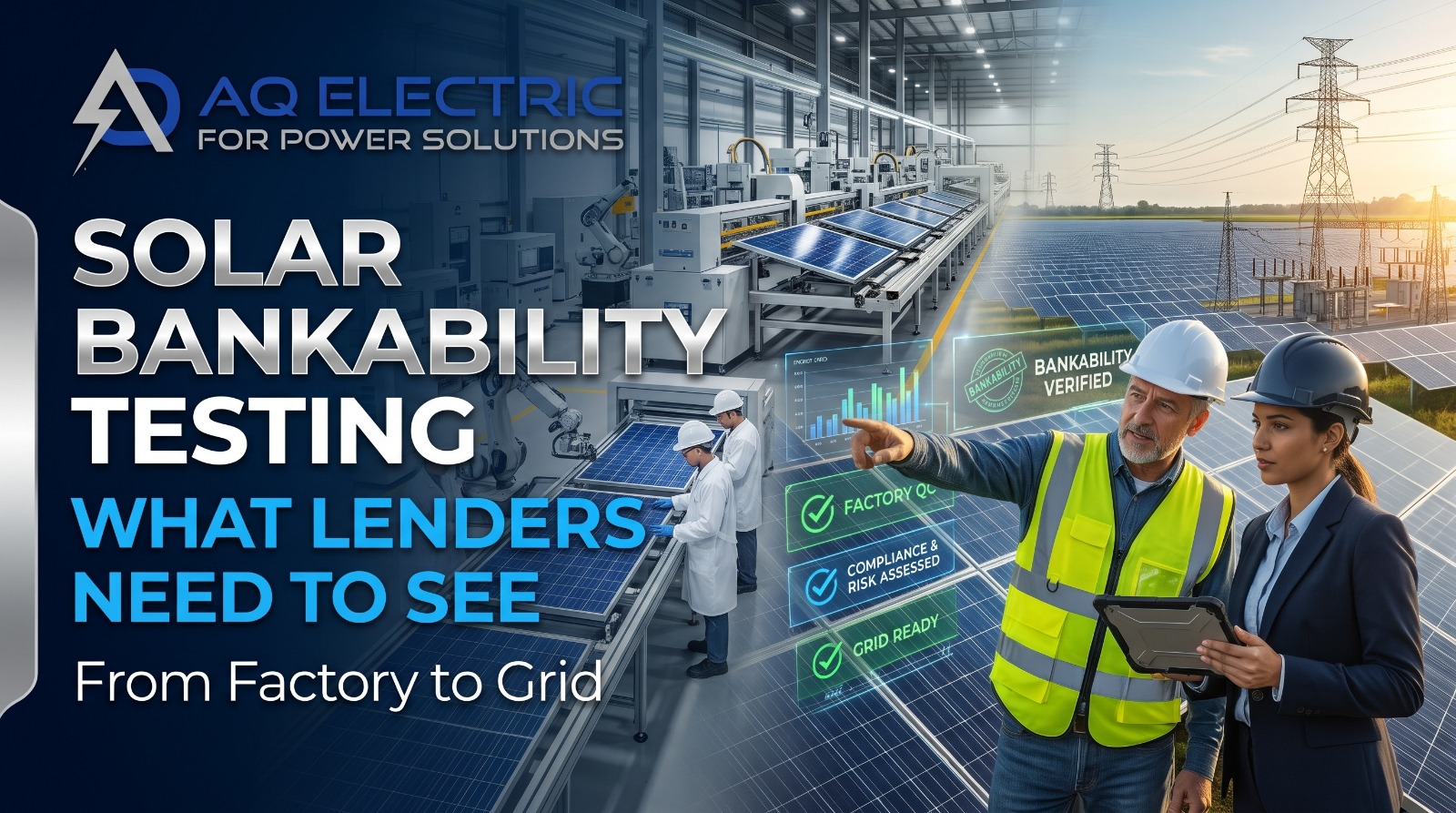
Batch-level verification closes the gap between the module that was tested and the module that is delivered. It is where solar bankability testing moves from the laboratory to the production line and the project site. Kiwa PVEL lists a manufacturing factory audit — incoming and outgoing inspection and a step-by-step production audit — among the six components of a typical bankability report, and TÜV Rheinland describes factory audits, batch testing, BOM verification, and pre-shipment electroluminescence inspection as the way to confirm that delivered modules keep their qualified quality.
What Batch Verification Covers
- Factory audit — quality systems, process controls, incoming material inspection, and calibration.
- BOM verification — confirming that cells, glass, encapsulant, backsheet or rear glass, junction box, and connectors match the approved bill of materials.
- Production witnessing — inspectors present during production of the project’s modules.
- Pre-shipment inspection — statistical sampling with visual inspection, flash testing, and EL imaging.
- Arrival inspection — checking for transport damage before modules are installed.
The need is real: Intertek CEA, which has carried out more than 80,000 quality inspections in over 340 module factories, reported that 71% of the factories it audited in 2025 were graded in its two lowest tiers. AQ Electric explains how factory and site acceptance testing work in its article on FAT vs SAT in solar PV projects, and how independent inspection protects owners and lenders in its article on third-party inspection for solar PV.
EL imaging is one of the most useful batch checks, because it reveals cracks and soldering defects invisible to the eye. AQ Electric explains the method in its article on electroluminescence EL testing for solar PV; for teams that run their own arrival checks, AQ Electric’s sister company EE Electronics supplies portable EL testing systems in Jordan.
Site, Commissioning, and Plant-Level Evidence
A plant built from excellent modules can still underperform if it is poorly designed, installed, or commissioned. Plant-level solar bankability testing therefore continues through construction and handover.
- Design review — independent review of string sizing, inverter loading, cabling, protection, and the yield model before construction.
- Construction quality — inspection of installation workmanship, module handling, and wiring.
- Commissioning tests — the IEC 62446-1 test sequence on every string, plus IV curve tracing and thermography under load, creating the baseline for the life of the plant. AQ Electric explains the sequence in its article on the solar PV commissioning process.
- Acceptance and performance tests — capacity or power performance index tests at completion and longer-term performance ratio tests, which lenders use to confirm that guarantees have been met. AQ Electric explains how these metrics are calculated in its article on the solar performance ratio.
Lenders’ advisors typically review or witness these tests before certifying completion and releasing drawdowns. Owners often appoint their own engineer to manage the same process from the owner’s side; see AQ Electric’s article on the owner’s engineer for solar PV projects.
Bankability of Operating Assets
Bankability does not end at commercial operation. When an operating plant is refinanced or sold, the new lender or buyer needs evidence that the asset is healthy and that its performance history supports the forecast. Typical evidence includes performance data analysed on a corrected basis, availability records, O&M history, and independent field inspection — aerial thermography of the whole plant, followed by IV curve tracing and EL on suspect areas. AQ Electric explains how this field evidence is gathered in its articles on drone inspection for solar PV plants and IV curve tracing for solar PV, and how buyers use it in its article on solar PV technical due diligence.
The Bankability Evidence Pack
The table below summarises the evidence that lenders and their advisors commonly look for at each stage, and who typically produces it.
| Stage | Evidence | Typically produced by |
|---|---|---|
| Product | IEC 61215 / IEC 61730 certificates; extended reliability test reports; independent PAN data | Certification bodies and accredited reliability laboratories |
| Manufacturer | Company evaluation, factory audit, warranty terms, track record | Independent engineer, inspection firms |
| Delivered batch | BOM verification, production witness reports, pre-shipment inspection with flash and EL data, arrival inspection | Third-party inspection and QA firms |
| Design | Design review, energy yield assessment with P50/P90 | Owner’s engineer, independent engineer |
| Construction and commissioning | Inspection reports, IEC 62446-1 test records, IV curves, thermography, punch lists | Independent testing and commissioning firms |
| Acceptance | Capacity / PPI and PR test reports against guarantees | EPC, witnessed by owner’s and lender’s advisors |
| Operation | Corrected performance history, availability, inspection campaigns | O&M provider, independent inspectors |
Bankability in the Gulf and MENA
Solar bankability testing in the region should reflect the conditions the plant will actually face. High UV exposure raises the importance of UV-induced degradation results for TOPCon and heterojunction modules; extreme heat makes thermal cycling and damp heat performance more relevant; and sandstorms, wind, and occasional hail make mechanical stress results worth examining. Long supply chains and very large module volumes make factory, pre-shipment, and arrival inspection particularly cost-effective.
The financing landscape is also changing. BloombergNEF reported that regional investors provided 85% of renewable energy financing in MENA in 2025, and development finance institutions and international banks remain active in many markets. As regional lenders take on more solar risk, the expectation of robust, independent evidence is rising with them. AQ Electric reviews the regional market in its MENA solar market outlook, and its experience in the Kingdom in its article on solar PV testing services in Saudi Arabia.
AQ Electric’s Solar Bankability Testing Services
AQ Electric for Power Solutions, founded in Jordan in 2019 and expanded to Egypt in 2021, provides the batch-level and plant-level parts of solar bankability testing across the MENA region. AQ Electric is a field testing and inspection company rather than a reliability laboratory, and it works alongside laboratory programmes by verifying that what reaches site, and what is built, matches what was tested and designed.
- Factory and arrival quality assurance — FAT witnessing, BOM checks, pre-shipment and site acceptance inspection through AQ Electric’s FAT and SAT quality assurance services.
- Independent inspection — construction and commissioning verification for owners and lenders through its third-party inspection services.
- Commissioning evidence — IEC 62446 testing, IV curve tracing, EL, and thermography through its testing and commissioning services.
- Design and yield support — design review and PVsyst energy yield reports through its engineering and consultation services.
Utility-scale experience
Evidence From Real Projects
AQ Electric’s engineers have delivered testing and commissioning on the 230 MWp Komombo plant in Aswan, Egypt, with China Energy Engineering Group (CEEC) and on the 120 MWp Wadi Ad Dawasir plant in Saudi Arabia with SEPCO – Power China, and thermal drone inspection for ACWA Power and NOMAC in Aswan — the kind of field evidence that lenders and their advisors rely on.
AQ Electric operates under an ISO 9001, ISO 14001, and ISO 45001-certified management system from offices in Amman, Jordan and New Cairo, Egypt, with more than 1.0 GW of PV project experience. For instruments used in field verification, EE Electronics explains the wider toolkit in its article on the solar PV tester. When selecting any independent testing provider, the criteria in AQ Electric’s article on how to choose a solar testing and commissioning partner apply. The project portfolio is on AQ Electric’s projects page.
Independent Evidence for Bankable Projects
AQ Electric’s quality, testing, and engineering services across the MENA region.
✓Quality Assurance (FAT & SAT)🔍Third-Party Inspection⚡Testing & Commissioning📐Engineering & Consultation🔬EL Testing📊IV Curve Tracing✉Speak to an Engineer
Frequently Asked Questions
What is solar bankability testing?
Solar bankability testing is the independent evidence that a PV project’s equipment and construction will perform as modelled over the financing term. It covers product testing (certification, extended reliability tests, PAN data), batch verification (factory audits, BOM checks, pre-shipment and arrival inspection), and plant-level evidence (commissioning, acceptance, and performance tests).
Does Tier 1 mean a solar module is bankable?
Not on its own. BloombergNEF’s Tier 1 classification is based on a manufacturer’s own-brand modules being used in six projects financed non-recourse by six different banks within two years. BloombergNEF describes it as a measure of industry acceptance, not quality.
Is IEC 61215 certification enough for bankability?
It is a minimum requirement, not proof of long-term durability. IEC 61215 screens for early failures, certification samples are chosen by manufacturers, and some components can change without recertification. Lenders increasingly expect extended reliability testing and batch verification as well.
What is extended reliability testing for solar modules?
Extended reliability testing subjects modules to longer and harsher stress sequences than IEC qualification — such as thermal cycling, damp heat, PID, LeTID, UV-induced degradation, mechanical stress, and hail — to approximate decades of field exposure. Programmes such as Kiwa PVEL’s PQP witness sample production and record the bill of materials.
Why does the bill of materials matter for bankability?
Test results apply to the specific materials used. If delivered modules use a different encapsulant, glass, cell, or junction box from the tested modules, the test evidence may not apply. BOM verification at the factory confirms that the delivered product matches the tested and approved one.
What is a PAN file and why do lenders care?
A PAN file describes a module’s electrical performance for energy simulation software such as PVsyst. Because the energy yield forecast drives the financial model, independently measured PAN data increases confidence in the P50 and P90 estimates that lenders use.
Which tests matter most for bankability in the Middle East?
UV-induced degradation, thermal cycling, damp heat, and mechanical stress results are especially relevant in high-UV, hot, and windy desert conditions, together with factory, pre-shipment, and arrival inspection for large imported module volumes.
Does AQ Electric provide solar bankability testing services in MENA?
AQ Electric provides the batch-level and plant-level parts of solar bankability testing across the MENA region — FAT and SAT, BOM and pre-shipment inspection, third-party inspection, commissioning tests, IV curve tracing, EL, thermography, and design and yield review — working alongside laboratory reliability programmes.
Make Your Project’s Bankability Case With Evidence
AQ Electric provides independent factory, site, and commissioning verification for solar projects across the MENA region — ISO-certified, with 1.0 GW of project experience alongside CEEC, SEPCO, Power China, ACWA Power, and NOMAC.