

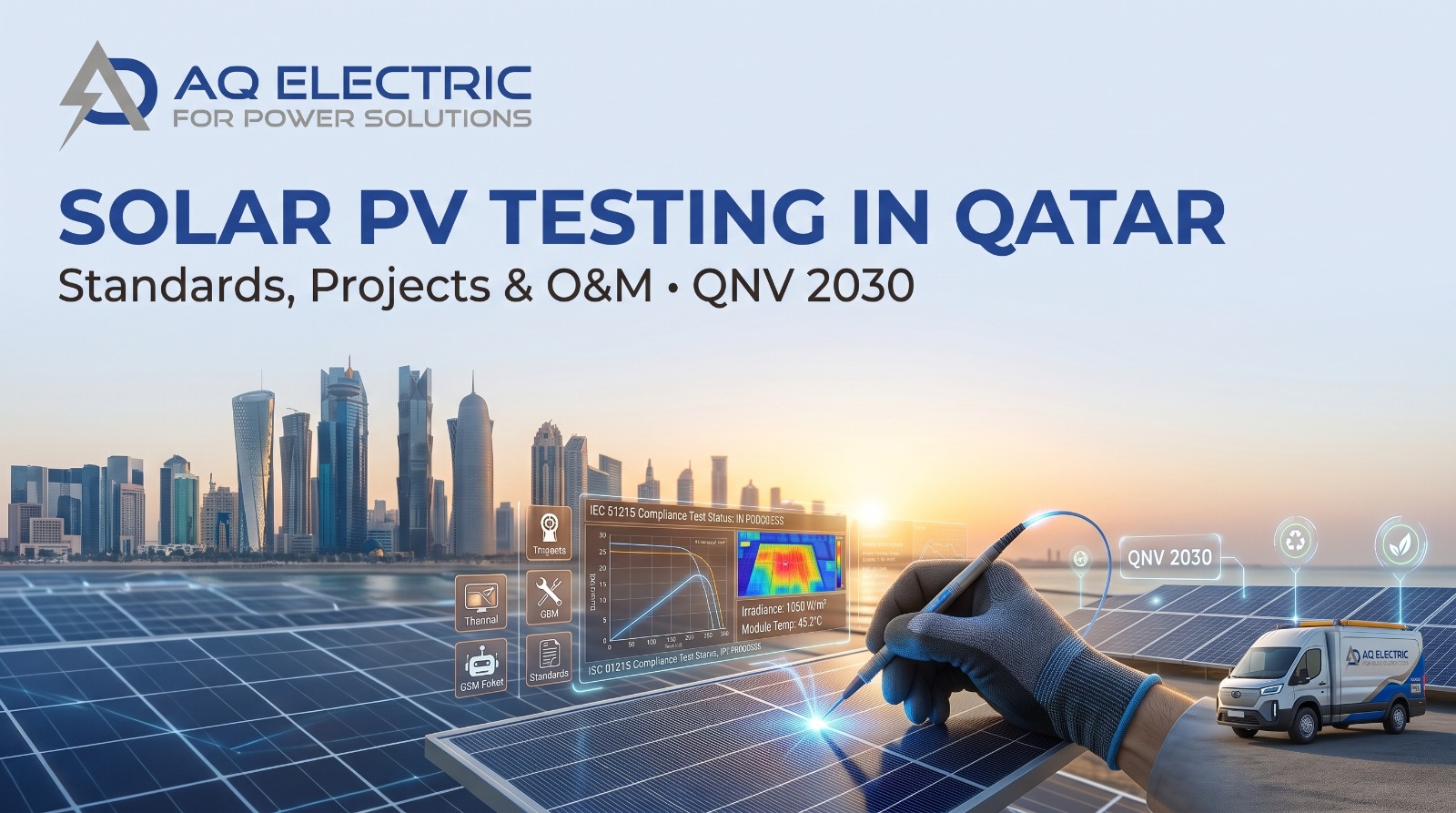
AQ Electric brings specialist solar testing services to the Qatari market backed by more than 1.0 GW of PV project experience across the MENA region — from the 120 MWp Wadi Ad Dawasir plant in neighbouring Saudi Arabia to the utility-scale solar clusters of Aswan, Egypt. As Qatar accelerates from its first large-scale solar plant toward a national target of 4,000 MW by 2030, the demand for rigorous, IEC-compliant solar PV testing services in Qatar — spanning commissioning, inspection, and long-term solar power plant operation and maintenance — is expanding rapidly. For every gigawatt QatarEnergy and KAHRAMAA bring online, the need for competent testing and O&M partners with proven Gulf-climate experience grows in step.
This guide explains everything an EPC contractor, IPP developer, asset owner, or lender’s technical advisor needs to understand about solar PV testing services in Qatar: the scale and structure of the Qatari solar market, the institutions and procurement framework, the landmark projects reshaping the national grid, why testing and solar power plant operation and maintenance matter especially in Qatar’s climate, how IEC 62446-1 applies in the Qatari context, and how AQ Electric delivers the full testing scope drawing on its proven regional track record. Whether you are commissioning a plant at Al Kharsaah, preparing for the 2 GW Dukhan development, or seeking a long-term O&M partner, this is the practical reference for getting solar testing right in the State of Qatar.
Qatar’s Solar Market and National Vision 2030
Qatar has moved decisively into utility-scale solar, transforming from a gas-dominated power system into an emerging solar market with world-class ambition. The nation’s solar journey is anchored in the Qatar National Vision 2030 (QNV 2030), whose fourth pillar — environmental development — calls for managing the environment in a manner that balances economic and social development with environmental protection. Solar energy is the centrepiece of that pillar, and it is generating growing demand for solar PV testing services in Qatar at every stage of the project lifecycle.
The numbers describe a market at an inflection point. Qatar’s solar journey began in October 2022 with the inauguration of the 800 MW Al Kharsaah plant — the country’s first large-scale solar power plant. In April 2025, the Ras Laffan and Mesaieed solar plants were formally inaugurated, adding a combined 875 MW and more than doubling Qatar’s solar production capacity to 1,675 MW. Together, these three plants supply around 15% of Qatar’s total peak electricity demand — a remarkable share for a country that still relies on gas-powered thermal plants for over 90% of its generation.
The trajectory ahead is even steeper. QatarEnergy’s sustainability strategy targets more than 4,000 MW of renewable energy capacity in operation by 2030, which would account for roughly 30% of Qatar’s total peak electricity demand. The centrepiece of reaching that target is the 2,000 MW Dukhan Solar Power Plant — set to become the largest single solar plant in Qatar and one of the largest in the Gulf. Every megawatt of this build-out requires commissioning, testing, and ongoing solar power plant operation and maintenance, making solar PV testing services in Qatar a structural, long-term requirement rather than a passing opportunity.
Renewable energy target by 2030
Current installed solar capacity
Dukhan — largest single plant, by 2029
AQ Electric MENA project experience
Landmark Qatari Solar Projects
Understanding the Qatari solar landscape means understanding its flagship projects — each of which represents a substantial requirement for solar PV testing services in Qatar and for long-term solar power plant operation and maintenance.
Al Kharsaah Solar Power Plant — 800 MW
Located in Qatar’s western desert about 80 km west of Doha, the Al Kharsaah plant is the country’s first and flagship large-scale solar project. Commissioned in October 2022, it covers 10 square kilometres, is equipped with more than 1.8 million bifacial solar panels on single-axis trackers, and has a production capacity of 800 MW — supplying electricity to roughly 60,000 homes and covering up to 10% of the nation’s peak electricity needs. It was developed by the Siraj 1 consortium (TotalEnergies and Marubeni holding 40%, with Siraj Energy — a QatarEnergy subsidiary — holding 60%) under a 25-year power purchase agreement with KAHRAMAA. Sited where solar irradiance consistently exceeds 2,000 kWh/m² annually, Al Kharsaah proved the viability of large-scale solar in Qatari conditions.
Ras Laffan and Mesaieed Solar Plants — 875 MW
Inaugurated in April 2025 and fully owned by QatarEnergy, the Ras Laffan and Mesaieed plants are purpose-built for Qatar’s industrial cities. The 458 MW Ras Laffan solar farm sits in Ras Laffan Industrial City in the north-east, while the 417 MW Mesaieed facility is located in Mesaieed Industrial City on the east coast, south of Doha. Both feature high-efficiency bifacial modules on single-axis trackers and use cleaning robots — a direct response to the region’s soiling challenge. Together they supply power to LNG liquefaction and petrochemical facilities, and are expected to cut carbon dioxide emissions by approximately 4.7 million tons annually. Plants of this scale, serving critical industrial loads, demand rigorous ongoing solar power plant operation and maintenance to protect availability.
Dukhan Solar Power Plant — 2 GW
Announced in 2024 and contracted to Samsung C&T as EPC, the Dukhan Solar Power Plant is Qatar’s most ambitious solar project yet. Located about 80 km west of Doha and developed in two phases, it will generate its first 1 GW toward the end of 2028 and reach its full 2 GW capacity by mid-2029. Once complete, Dukhan will double Qatar’s operational solar capacity and, alongside Al Kharsaah, Mesaieed, and Ras Laffan, help contribute up to 30% of Qatar’s total peak electricity demand. KAHRAMAA has already awarded over QAR 2.2 billion in grid-expansion contracts — including a new 400 kV substation, underground cables, and overhead transmission lines — to integrate Dukhan into the national grid. A project of this magnitude represents one of the largest single requirements for solar PV testing services in Qatar in the country’s history.
Energy Storage — 2 GW / 8 GWh by 2030
To manage the intermittency of its growing solar fleet, Qatar’s renewable strategy calls for around 2 GW / 8 GWh of battery energy storage by 2030, with the KAHRAMAA procurement process underway. Battery-integrated projects add new testing and commissioning requirements — battery management system checks, charge/discharge verification, and storage-grid integration testing — that a capable solar testing partner must be equipped to handle.
AQ Electric delivers testing, commissioning, and O&M across the Gulf — call +962 79 51 54 126 or use the enquiry form.
The Regulatory and Procurement Landscape
Delivering solar PV testing services in Qatar means working within a framework dominated by two state entities and their partners.
- QatarEnergy — the state-owned energy giant leading Qatar’s solar programme as developer and owner, directly or through subsidiaries. Its sustainability strategy sets the 4,000 MW-by-2030 target.
- KAHRAMAA — the Qatar General Electricity and Water Corporation is the sole power and water transmission and distribution operator, the offtaker for solar PPAs, and the entity building the grid infrastructure to integrate new solar capacity.
- Siraj Energy — a joint venture (QatarEnergy and KAHRAMAA) established to develop solar projects, the majority partner in the Al Kharsaah Siraj 1 consortium.
- International partners — TotalEnergies, Marubeni, and Samsung C&T are contracted across Qatar’s flagship solar projects, bringing global EPC and development expertise.
Qatar’s solar procurement has evolved through both the consortium/IPP model (Al Kharsaah, developed by Siraj 1 under a 25-year PPA with KAHRAMAA) and direct QatarEnergy ownership (Ras Laffan and Mesaieed). Across both structures, the technical standard expected for grid-connected commissioning converges on IEC 62446-1, and bankable projects require testing documentation that satisfies both KAHRAMAA’s technical requirements and, where international lenders are involved, their due-diligence standards. Solar PV testing services in Qatar must be documented to this bankable standard — a documentation fluency that AQ Electric brings from lender-financed projects across the region. Notably, Qatar’s energy leadership has emphasised building national expertise in the construction, operation, and maintenance of solar power plants — creating opportunities for specialist regional partners who can support and transfer that expertise.
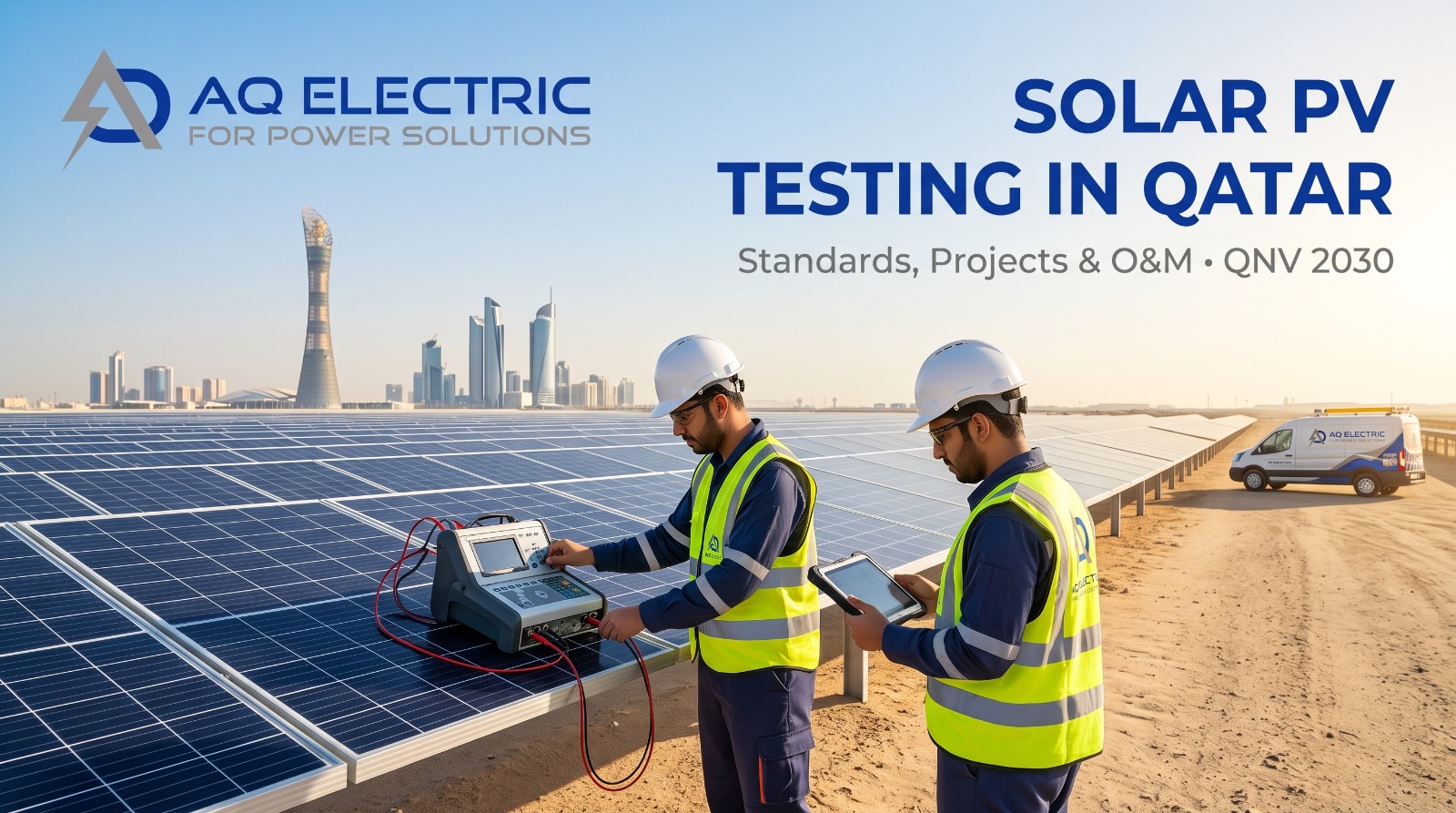
Where Qatari Solar Is Concentrated
Qatar’s solar capacity is concentrated in specific regions where resource, land, and grid or industrial demand converge — and understanding this geography is essential to understanding what solar PV testing services in Qatar need to be equipped for.
- Western desert (Al Kharsaah and Dukhan) — the heart of Qatar’s utility-scale solar, west of Doha, where irradiance exceeds 2,000 kWh/m² annually and vast land is available. Al Kharsaah operates here today; the 2 GW Dukhan plant will join it by 2029.
- Ras Laffan Industrial City (north-east) — home to the 458 MW Ras Laffan plant, integrated with Qatar’s LNG and petrochemical heartland.
- Mesaieed Industrial City (east coast) — site of the 417 MW Mesaieed plant, on the coast south of Doha, serving industrial loads.
- Distributed and rooftop solar — an emerging segment, with the national strategy contemplating around 200 MW of distributed rooftop solar to complement utility-scale capacity.
Each location presents its own operating environment. The western desert combines extreme heat with heavy dust; the coastal industrial sites at Mesaieed and Ras Laffan add humidity and salt exposure. A single national testing approach does not fit every site — regional familiarity and Gulf-climate experience matter, which is exactly what AQ Electric’s work across Saudi Arabia and Egypt provides.
Why Solar Testing Services Matter More in Qatar
The generic global playbook for solar testing was written around temperate operating environments. Applied unmodified to Qatar, it leaves critical risks unmanaged. AQ Electric’s experience across the Gulf — particularly on the Wadi Ad Dawasir project in neighbouring Saudi Arabia, whose climate closely mirrors Qatar’s — has produced a testing approach adapted specifically to these conditions.
Extreme Heat and Its Effect on Testing
Qatar experiences some of the highest sustained ambient temperatures of any solar market, with summer highs regularly exceeding 45 °C and module operating temperatures crossing 70 °C. This affects solar PV testing services in Qatar in two ways: expected values for open-circuit voltage and operating current must be temperature-corrected using Qatar-specific profiles rather than standard test conditions, and thermal stress reveals defects — hot connections, cell cracks, bypass diode failures — that would remain hidden in cooler climates.
Dust and Soiling
Soiling is one of the most significant Qatar-specific issues — so significant that both the Ras Laffan and Mesaieed plants were equipped with cleaning robots from the outset. Dust deposition can reduce module output substantially within days without cleaning. Soiling ratio measurement, cleaning-cycle optimisation, and post-cleaning performance verification are therefore core deliverables of solar PV testing services in Qatar — and central to effective solar power plant operation and maintenance in the country.
Coastal Humidity and Salt
Qatar’s peninsular geography means many solar sites — especially the industrial-city plants at Ras Laffan and Mesaieed — face humidity and salt-spray corrosion on structures, junction boxes, and combiner enclosures. Corrosion inspection becomes a critical periodic activity in these coastal environments.
Critical Industrial Loads
Because several Qatari solar plants directly supply LNG and petrochemical facilities, availability is exceptionally important — downtime affects not just electricity supply but industrial production. This raises the stakes for rigorous testing and disciplined solar power plant operation and maintenance.
The Full Scope of Solar PV Testing Services in Qatar
Comprehensive solar PV testing services in Qatar span the entire project lifecycle, from factory acceptance through commissioning to periodic operational testing. AQ Electric delivers the complete scope, drawing on field-proven methodology from across its 1.0 GW of regional project experience.
Testing and Commissioning
The core of solar PV testing services in Qatar is the commissioning test regime — visual inspection, earthing continuity, polarity verification, open-circuit voltage and operating current measurement, and insulation resistance testing on every string, all documented to IEC 62446-1. This is AQ Electric’s flagship testing and commissioning service.
IV Curve Tracing
IV curve tracing is the definitive diagnostic for identifying underperforming strings and pinpointing the specific fault mechanism. On large Qatari plants like Al Kharsaah and the forthcoming Dukhan, systematic IV curve tracing across the array is essential to verify the DC side is delivering full power. AQ Electric provides dedicated IV curve tracing services as a core part of its solar testing offering.
Thermographic and Drone Inspection
At Qatari project scale — where a single plant like Dukhan will hold millions of modules — aerial thermographic inspection by drone is the only practical way to scan for hot spots and connection faults within a commissioning or maintenance schedule. AQ Electric’s drone inspection services deliver rapid, comprehensive thermal assessment across utility-scale plants.
Electroluminescence (EL) Testing
For module-level defect detection — microcracks, cell breaks, and PID invisible to other tests — electroluminescence testing is the definitive tool, particularly valuable for warranty protection on the massive module populations of Qatari utility plants. AQ Electric provides on-site EL testing services integrated with its broader diagnostics.
Quality Assurance and Third-Party Inspection
Factory and Site Acceptance Testing verify equipment before and after installation, while independent inspection provides owners and lenders objective assurance. AQ Electric’s FAT and SAT services and independent verification protect Qatari projects from defective equipment and installation faults.
IEC 62446-1 in the Qatari Context
All credible solar PV testing services in Qatar anchor on the international standard IEC 62446-1, which defines the minimum testing, documentation, and inspection requirements for grid-connected PV systems. On every Gulf project, AQ Electric applies this standard as the baseline commissioning framework. For a full walkthrough of the standard and its three testing categories, see AQ Electric’s complete IEC 62446-1 article.
In the Qatari context, three considerations shape how the standard is applied: temperature-corrected expected values calculated against Qatar’s extreme summer temperatures; Category 2 testing (IV curve tracing and thermography) as the effective baseline for utility-scale projects rather than an optional extra; and multi-advisor documentation structured to satisfy KAHRAMAA’s technical requirements alongside international lenders’ technical advisors on consortium-financed projects such as Al Kharsaah.
Solar Power Plant Operation and Maintenance in Qatar
Solar PV testing services in Qatar do not end at commissioning. The longest and most financially significant phase of any plant’s life is its operational phase — and this is where solar power plant operation and maintenance becomes critical. Effective solar power plant operation and maintenance in Qatar’s harsh climate is the single most important factor in protecting a plant’s yield across its 25-to-30 year design life.
Solar power plant operation and maintenance encompasses the full set of activities required to keep a PV plant performing to specification: preventive maintenance, corrective repairs, and predictive condition-based maintenance driven by continuous monitoring data. In Qatar specifically, solar power plant operation and maintenance must contend with intense desert soiling, extreme heat-driven equipment stress, and — at coastal industrial sites — salt corrosion, making a well-designed O&M programme far more consequential than in temperate markets.
Why Solar Power Plant Operation and Maintenance Matters More in Qatar
The economics are clear. Poorly-maintained modules degrade two to three times faster than well-maintained ones. Soiling alone can reduce output substantially between cleaning cycles in the Qatari desert — which is exactly why Qatar’s newest plants deploy cleaning robots. Inverter thermal derating in Qatar’s summer conditions silently caps output at exactly the moment of peak generation. Each of these losses is preventable through a disciplined solar power plant operation and maintenance programme — and each, left unmanaged, compounds year after year to erode the returns of a plant that may have been perfectly built and commissioned.
The O&M Activities That Matter Most in Qatar
A comprehensive solar power plant operation and maintenance programme for a Qatari plant includes module cleaning optimisation, infrared thermographic scanning, IV curve tracing, inverter servicing, transformer testing, MV cable testing, and continuous performance monitoring with loss decomposition. AQ Electric delivers all of these through its solar operation and maintenance services. For a complete breakdown of what a best-practice solar power plant operation and maintenance programme involves across the MENA region, see our detailed solar O&M article.
The link between testing and solar power plant operation and maintenance is direct: the same disciplines applied at commissioning — IV curve tracing, thermography, insulation testing — are repeated periodically through the operational phase to catch degradation early. This is why AQ Electric integrates testing and solar power plant operation and maintenance into a single continuous assurance service rather than treating them as separate transactions — an approach especially valuable for Qatar’s early plants like Al Kharsaah that are now several years into operation.
Solar Power Plant Operation and Maintenance Across Qatar and the Gulf
Protect your plant’s yield with AQ Electric’s solar power plant operation and maintenance services — combining IV curve tracing, thermography, and continuous performance monitoring, delivered by ISO-certified engineers with 1.0 GW of regional experience and proven Gulf-climate expertise.
Challenges Unique to Qatari Solar Projects
Delivering solar PV testing services in Qatar and sustaining solar power plant operation and maintenance in the country means confronting a distinct set of challenges that AQ Electric’s regional experience has prepared it to address.
Extreme Heat and Thermal Management
Qatar’s summer conditions push every electrical component toward its thermal limits. Inverters derate, transformers lose headroom, and cable insulation ages faster. Testing must be scheduled around cooler windows for accuracy, and solar power plant operation and maintenance must prioritise cooling-system maintenance to prevent heat-driven output loss.
Desert Soiling and Cleaning Technology
Dust deposition in the western desert is relentless. Qatar’s newest plants deploy cleaning robots, but even robotic cleaning requires performance verification — confirming that cleaning is actually restoring output — and optimising cleaning frequency against cost. This is a specialist O&M skill that directly affects plant economics.
Battery Storage Integration
As Qatar procures around 2 GW / 8 GWh of battery storage by 2030, testing and commissioning scope expands to include battery management systems, charge/discharge verification, and storage-grid integration. A capable solar testing partner must be prepared for this added complexity.
Industrial-Load Reliability
With plants directly supplying LNG and petrochemical facilities, testing and O&M must meet the reliability expectations of critical industrial operations — where downtime carries costs far beyond lost electricity generation.
AQ Electric’s Regional Track Record
AQ Electric for Power Solutions, founded in Jordan in 2019 and expanded to Egypt in 2021, provides solar testing services across the MENA region and beyond, backed by over 1.0 GW of PV project experience and an ISO 9001, ISO 14001, and ISO 45001-certified management system. While Qatar represents a growth market for AQ Electric, our credibility rests on a proven regional track record delivered in climates and at scales directly comparable to the State of Qatar.
Regional Proof
Gulf and MENA Experience Directly Relevant to Qatar
The Gulf climate that challenges Qatari solar plants is the same climate AQ Electric has worked in across the region. Our experience translates directly to the demands of solar PV testing services in Qatar:
| Project | Location | Capacity | Relevance to Qatar |
|---|---|---|---|
| Wadi Ad Dawasir | Saudi Arabia | 120 MWp | Gulf desert climate, utility scale, SEPCO – Power China |
| Komombo | Aswan, Egypt | 230 MWp | Extreme heat & dust, large scale, CEEC |
| ACWA / ALCOM | Aswan, Egypt | 137 MWp | Thermal drone inspection, ACWA Power & NOMAC |
| SECI Projects | Aswan, Egypt | 115 MWp | Desert O&M, utility scale |
| Al Manakher | Amman, Jordan | 51.94 MWp | Utility-scale testing & commissioning |
This regional depth — proven clients, proven Gulf-climate experience, and proven utility scale — is what AQ Electric brings to every conversation about solar PV testing services in Qatar. Our client base includes names active across the entire Gulf, including SEPCO, Power China, CEEC, ACWA Power, and NOMAC. For the full portfolio, see our complete project list. For our perspective on neighbouring Gulf markets, see our guide to solar testing services in Saudi Arabia.
Choosing a Solar Testing Partner in Qatar
Selecting a provider of solar PV testing services in Qatar is a decision that shapes the bankability and long-term performance of the asset. Seven criteria consistently separate genuine specialists from generalists:
- Gulf climate experience. Proven work in comparable heat, dust, and coastal conditions — like AQ Electric’s Wadi Ad Dawasir project in Saudi Arabia and its Aswan portfolio in Egypt.
- ISO certifications. ISO 9001, ISO 14001, and ISO 45001 as a minimum. AQ Electric holds all three.
- IEC 62446-1 competency. Demonstrated with sample reports in the format the provider will deliver.
- Full in-house testing scope. Commissioning, IV curve tracing, EL testing, thermographic drone inspection, FAT/SAT, and solar power plant operation and maintenance delivered in-house, not subcontracted.
- Bankable documentation. A track record of reports accepted by lenders’ technical advisors and independent engineers.
- Recognised client relationships. AQ Electric’s clients include SEPCO, Power China, CEEC, ACWA Power, and NOMAC — names active across the Gulf.
- Integrated testing and O&M. A partner providing both commissioning testing and ongoing solar power plant operation and maintenance delivers continuous assurance across the plant’s life.
AQ Electric Solar Services for Qatar
Full-lifecycle testing, commissioning, and O&M — delivered across the Gulf.
⚡Testing & Commissioning🔧Operation & Maintenance📊IV Curve Tracing🔬EL Testing🚁Drone Inspection🔍Third-Party Inspection✓Quality Assurance (FAT & SAT)✉Speak to an Engineer
Frequently Asked Questions
What solar testing services does AQ Electric provide in Qatar?
AQ Electric provides the full scope of solar PV testing services in Qatar: testing and commissioning, IV curve tracing, electroluminescence (EL) testing, thermographic drone inspection, FAT and SAT quality assurance, third-party inspection, and solar power plant operation and maintenance — all to IEC 62446-1 standard, with over 1.0 GW of regional project experience.
What are Qatar’s main solar power plants?
Qatar’s flagship plants are Al Kharsaah (800 MW, operational since 2022), Ras Laffan (458 MW) and Mesaieed (417 MW) — inaugurated in 2025 — and the 2 GW Dukhan plant under construction by Samsung C&T, due to reach full capacity by 2029. Together they support Qatar’s 4,000 MW-by-2030 target.
Why is solar power plant operation and maintenance so important in Qatar?
Qatar’s extreme heat, heavy desert soiling, and coastal corrosion cause faster degradation and higher losses than temperate climates. Disciplined solar power plant operation and maintenance — cleaning optimisation, thermography, IV curve tracing, and inverter servicing — is essential to protect yield across the plant’s 25-year life.
How do Qatar’s climate conditions affect solar testing?
Extreme heat requires temperature-corrected expected values, desert dust imposes heavy soiling (hence the cleaning robots on Qatar’s newest plants), and coastal salt causes corrosion. Thermal stress also reveals defects invisible in cooler climates — making thermographic inspection especially valuable. AQ Electric’s Gulf experience means our testing is calibrated for exactly these conditions.
Who develops and operates solar projects in Qatar?
QatarEnergy leads Qatar’s solar programme as developer and owner, with KAHRAMAA as the offtaker and grid operator, and Siraj Energy (a QatarEnergy/KAHRAMAA joint venture) developing projects. International partners include TotalEnergies, Marubeni, and Samsung C&T.
Can AQ Electric handle large utility-scale Qatari solar plants?
Yes. AQ Electric has the equipment, manpower, and systematic methodology to test utility-scale plants, demonstrated on projects up to 230 MWp (Komombo, Egypt) and across 1.0 GW of regional experience — directly applicable to Qatar’s Al Kharsaah and Dukhan-scale plants.
Does AQ Electric test solar-plus-storage projects?
As Qatar procures around 2 GW / 8 GWh of battery storage by 2030, testing and commissioning scope expands to include battery integration. AQ Electric’s engineering team is equipped to support this added complexity alongside core PV testing.
Solar PV Testing Services in Qatar — Backed by Proven Gulf Experience
AQ Electric delivers IEC 62446-1-compliant solar testing services across Qatar — testing, commissioning, IV curve tracing, EL testing, inspection, and solar power plant operation and maintenance. Proven across 1.0 GW of MENA experience and trusted by SEPCO, Power China, CEEC, ACWA Power, and NOMAC.
MENA PV projects supported
MENA countries covered
ISO certifications9001 · 14001 · 45001
Founded in Jordan