

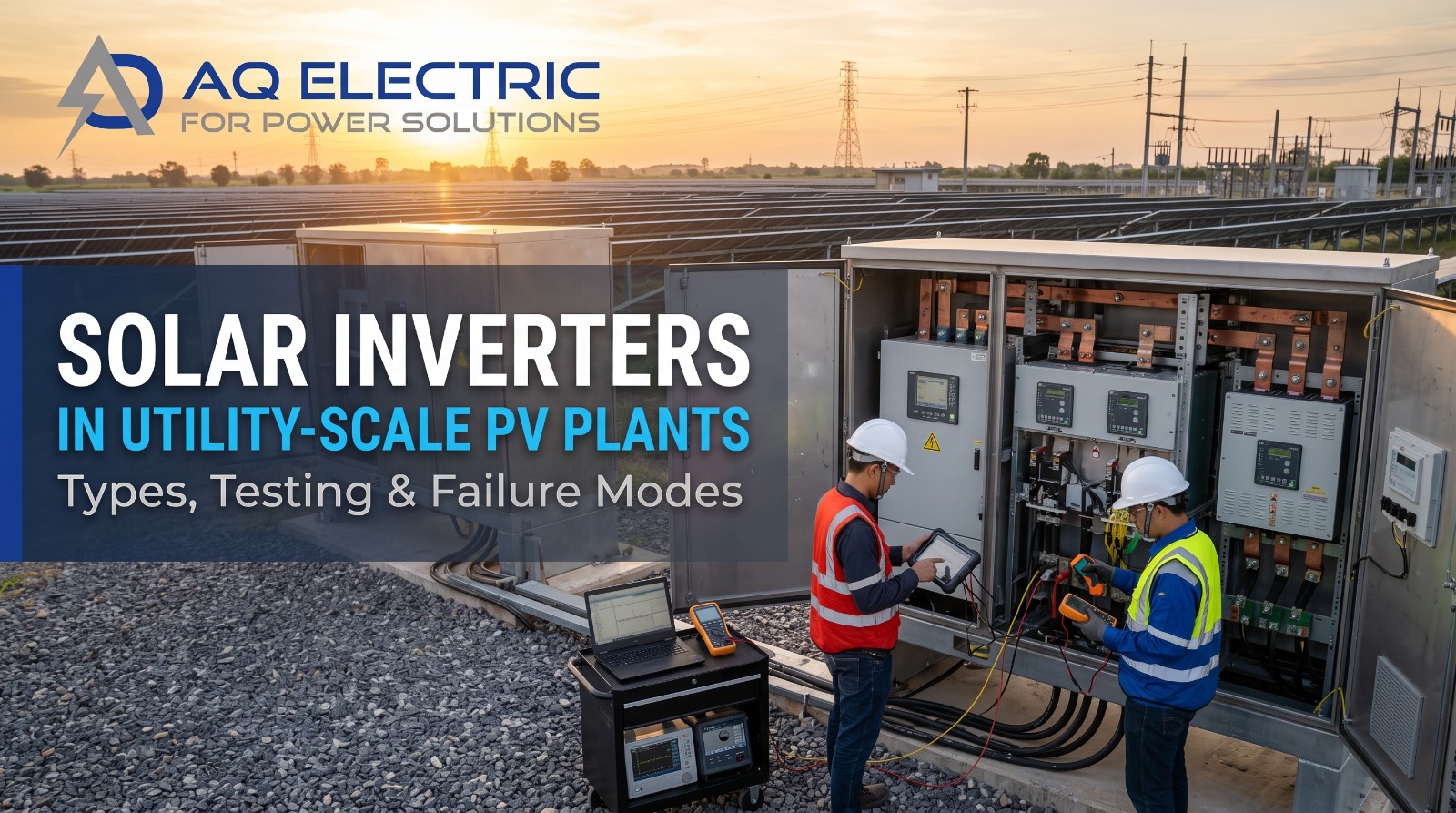
At AQ Electric, having delivered testing, commissioning, and O&M services on over 1.0 GW of solar PV projects across the MENA region, we have learned one truth about solar inverters that every asset owner eventually discovers: the inverter is where a solar plant most often loses money. Modules degrade slowly and predictably; transformers, if properly maintained, run for decades. But solar inverters — the beating heart of every photovoltaic plant — are the single largest source of unplanned downtime and energy loss on most sites. Understanding how they work, how they are tested, and how they fail is therefore central to protecting the return on any solar investment.
This guide draws on AQ Electric’s field experience across projects such as the Komombo 230 MWp plant in Aswan, the Wadi Ad Dawasir 120 MWp plant in Saudi Arabia, and dozens of others, to explain solar inverters from the ground up: what they do, the difference between central and string inverters, how inverter testing works within the IEC 62446-1 framework, how to read and diagnose inverter losses, the failure modes that most commonly take inverters offline, and how a disciplined O&M programme keeps them running. Whether you are an EPC contractor, an IPP owner, or an O&M manager, this is the practical reference on the most critical piece of active equipment in your plant.
What Solar Inverters Do
A solar inverter is the device that converts the direct current (DC) electricity generated by photovoltaic modules into the alternating current (AC) electricity that the grid requires. This is the inverter’s primary and defining function — but in a modern utility-scale plant, the solar inverter does a great deal more than simple DC-to-AC conversion.
Today’s grid-connected solar inverters also perform Maximum Power Point Tracking (MPPT) to extract the most possible energy from the array, provide grid-support functions such as reactive power control and voltage regulation, deliver fault ride-through capability to keep the plant connected during grid disturbances, and act as the primary data-gathering point for plant monitoring. When AQ Electric commissions a solar inverter, we are not simply confirming it converts DC to AC — we are verifying that every one of these functions performs to specification and to the grid code.
Because every watt the plant generates passes through a solar inverter, inverter performance directly determines plant revenue. A solar inverter operating even a few percentage points below its optimal efficiency, or tripping offline for even a few hours a month, represents lost energy that can never be recovered. This is precisely why inverter testing and inverter O&M are among the highest-value services AQ Electric provides to solar asset owners across the MENA region.
Central vs String vs Micro Inverters
Not all solar inverters are the same. The choice of inverter architecture shapes everything from plant layout and cabling to testing methodology and O&M strategy. There are three principal types of solar inverter, and understanding the differences is essential for anyone specifying, testing, or maintaining a PV plant.
Central Inverters
Central inverters are large, high-capacity solar inverters — typically rated from several hundred kilowatts up to several megawatts — that convert the DC output of many strings simultaneously. They are the traditional choice for large utility-scale plants, where a small number of central inverters housed in dedicated inverter stations serve the entire array. Central inverters offer the lowest cost per watt and are simpler to monitor as discrete units, but a single central inverter failure takes a large block of the plant offline at once — which is why central inverter testing and rapid-response O&M are so commercially important.
String Inverters
String inverters are smaller solar inverters — typically rated from a few kilowatts up to around 350 kW — that each handle the output of one or several strings. Modern utility-scale plants increasingly use large numbers of string inverters distributed across the array rather than a few central inverters. The distributed architecture means a single string inverter failure removes only a small fraction of plant capacity, improving overall availability. String inverters have become dominant in commercial and industrial installations and are increasingly common at utility scale. Their distributed nature changes the testing approach: instead of testing a handful of central units, AQ Electric’s field teams verify performance across a large population of distributed string inverters.
Microinverters
Microinverters are very small solar inverters mounted at individual module level, converting DC to AC right at the panel. They are used almost exclusively in residential and small commercial installations, where their module-level MPPT and monitoring granularity offer advantages. They are rarely seen in utility-scale plants and are consequently outside the main scope of most utility O&M contracts.
| Type | Typical rating | Best for | Failure impact |
|---|---|---|---|
| Central inverter | 500 kW – 5 MW+ | Large utility-scale plants | High — large block offline |
| String inverter | 3 kW – 350 kW | C&I and modern utility | Low — small fraction offline |
| Microinverter | 250 W – 2 kW | Residential, small C&I | Minimal — single module |
AQ Electric delivers inverter testing across central and string architectures throughout MENA — call +962 79 51 54 126.
Key Solar Inverter Specifications
When specifying or testing a solar inverter, a handful of parameters determine how well the inverter will perform in service. AQ Electric’s commissioning engineers verify each of these against the datasheet and the plant design during every inverter commissioning.
Rated Power and Nominal Power
The inverter’s nominal AC power output (in kW or MW) is its headline rating. Understanding the relationship between the inverter’s nominal power and the DC capacity of the array connected to it — the DC/AC ratio or “inverter loading ratio” — is critical, because it directly governs how much energy is clipped at peak production and how much loss occurs relative to nominal inverter power.
Efficiency and Euro/CEC Efficiency
A solar inverter’s efficiency describes how much of the DC power entering it emerges as usable AC. Peak efficiency figures above 98% or even 99% are common today, but the weighted “European efficiency” and “CEC efficiency” figures — which reflect real-world operation across a range of loads — are more meaningful for predicting actual yield.
MPPT Voltage Range and Number of MPPTs
The inverter’s MPPT operating voltage window must match the string design across the full temperature range of the site. The number of independent MPPT inputs determines how granularly the inverter can optimise different sections of the array — important where shading or orientation varies.
Maximum Input Current and Voltage
These limits constrain how many strings can connect to each input and how long strings can be. Exceeding them risks damage; falling short wastes inverter capability. AQ Electric’s string testing verifies that actual field values remain safely within these limits.
MPPT: How Inverters Maximise Yield
Maximum Power Point Tracking is the function that most directly determines how much energy a solar inverter harvests from the array. A PV array’s power output varies continuously with irradiance and temperature, and at any moment there is a specific combination of voltage and current — the maximum power point — at which the array delivers the most power. The inverter’s MPPT algorithm continuously adjusts its operating point to track this maximum as conditions change.
When MPPT works correctly, the solar inverter extracts nearly all the available energy. When it fails or performs poorly — because of a design mismatch between the string voltage and the MPPT window, a firmware issue, or a fault in one MPPT channel — the losses can be significant and are easily overlooked because the inverter appears to be operating normally. Detecting sub-optimal MPPT performance is one of the diagnostic capabilities AQ Electric brings to inverter testing and performance analysis, using IV curve tracing and performance-ratio verification to confirm the inverter is tracking correctly across all conditions.
Why MPPT matters for your revenue
A string connected to an MPPT input operating outside its optimal window can lose 5–15% of its potential yield — silently, every day, for years. Only systematic testing detects this. AQ Electric’s IV curve tracing and performance verification services are specifically designed to catch MPPT-related losses before they erode years of revenue.
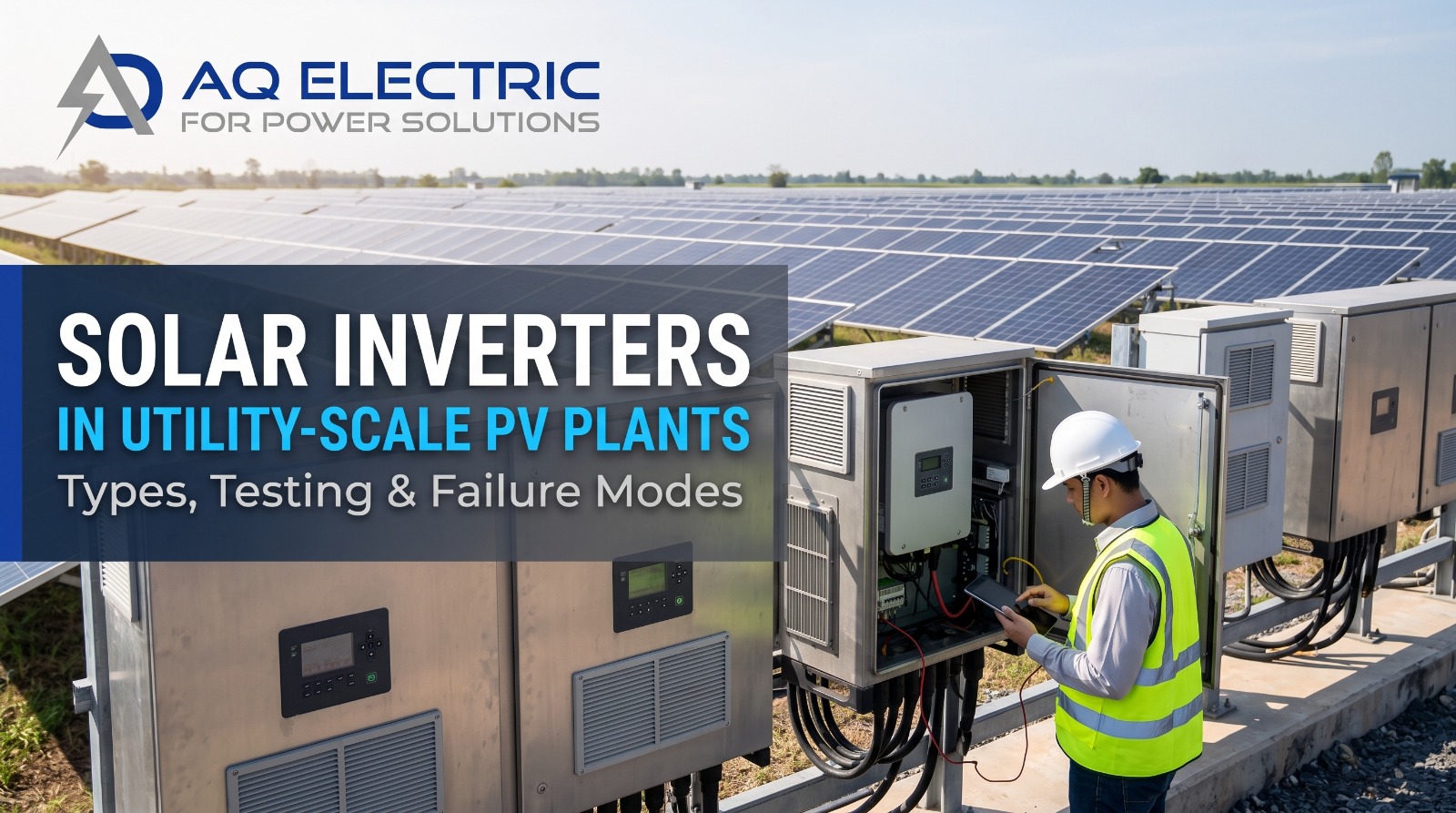
Understanding Solar Inverter Losses
Every solar inverter loses some energy in the DC-to-AC conversion process, and understanding the different categories of inverter loss is essential to diagnosing plant underperformance. AQ Electric’s performance analysis work routinely decomposes plant losses to isolate exactly how much is attributable to the inverter — information that directly informs whether an inverter needs service, replacement, or reconfiguration.
Conversion Loss
The most fundamental inverter loss is the conversion loss inherent in switching DC to AC. This is captured by the inverter’s efficiency rating and is unavoidable, though it varies with load — inverters are typically least efficient at very low loads.
Clipping Loss (Loss Over Nominal Inverter Power)
When the DC power available from the array exceeds the inverter’s nominal AC power rating — which happens deliberately in plants with a high DC/AC ratio — the inverter “clips” the excess, and that energy is lost. This inverter loss over nominal power is a designed trade-off: a higher DC/AC ratio captures more energy in low-light conditions at the cost of some clipping at peak. Quantifying clipping loss accurately is part of the performance analysis AQ Electric provides, helping owners understand whether their DC/AC ratio was optimally chosen.
Standby and Night Consumption
Solar inverters consume a small amount of power themselves, including overnight when they draw from the grid to keep control electronics alive. Over a year this is a minor but measurable loss.
Thermal Derating Loss
When a solar inverter overheats — a frequent occurrence in the MENA summer — it protects itself by derating, reducing its output below what the array could deliver. Thermal derating loss is one of the most significant and most preventable inverter losses in hot climates, and detecting it is a core part of AQ Electric’s inverter O&M service. Poor ventilation, blocked filters, or failed cooling fans all cause derating that a proper maintenance programme prevents.
Solar Inverter Testing and Commissioning
Solar inverter testing sits within the broader commissioning framework defined by the international standard IEC 62446-1. For a full walkthrough of that standard, see AQ Electric’s complete IEC 62446-1 guide. The inverter-specific elements of commissioning include the following stages, all of which AQ Electric delivers as part of its testing and commissioning services.
Pre-Energisation Inverter Checks
Before a solar inverter is energised, AQ Electric’s engineers verify the mechanical installation, DC and AC cable terminations and torque values, protective earthing, cooling-system installation, and the correspondence between the physical string connections and the design drawings. Errors caught here are trivial to fix; the same errors caught after energisation can mean equipment damage.
Functional and Grid-Interaction Testing
Once energised, the inverter is tested for correct start-up sequence, MPPT operation, grid synchronisation, reactive power control, and the protection functions mandated by the grid code — anti-islanding, frequency and voltage ride-through, and disconnection thresholds. These functional tests confirm the inverter behaves correctly not only in normal operation but during grid disturbances.
Performance Verification
AQ Electric verifies that each inverter is achieving its expected efficiency and that the strings connected to it are performing to specification, using string testing and IV curve tracing to confirm the DC side is delivering full power to the inverter input. This is where MPPT problems, string faults, and mismatch losses are caught. Our dedicated IV curve tracing services are central to this verification.
Thermographic Inspection
Infrared thermographic scanning of inverter cabinets, DC and AC terminations, and cooling systems under load reveals hot connections and cooling issues before they cause failures. This connects directly to AQ Electric’s drone inspection services for plant-wide thermal assessment.
Common Solar Inverter Failure Modes
From more than a decade of solar plant O&M and inverter testing across the MENA region, AQ Electric has catalogued the failure modes that most consistently take solar inverters offline. Recognising these patterns early is the difference between a scheduled repair and an emergency outage during peak generation.
1. Cooling System Failure
Fan failures, blocked air filters, and clogged heat sinks are the most common cause of solar inverter problems in hot climates. As cooling degrades, the inverter derates and eventually trips on over-temperature — almost always at midday when generation and ambient heat both peak. Regular filter cleaning and fan inspection, part of AQ Electric’s inverter O&M service, prevents the majority of these failures.
2. Capacitor Degradation
The DC-link capacitors inside a solar inverter degrade over time, accelerated by heat. Capacitor failure is one of the leading causes of inverter breakdown after several years of service, and its onset can be detected through monitoring and periodic inspection before catastrophic failure occurs.
3. IGBT and Power Module Failure
The insulated-gate bipolar transistors (IGBTs) that perform the actual DC-to-AC switching are subject to thermal cycling stress. Their failure is often sudden and takes the inverter fully offline. Thermal management and load-pattern monitoring reduce the risk.
4. DC Input and Connector Faults
Faults on the DC side — failed string fuses, degraded connectors, ground faults — present at the inverter as reduced input or fault codes. AQ Electric’s string testing and IV curve tracing isolate whether the problem is in the inverter or upstream in the array.
5. Grid-Side and Protection Trips
Solar inverters trip offline in response to grid disturbances — voltage sags, frequency excursions, or protection mis-coordination. Recurrent nuisance trips often indicate a protection-settings issue rather than an inverter fault, and diagnosing the difference requires proper commissioning records and functional testing.
6. Firmware and Control Faults
Modern solar inverters are sophisticated computers, and firmware bugs, configuration errors, and communication failures cause a meaningful share of inverter downtime. Keeping firmware current and configuration documented is a basic but frequently-neglected part of inverter O&M.
Solar Inverter O&M Best Practice
A disciplined solar inverter O&M programme is the single most effective way to protect inverter availability and, through it, plant revenue. AQ Electric’s inverter maintenance approach — delivered as part of our broader solar PV operation and maintenance services — is built around the following activities. For the plant-wide O&M context, see our complete solar O&M guide.
- Preventive cooling maintenance — scheduled filter cleaning, fan inspection, and heat-sink cleaning, timed around the seasonal heat profile of the site.
- Thermographic inspection — periodic infrared scanning of inverter cabinets and terminations under load to catch hot connections early.
- Firmware management — keeping inverter firmware current and configuration documented and backed up.
- Performance trending — continuous monitoring of each inverter’s efficiency, availability, and loss profile to detect gradual degradation.
- DC-side verification — periodic string testing and IV curve tracing to confirm the array is delivering full power to each inverter.
- Spare parts strategy — maintaining critical spares (fans, filters, fuses, control boards) to minimise repair time when failures occur.
Protect Your Inverter Fleet with Expert O&M
AQ Electric’s inverter testing and O&M services keep your solar inverters running at peak performance across their full service life. From commissioning to periodic maintenance, our ISO-certified engineers deliver measurable protection for your plant’s most critical active equipment.
Solar Inverters in MENA Conditions
Operating solar inverters in the MENA region introduces stresses that generic global guidance does not fully address — and it is precisely this regional expertise that AQ Electric brings to every inverter engagement across Jordan, Egypt, Saudi Arabia, and the wider Gulf.
Extreme Heat and Derating
With ambient temperatures exceeding 45 °C and inverter station internal temperatures rising higher still, thermal derating is the dominant inverter performance issue in the region. Inverters must be selected with adequate derating headroom, sited with proper ventilation, and maintained with rigorous attention to cooling. AQ Electric’s experience across Aswan’s Benban ecosystem and the Saudi interior has produced a detailed understanding of how different inverter models behave under sustained MENA heat.
Dust and Filter Fouling
Airborne dust rapidly fouls inverter air filters and cooling passages, accelerating the derating problem. In the MENA context, filter maintenance intervals must be far shorter than manufacturer defaults assume — a lesson AQ Electric applies across its O&M contracts.
Coastal Corrosion
At coastal sites such as Aqaba and the Red Sea and Gulf coastlines, salt air corrodes inverter enclosures, terminals, and cooling components. Inverter enclosure integrity and corrosion inspection become critical O&M activities in these environments.
How AQ Electric Supports Solar Inverter Testing & O&M
AQ Electric for Power Solutions, founded in Jordan in 2019 and expanded to Egypt in 2021, provides a comprehensive range of technical services for solar inverters and complete PV plants across the MENA region and beyond. With more than 1.0 GW of PV project experience and an ISO 9001, ISO 14001, and ISO 45001-certified management system, AQ Electric is the specialist testing and O&M partner trusted by the region’s leading developers and EPCs.
Our inverter-related services draw on real project experience, including:
- Komombo 230 MWp (Aswan, Egypt) — testing and commissioning support delivered for China Energy Engineering Group (CEEC).
- Wadi Ad Dawasir 120 MWp (Saudi Arabia) — testing and commissioning support delivered for SEPCO – Power China.
- ACWA 67 MWp, ALCOM 70 MWp, and TK 28 MWp (Aswan, Egypt) — thermal drone inspection and technical services delivered for ACWA Power & NOMAC.
- SECI Projects 115 MWp (Aswan, Egypt) — operation and maintenance programme support.
For solar inverters specifically, AQ Electric delivers pre-energisation inspection, functional and grid-interaction testing, performance verification through IV curve tracing, thermographic inspection via drone inspection services, and full lifecycle operation and maintenance. Every engagement is documented to IEC 62446-1 standard and structured to satisfy the requirements of international lenders and their technical advisors.
Whether you are commissioning a new plant, investigating inverter underperformance, or seeking a long-term O&M partner, AQ Electric’s engineering team has the equipment, the standards, and the regional field experience to protect your inverter fleet and maximise your plant’s output.
AQ Electric Solar PV Services
Full-lifecycle technical services for solar inverters and complete PV plants.
⚡Testing & Commissioning🔧Operation & Maintenance🔍Third-Party Inspection✓Quality Assurance (FAT & SAT)📐Engineering Services🚁Drone Inspection📊IV Curve Tracing✉Speak to an Engineer
Frequently Asked Questions
What is the difference between a central and a string solar inverter?
A central solar inverter is a large unit (500 kW to several MW) that converts the output of many strings at once, used in large utility plants. A string inverter is smaller (up to ~350 kW) and handles fewer strings, distributed across the array. String inverters reduce the impact of any single failure; central inverters offer lower cost per watt.
Why do solar inverters fail more often than other plant equipment?
Solar inverters contain active power electronics (IGBTs, capacitors, cooling systems) that experience continuous thermal cycling and heat stress, especially in MENA conditions. This makes them the most failure-prone major component. Proper O&M — particularly cooling maintenance — dramatically reduces failure rates.
What is inverter clipping or loss over nominal power?
When the array’s DC output exceeds the inverter’s nominal AC rating, the inverter limits (“clips”) output to its rated power and the excess is lost. This inverter loss over nominal power is a designed trade-off in high DC/AC-ratio plants. AQ Electric’s performance analysis quantifies clipping to confirm the DC/AC ratio was optimally chosen.
How often should solar inverters be maintained?
In MENA conditions, air filter cleaning and cooling inspection should be far more frequent than manufacturer defaults — often quarterly or more. Thermographic inspection twice a year and continuous performance monitoring complete a robust programme. AQ Electric tailors intervals to each site’s heat and dust profile.
Can AQ Electric test and commission solar inverters across the MENA region?
Yes. AQ Electric delivers inverter testing, commissioning, and O&M across Jordan, Egypt, Saudi Arabia, the UAE, Oman, Kuwait, and Qatar, with over 1.0 GW of project experience and ISO-certified processes. See our testing and commissioning services to learn more.
How do you diagnose whether a problem is in the inverter or the array?
AQ Electric uses IV curve tracing and string testing to verify the DC side is delivering full power to the inverter input. If the array is healthy but output is low, the issue is in the inverter or its MPPT; if the strings show faults, the problem is upstream. This isolation is central to effective inverter diagnostics.
The Heart of Your Solar Plant Deserves Expert Care
Solar inverters are the most critical — and most failure-prone — active equipment in your PV plant. AQ Electric delivers specialist inverter testing, commissioning, and O&M with ISO-certified processes and over 1.0 GW of PV project experience across the MENA region. Trusted by ACWA Power, NOMAC, SEPCO, CEEC, Wärtsilä, and Belectric.
PV projects supported
MENA countries covered
ISO certifications9001 · 14001 · 45001
Founded in Jordan