

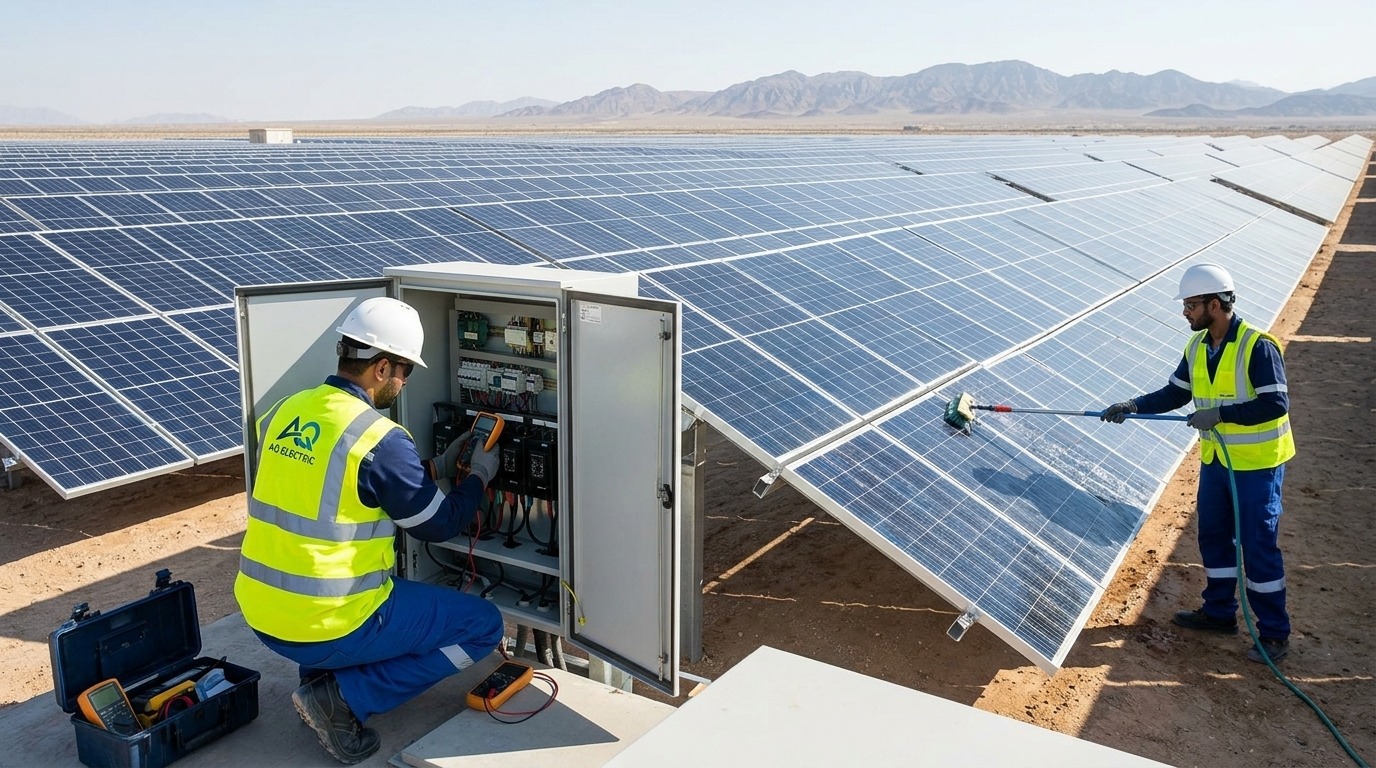
With more than 3 TW of solar PV capacity installed globally and the MENA region adding a record 12.2 GW in 2025 alone, the industry has crossed an important threshold: maintaining the fleet is now as commercially important as building it. Every megawatt on the ground needs continuous care to protect its yield — and every operator who neglects that care watches their revenue quietly leak away, year after year.
This guide is written for solar developers, EPC contractors, IPPs, and asset owners across the MENA region who want a clear, honest understanding of what solar PV plant operation and maintenance actually involves in 2026 — beyond the marketing language. We cover what O&M is, why it directly determines the ROI of your project, the specific activities that matter, the international standards you should demand (including IEC 62446-1), and the unique challenges of running plants in the harsh climate of Saudi Arabia, the UAE, Jordan, Egypt, Oman, and the wider Gulf.
What is Solar PV Operation and Maintenance?
Solar operation and maintenance (commonly abbreviated as O&M) refers to the full set of technical, engineering, and administrative activities required to keep a solar photovoltaic plant running at its designed performance level for the entire duration of its 25-to-30 year operating life. It is a fundamentally different discipline from installation or commissioning: while an EPC contractor builds the plant once, an O&M provider stewards it for decades.
In practice, the maintenance of a solar power plant covers everything from module cleaning schedules and thermal imaging inspections to inverter servicing, transformer testing, SCADA monitoring, warranty administration, spare-parts management, and regulatory reporting. A well-run O&M contract does not simply react to failures — it is a proactive program designed to prevent yield loss, extend equipment life, and preserve the bankability of the asset for its owners and lenders.
Modern solar O&M is typically split into two contract categories:
- Technical O&M — physical maintenance of the plant: preventive inspections, corrective repairs, cleaning, thermography, string testing, inverter and transformer servicing, and performance analysis.
- Commercial or Asset Management O&M — contract compliance, insurance claims, warranty enforcement, energy billing reconciliation, and reporting to lenders and regulators.
For large utility-scale plants, both are usually delivered by the same specialist provider under a single O&M agreement with KPI-guaranteed performance ratios and response-time SLAs.
Why O&M Determines Your Solar Investment ROI
The single most misunderstood fact in the solar industry is this: the value of a PV plant is not created at commissioning — it is preserved (or destroyed) during operation. A well-built plant with poor O&M will underperform a modestly-built plant with excellent O&M within five years. The numbers explain why.
Annual degradation of well-maintained modules
Degradation of poorly maintained modules per year
Soiling losses in Gulf/desert climates without cleaning
Typical yield loss from undetected string failures
These numbers compound. A plant losing 8% to string failures, another 10% to soiling, and 2% extra to accelerated degradation is producing 20% less energy than its financial model assumed — often the difference between meeting debt-service coverage ratios and defaulting on lender covenants. This is why lender’s technical advisors and independent engineers now insist on qualified O&M providers before approving project financing, and why serious IPPs treat the O&M contract as a first-tier procurement decision rather than an afterthought.
Bottom line
Every dollar spent on a competent O&M partner typically returns four to seven dollars in preserved energy yield over the life of the plant. It is one of the highest-return decisions the owner will ever make — and one of the most common to get wrong.
Get a free O&M readiness assessment from AQ Electric’s engineering team.
The Three Types of Solar O&M Services
Solar power plant maintenance is not a single activity. It is a layered program built from three complementary strategies, each with a different cost profile and a different role in protecting the asset. Understanding this hierarchy is essential when negotiating an O&M scope of work.
1. Preventive Maintenance
Preventive maintenance is scheduled, calendar-driven work performed regardless of whether a fault has occurred. It includes periodic visual inspections, module cleaning, torque checks on structural bolts, insulation resistance testing, and firmware updates. Its purpose is to keep the plant within its designed operating envelope and to catch small issues before they escalate. This category typically represents 60–70% of routine O&M activity by hours.
2. Corrective Maintenance
Corrective work is reactive: a fault occurs, an alarm is raised, a technician is dispatched, and the failure is repaired. Response-time SLAs (e.g., inverter fault repaired within 24 hours) are the core commercial metric here. A good corrective program depends on high-quality spare-parts inventory, trained field engineers, and remote diagnostic capability that reduces the number of truck rolls needed.
3. Predictive (Condition-Based) Maintenance
Predictive maintenance is the fastest-growing category and the one that most clearly separates specialist providers from generalists. It uses continuous monitoring data — inverter loss over nominal power, string current deviation, hotspot temperature trends, transformer oil analysis, and PR (performance ratio) drift — to anticipate failures before they happen. Techniques such as drone thermography, IV curve tracing, and electroluminescence testing are the diagnostic backbone of a predictive program.
| Type | Trigger | Typical activities | Best for |
|---|---|---|---|
| Preventive | Schedule-based | Cleaning, torque checks, IR testing, visual inspection | All plants, baseline requirement |
| Corrective | Fault or alarm | Inverter repair, string fault isolation, cable replacement | All plants, response SLA critical |
| Predictive | Data-driven | Thermography, IV curve tracing, EL testing, oil analysis | Utility-scale & bankable projects |
Core O&M Activities for Solar Power Plants
A comprehensive O&M program for a solar power plant covers roughly a dozen technical activities across the DC and AC sides of the plant. Below are the most impactful ones — the activities that most directly determine whether a plant meets its performance guarantees.
Module Cleaning and Soiling Management
In the Gulf, dust deposition can reduce module output by 1% per week during dry seasons. Cleaning frequency, water quality, cleaning method (dry brush, wet, or robotic), and scheduling around irradiance conditions all materially affect yield. A specialist O&M provider will design a soiling model unique to each plant based on measured soiling ratio data, not a generic schedule.
Thermography and Hot-Spot Detection
Infrared thermography, increasingly performed by drone at utility scale, identifies temperature anomalies that indicate cell failure, bypass diode issues, string mismatches, or connector faults. A single undetected hot-spot module can, over time, damage the entire string. Aerial thermography of a 100 MW plant that once required weeks of ground work is now completed in under two days by a qualified UAV team.
IV Curve Tracing and String Testing
IV curve tracing is the definitive test for identifying underperforming strings and diagnosing the specific fault mechanism — whether shading, mismatch, degradation, or wiring. Combined with routine string wiring checks and continuity tests, it provides the DC-side ground truth that monitoring data alone cannot deliver.
Inverter Servicing
Central and string inverters require regular filter cleaning, firmware updates, capacitor inspection, and cooling-system checks. Inverter downtime is the single largest source of unplanned energy loss at most plants — often exceeding module-related losses by an order of magnitude. Predictive analytics on inverter loss over nominal power is now a standard part of any serious O&M program.
Transformer Testing and Maintenance
The transformer in a solar power plant — whether an auxiliary transformer serving auxiliary loads or the main step-up solar transformer feeding the grid — is one of the most critical and most expensive components on site. A failed transformer for a solar power plant can take the entire plant offline for weeks. Maintenance includes annual oil sampling and DGA (dissolved gas analysis), insulation resistance testing, tap-changer inspection, and thermographic scanning under load. Solar system transformers deserve the same rigour applied to any HV asset.
MV Cable Testing (VLF)
Medium-voltage cables between combiner boxes, inverter stations, and the substation degrade slowly and fail suddenly — often at the worst possible moment. Very Low Frequency (VLF) testing is the industry-accepted method for detecting insulation weakness before it becomes a fault, and it should be part of every three-year maintenance cycle.
Monitoring and Performance Analysis
Modern O&M lives inside a monitoring platform. Data from inverters, string boxes, weather stations, and pyranometers is aggregated in real time and analysed against expected production models. Performance ratio (PR) verification, availability calculations, and loss decomposition (soiling, shading, DC, AC, MV, availability) are the output — and the basis for the monthly reports that owners and lenders require.
AQ Electric provides IV curve tracing, drone thermography, EL testing, and VLF services across the MENA region.
IEC 62446-1 and the Standards Your O&M Must Meet
Any credible O&M program should be anchored in international standards, not house rules. The most important of these for the solar industry is IEC 62446-1 — the international standard for grid-connected PV systems that defines the minimum documentation, inspection, and testing requirements for both commissioning and periodic maintenance.
The standard specifies three categories of inspection and testing that a qualified O&M team should perform on a regular schedule:
- Category 1 — Basic visual inspection and standard electrical tests (continuity, polarity, insulation resistance, string current and voltage).
- Category 2 — Additional tests including string I-V curve measurement and infrared inspection.
- Category 3 — Advanced diagnostic tests such as electroluminescence imaging and detailed thermography for larger or higher-risk plants.
Beyond IEC 62446-1, credible O&M providers also work to IEC 61724 (performance monitoring), IEC 61215 and IEC 61730 (module qualification), and quality-management systems such as ISO 9001, ISO 14001, and ISO 45001. When you evaluate an O&M contractor, ask which standards they operate under and which ones they hold current certifications for. A provider that cannot answer this question in one sentence is not a serious candidate.
Owner’s tip
Request a sample IEC 62446-1 test report from any O&M bidder as part of your RFP. The quality, completeness, and traceability of that document is the single best predictor of the quality of the O&M service you will receive.
Unique O&M Challenges in MENA Climate
Global O&M best practice does not translate directly to the Middle East. The MENA climate presents a distinct set of challenges that require O&M providers to adapt their protocols, staffing, and equipment selection in ways that European or East Asian playbooks simply do not cover.
Extreme Heat
Module operating temperatures in the Gulf routinely exceed 70°C, accelerating degradation, stressing inverters, and reducing the efficiency of every electrical component on site. O&M schedules must be built around cooler working windows (dawn, dusk, night), and inverter cooling systems require more frequent inspection than in temperate climates.
Dust, Sand, and Soiling
Soiling losses are the single largest MENA-specific issue. In Saudi Arabia, Kuwait, and Egypt’s Western Desert, soiling can reduce output by 25% or more within a few weeks without cleaning. Optimising the cleaning cycle — balancing cleaning cost against yield gain — is a specialist skill and one of the most valuable services a competent regional O&M partner brings.
Sandstorms and Abrasion
Beyond routine dust, sandstorms cause physical abrasion of the front glass over time, gradually reducing transmittance. Anti-reflective coating degradation, micro-scratching, and edge seal erosion all need to be monitored with EL testing and periodic module inspection.
Water Scarcity
Cleaning modules requires water — the one resource the Gulf has least of. Modern O&M in the region increasingly uses dry-brush and semi-dry robotic cleaning, or treated grey-water systems, to reduce consumption. Water-use planning is now part of the O&M design conversation from day one.
Humidity and Coastal Corrosion
Plants along the Red Sea, Arabian Gulf, and Mediterranean coasts face aggressive salt-spray corrosion on structures, junction boxes, and cable trays. Corrosion inspection of PV structures becomes a critical annual activity, and stainless-steel or galvanised hardware selection during EPC directly affects long-term O&M cost.
Case Study: Solar O&M in Jordan
Jordan was one of the earliest movers in Middle Eastern solar, launching its first utility-scale round in 2013 and building out roughly 2.1 GW of installed capacity across Amman, Aqaba, Karak, and Irbid governorates. As the first wave of Jordanian plants now reaches ten years of operation, the country has become an important real-world laboratory for regional O&M practice.
Jordan Project Portfolio
AQ Electric’s Jordan Track Record
Founded in Jordan in 2019, AQ Electric has delivered testing, commissioning, and ongoing technical services across major Jordanian solar sites in Amman, Aqaba, Karak, and Irbid. This home-market foundation gave the company its earliest exposure to full-lifecycle plant operations under real MENA conditions — before expanding into Egypt, Saudi Arabia, and beyond.
Working alongside partners including ACWA Power, NOMAC, Wärtsilä, Belectric, SEPCO, and Philadelphia Solar on more than 1.0 GW of cumulative PV project experience, AQ Electric’s engineering team has built a regional playbook for O&M that reflects lessons learned from projects operating in every climate zone from the Dead Sea basin to the Wadi Rum desert.
Three lessons stand out from a decade of Jordanian operation that apply to any O&M program in the region:
- Cleaning ROI is site-specific. A cleaning schedule optimised for Aqaba (coastal, low dust) is wrong for Ma’an (interior, high dust). The economics must be modelled per site.
- MV cable degradation appears earlier than expected. Plants five to seven years old are already showing insulation issues that VLF testing catches before failure.
- Transformer thermographic scanning under load is non-negotiable. Several Jordanian plants have avoided major transformer failures thanks to routine thermal imaging of their step-up units.
Solar O&M project in Jordan or the wider MENA region?
Speak to AQ Electric’s engineering team about your plant’s specific requirements — from bankable IEC 62446 testing to full-scope predictive O&M.
How to Choose a Solar O&M Partner
The right O&M partner is a multi-year commercial and technical relationship, not a commodity purchase. Six qualifying criteria should shape your shortlist:
1. Certifications and Standards Compliance
Look for ISO 9001 (quality), ISO 14001 (environmental), and ISO 45001 (occupational health & safety) at a minimum. IEC 62446-1 competency and IEC 61724 monitoring expertise should be demonstrated with sample reports.
2. Documented Track Record
Ask for cumulative GW of plants tested, commissioned, and maintained. Ask for named references — not logos on a slide, but people you can call. A serious provider will offer both.
3. Regional Presence and Response Capability
An O&M provider with technicians hours away, rather than days, is worth a significant premium in the total cost of ownership. Regional depots, warehouse of spares, and MENA-based engineering teams matter.
4. Diagnostic Capability
IV curve tracing, EL testing, drone thermography, and VLF cable testing should all be delivered in-house, not subcontracted. In-house capability is faster, cheaper, and produces higher-quality data.
5. Reporting Discipline
Monthly performance reports should include PR calculation, availability, energy loss decomposition, ticket log, and trend analysis. Ask to see a sample. The clarity of the report is the clarity of the thinking behind it.
6. Commercial Alignment
KPI-guaranteed availability, performance-linked incentives, and clear penalties for missed SLAs align the O&M provider’s interests with the owner’s. Fixed-fee contracts with no performance link are a warning sign.
Frequently Asked Questions
What is the typical cost of solar O&M in MENA?
Utility-scale solar O&M contracts in the MENA region typically range from USD 5 to USD 12 per kWp per year depending on plant size, location, scope, and inclusion of module cleaning. Larger plants achieve better unit economics.
How often should a solar PV plant be inspected?
Visual inspections should be monthly; full thermographic and IV curve inspection at least annually; VLF cable testing every three years; transformer DGA annually. IEC 62446-1 provides the reference schedule.
Can O&M be done in-house instead of outsourced?
It can, but rarely economically for utility-scale plants. Specialist providers spread equipment cost (drones, IV tracers, EL testers, VLF sets) and engineering capability across many plants, delivering higher quality at lower unit cost than a single-plant in-house team.
What is the difference between O&M and asset management?
O&M is the technical stewardship of the physical plant. Asset management is the commercial stewardship of the project as a financial asset — insurance, tax, refinancing, exit planning. They complement each other and are often bundled.
Does solar O&M require IEC 62446-1 certification?
IEC 62446-1 is a standard rather than a certification, but a qualified O&M provider should be able to demonstrate that their inspection and testing procedures comply with it in full. Most bankable projects now require this.
Ready to protect your solar investment?
AQ Electric provides ISO-certified solar PV testing, commissioning, and O&M services across Jordan, Egypt, Saudi Arabia, the UAE, Oman, Kuwait, and Qatar. Over 1.0 GW of project experience with the region’s leading developers, EPCs, and IPPs.
of PV projects supported
MENA countries covered
14001 · 45001
Certified management systems
Trusted since — founded in Jordan