

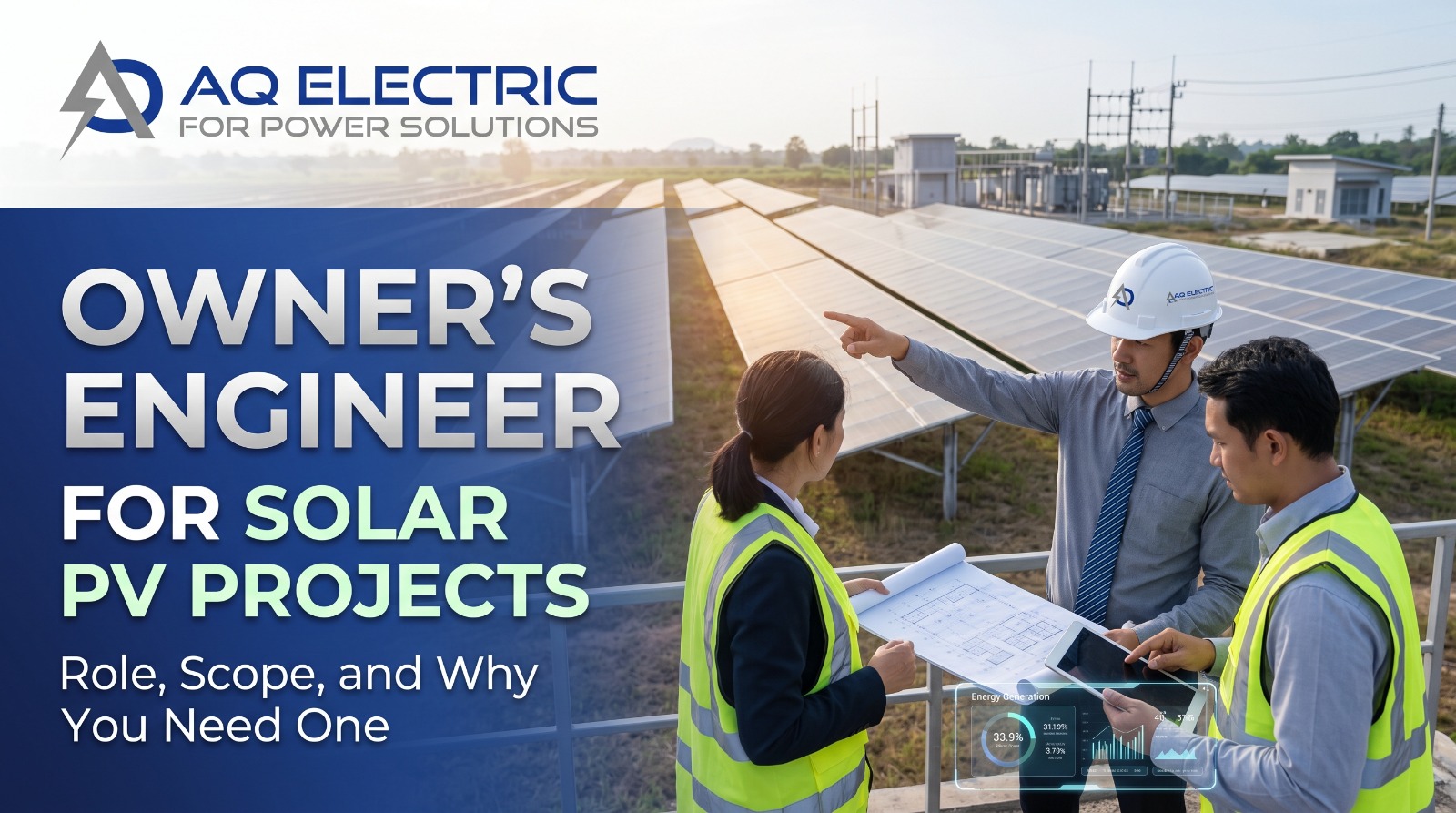
AQ Electric provides owner’s engineering support for solar PV projects across the MENA region, and the reason owners appoint us is always the same: on a solar project, everyone at the table works for someone — the EPC contractor for its margin, the manufacturer for its sales, the lender for its loan — and the owner needs one technical team that works only for the owner. An owner’s engineer for solar PV is that team. With more than 1.0 GW of PV project experience across Jordan, Egypt, and Saudi Arabia, AQ Electric’s engineers act as the owner’s independent technical representative from site survey and design review through construction supervision, commissioning, and the move into operation.
Key takeaways
An owner’s engineer (OE) for solar PV is an independent engineering firm appointed by the project owner or developer to protect the owner’s technical and commercial interests across the project lifecycle. The OE reviews designs, supports tendering and contractor selection, supervises construction quality, witnesses testing and commissioning, and prepares the plant for operation. Most utility-scale solar plants are built under EPC turnkey contracts, which under the widely used FIDIC Silver Book have no independent Engineer — so an owner who wants independent technical oversight has to appoint it. The OE is different from the lender’s technical advisor, who works for the bank, and from the EPC’s own quality team, which works for the contractor.
What Is an Owner’s Engineer for Solar PV?
An owner’s engineer for solar PV is an independent technical advisor appointed by a project owner, developer, or investor to represent the owner’s interests throughout the life of a solar project. The owner’s engineer does not design and build the plant — that is the EPC contractor’s job — and it does not finance it. Its role is to make sure that what the owner is paying for is what the owner actually receives: a plant that is well designed, competently procured, properly built, fully tested, and ready to perform for 25 years or more.
In practice, an owner’s engineer for solar PV works across the full project lifecycle: assessing sites and feasibility, reviewing preliminary and detailed designs, preparing technical specifications and supporting the selection of contractors and suppliers, supervising construction quality, witnessing factory, site, and commissioning tests, assisting with energisation and grid connection, and planning the operation and maintenance phase. Industry leaders such as DNV describe owner’s engineering in very similar terms, from request-for-proposal development and design review through construction monitoring, factory inspections, site inspections, commissioning, take-over, and punch-listing.
The defining feature is independence. The owner’s engineer is paid by the owner, reports to the owner, and has no financial interest in the EPC contractor’s margin or the equipment supplier’s sales. That independence is what gives its findings weight in negotiations, disputes, and acceptance decisions.
Why Solar Owners Need Their Own Engineer
Owners need an owner’s engineer for solar PV because the information gap between owner and contractor is large, the money involved is large, and the consequences of getting it wrong last for decades.
The Information Gap
An EPC contractor builds solar plants for a living and knows every technical detail of its own design, equipment choices, and construction methods. Many owners — investment funds, industrial companies, developers moving into a new market — do not have an in-house engineering team with the same depth. Without independent expertise, the owner cannot judge whether a design shortcut, an equipment substitution, or a commissioning result is acceptable.
Conflicting Incentives
Under a fixed-price contract, every cost the EPC saves improves its margin. Most contractors are professional and reputable, but the incentive structure means the owner should not rely on the contractor to police itself. An owner’s engineer for solar PV provides the counterweight.
Defects Are Built In Early
Independent industry data shows how much is at stake. Raptor Maps’ 2026 Global Solar Report, based on 373 GW of inspection data, observed an average power loss of 4.46% already present at commissioning — losses created during design, procurement, and construction, exactly the phases an owner’s engineer oversees. On a utility-scale plant, a few percentage points of permanent underperformance can outweigh the entire cost of independent engineering many times over.

The Contract Gap: FIDIC and EPC Turnkey Projects
One of the strongest arguments for appointing an owner’s engineer for solar PV comes from how solar plants are contracted.
Many international construction projects use FIDIC standard forms of contract. Under the FIDIC Red Book (employer-designed works) and Yellow Book (plant and design-build), an independent Engineer administers the contract, makes determinations, and acts as a technical check between the employer and the contractor. Under the FIDIC Silver Book — the form designed for EPC turnkey projects, where a single contractor takes responsibility for design, procurement, and construction — there is no independent Engineer. Instead, the employer appoints an Employer’s Representative, and FIDIC’s own description of the 1999 Silver Book notes that this representative is not required to act impartially.
Utility-scale solar plants are very often delivered on an EPC turnkey basis because owners and lenders want price and schedule certainty. The trade-off is that the owner has less control over the design and execution, and the contract itself does not provide an independent technical check. Owners commonly fill that gap by appointing their engineer to act as, or to support, the Employer’s Representative. In other words, under turnkey contracting, independent technical oversight is not automatic — the owner has to choose it.
Why this matters
Turnkey contracting transfers design and construction risk to the EPC — but it also removes the independent Engineer that other contract forms provide. An owner’s engineer for solar PV is how owners restore independent technical oversight on turnkey projects.
Owner’s Engineer vs Lender’s Technical Advisor vs EPC
A solar project often has several technical parties at once. Confusion about who does what is common, so the distinctions are worth setting out clearly.
| Party | Works for | Main objective | Typical scope |
|---|---|---|---|
| Owner’s engineer | The owner / developer | Protect the owner’s technical and commercial interests | Feasibility, design review, tendering, construction supervision, testing witness, handover, O&M planning |
| Lender’s technical advisor | The lender / bank | Protect the lender’s capital and confirm bankability | Due diligence, yield review, construction monitoring for drawdowns, completion certification |
| EPC contractor | Itself, under contract to the owner | Deliver the plant to contract at a profit | Design, procurement, construction, commissioning |
| Third-party inspector | Whoever appoints it (often owner or lender) | Independent verification of quality at defined stages | Factory inspection, construction audits, commissioning witness, safety audits |
The owner’s engineer and the lender’s technical advisor often work on the same project in parallel and review many of the same documents, but they answer to different clients and ask different questions. The owner’s engineer asks whether the plant is the best the owner can get for the money. The lender’s technical advisor asks whether the plant is safe to lend against. For more on the lender’s side, see AQ Electric’s article on the lender’s technical advisor for solar PV projects.
Third-party inspection overlaps with owner’s engineering but is narrower: it verifies quality at defined points, while the owner’s engineer manages the owner’s technical position across the whole project. AQ Electric explains that service in its article on third-party inspection for solar PV.
The Owner’s Engineer Scope Across the Lifecycle
The scope of an owner’s engineer for solar PV follows the project from the first site visit to the start of commercial operation. The stages below reflect how AQ Electric structures its full consultation services.
1. Site Survey and Feasibility Study
The owner’s engineer assesses the site — topography, access, soil and drainage, shading, and grid-connection options — and reviews or prepares the feasibility study, including the solar resource, preliminary layout, and energy yield estimate. In the MENA region, this stage must apply realistic assumptions for heat, soiling, and coastal corrosion; optimistic assumptions at feasibility become financial disappointments in operation.
2. Conceptual and Detailed Design Review
Whether the design is prepared by the owner’s team or the EPC, the owner’s engineer reviews it independently: string sizing across the full site temperature range, inverter loading ratio, cable sizing and voltage drop, protection and earthing, structures and foundations, and the energy yield model. Design review is where many permanent losses can still be removed at almost no cost.
3. Tender and Contractor Selection Support
The owner’s engineer helps prepare the technical specifications and employer’s requirements, evaluates bids technically, compares equipment proposals, and identifies gaps or risks in contractors’ offers. A precise technical specification is the owner’s most powerful tool: under a turnkey contract, anything the specification does not require, the contractor is not obliged to provide.
4. Installation Supervision and Quality Control
During construction, the owner’s engineer becomes the owner’s eyes on site: monitoring progress against schedule, auditing workmanship and materials, verifying compliance with approved drawings, reviewing method statements, and managing punch lists and non-conformance reports. Equipment quality is checked at the factory and on arrival through factory and site acceptance testing, delivered by AQ Electric through its FAT and SAT quality assurance services.
5. Testing and Commissioning Support
The owner’s engineer reviews commissioning procedures, witnesses tests, and checks results against expected values and acceptance criteria — including IEC 62446-1 commissioning testing for the PV array. For the standard behind these tests, see AQ Electric’s IEC 62446-1 article. Where the owner wants the testing itself carried out by an independent team, AQ Electric delivers it through its testing and commissioning services.
6. Energisation and Grid Connection Assistance
The owner’s engineer supports the interface with the grid operator and offtaker, reviews protection settings and grid-code compliance testing, and confirms that the plant is safe and ready to energise. This stage often runs on a tight timeline, and delays can be expensive.
7. Operation and Maintenance Planning
Before handover, the owner’s engineer reviews the as-built documentation, warranties, spare-parts lists, and the O&M contract, and helps the owner plan the operational phase — including performance guarantees and the testing regime that will protect yield over the plant’s life. For what a strong operational programme involves, see AQ Electric’s article on solar PV plant operation and maintenance.
Put an independent engineering team on the owner’s side — call +962 79 51 54 126.
What an Owner’s Engineer Delivers
The value of an owner’s engineer for solar PV is visible in its deliverables. Typical outputs include:
- Feasibility and site assessment reports — site conditions, resource, preliminary layout, and yield.
- Design review reports — comments on drawings, calculations, and yield models, tracked until resolved.
- Technical specifications and bid evaluations — employer’s requirements and technical comparison of offers.
- Inspection reports and NCR registers — findings from factory, site, and construction inspections, with close-out status.
- Progress reports — schedule, quality, and risk status for the owner and investment committee.
- Test witness reports — FAT, SAT, and commissioning results reviewed against acceptance criteria.
- Punch lists and completion recommendations — what must be fixed before the owner accepts the plant.
- Handover and O&M readiness review — documentation, warranties, and operational planning.
When You Need an Owner’s Engineer
Not every solar project needs a full-scope owner’s engineer. But the case becomes strong in the following situations:
- Utility-scale or large C&I projects, where the investment and the cost of permanent underperformance are high.
- EPC turnkey contracts, where the contract form does not include an independent Engineer.
- Owners without a large in-house engineering team, such as investment funds, industrial companies, and developers entering a new market.
- Projects in demanding climates, where design and equipment choices for heat, dust, and corrosion matter more.
- Projects with complex interfaces, such as substations, storage, or multiple contractors.
- Projects heading for sale or refinancing, where a strong independent quality record supports value later; see AQ Electric’s article on solar PV technical due diligence.
Owners do not have to choose between everything and nothing. The scope can be tailored — for example, design review and commissioning witness only, or full lifecycle support — depending on the owner’s in-house capability and risk appetite.
How to Choose an Owner’s Engineer
An owner’s engineer for solar PV is only as valuable as its independence and expertise. When selecting one, look for:
- Genuine independence — no commercial ties to the EPC contractor or equipment suppliers on your project.
- Solar-specific experience — named utility-scale projects, not general construction experience.
- Regional experience — familiarity with local climate, grid codes, offtakers, and lender expectations.
- In-house testing capability — the ability to verify findings with measurement (IV curve tracing, thermography, electroluminescence), not only by visual inspection.
- Lifecycle coverage — design, procurement, construction, commissioning, and O&M expertise in one team.
- Certified management systems — ISO 9001, ISO 14001, and ISO 45001 as evidence of systematic quality, environmental, and safety management.
- Clear reporting — a sample report that shows how findings are evidenced and tracked to close-out.
Many of the same criteria apply to choosing a testing partner; AQ Electric covers them in its article on how to choose a solar testing and commissioning partner.
Owner’s Engineering in the Gulf and MENA
The Gulf and wider MENA region are building some of the world’s largest solar plants, and several regional factors make independent owner’s engineering especially valuable.
Turnkey Contracting at Gigawatt Scale
Large regional projects are typically delivered as EPC turnkey packages on tight schedules. The combination of scale, speed, and limited contractual oversight increases the value of an independent technical representative on the owner’s side.
Climate-Specific Design Decisions
Extreme heat, heavy soiling, sandstorms, and coastal salt exposure affect string design, inverter derating, cable sizing, cleaning strategy, and corrosion protection. An owner’s engineer with regional experience can challenge design assumptions that would be acceptable in temperate markets but costly in the desert.
Imported Equipment and Long Supply Chains
Most modules, inverters, and many transformers are imported from overseas. Factory inspection, pre-shipment checks, and arrival inspection become central to the owner’s engineer’s role.
Multiple Stakeholders
Regional projects frequently involve state offtakers, development finance institutions, international EPCs, and local partners. The owner’s engineer helps the owner manage technical interfaces across all of them. For a picture of one major regional market, see AQ Electric’s article on solar testing services in Egypt.
AQ Electric’s Owner’s Engineering Support
AQ Electric for Power Solutions, founded in Jordan in 2019 and expanded to Egypt in 2021, provides owner’s engineering support for solar PV projects through its full consultation services, covering every stage described in this article: site survey and feasibility study, conceptual and detailed design review, tender and contractor selection support, installation supervision and quality control, testing and commissioning support, energisation and grid connection assistance, and operation and maintenance planning. AQ Electric also provides back-office PV design — including PVsyst energy yield reports, single-line diagrams, layouts, and bills of materials — and tendering support for developers and EPCs.
What sets AQ Electric apart as an owner’s engineer for solar PV is that its engineers come from the field. The company has supported China Energy Engineering Group (CEEC) with testing and commissioning on the 230 MWp Komombo plant in Aswan, Egypt; supported SEPCO – Power China on the 120 MWp Wadi Ad Dawasir plant in Saudi Arabia; and delivered thermal drone inspection for ACWA Power and NOMAC on utility-scale plants in Aswan. Because AQ Electric performs commissioning testing, IV curve tracing, electroluminescence imaging, and thermography in-house, its owner’s engineering findings can be verified with measurement rather than opinion. The full list is on AQ Electric’s projects page.
AQ Electric operates under an ISO 9001, ISO 14001, and ISO 45001-certified management system, with offices in Amman, Jordan and New Cairo, Egypt, and more than 1.0 GW of PV project experience across the region. To scope owner’s engineering support for your project, explore AQ Electric’s solar PV engineering and consultation services.
Independent Engineering on the Owner’s Side
AQ Electric’s lifecycle services across the MENA region.
📐Engineering & Consultation🔍Third-Party Inspection✓Quality Assurance (FAT & SAT)⚡Testing & Commissioning🔧Operation & Maintenance🎓Training Services✉Speak to an Engineer
Frequently Asked Questions
What does an owner’s engineer do on a solar PV project?
An owner’s engineer for solar PV represents the project owner’s technical interests across the lifecycle: site and feasibility assessment, design review, technical specifications and bid evaluation, construction supervision and quality control, test and commissioning witness, grid connection support, and O&M planning.
What is the difference between an owner’s engineer and a lender’s technical advisor?
The owner’s engineer works for the project owner and focuses on getting the best possible plant for the owner’s money. The lender’s technical advisor works for the bank and focuses on whether the project is safe to lend against. They often work on the same project in parallel.
Why do EPC turnkey solar projects need an owner’s engineer?
Under the FIDIC Silver Book used for EPC turnkey projects, there is no independent Engineer administering the contract, and the Employer’s Representative is not required to act impartially. Owners who want independent technical oversight therefore appoint their own engineer.
When should an owner’s engineer be appointed?
As early as possible — ideally at the feasibility or design stage. Design review and specification writing are where the owner’s engineer can remove the most risk at the lowest cost. Appointing one only at commissioning limits what can still be changed.
Can the owner’s engineer scope be limited to certain stages?
Yes. Owners often tailor the scope to their in-house capability — for example, design review and commissioning witness only — or appoint full lifecycle support for large or complex projects.
Is an owner’s engineer the same as a third-party inspector?
Not exactly. A third-party inspector verifies quality at defined stages, such as factory tests, construction audits, or commissioning. An owner’s engineer manages the owner’s technical position across the whole project, and third-party inspection is often one of the tools it uses.
Does AQ Electric provide owner’s engineering for solar PV in MENA?
Yes. AQ Electric’s full consultation services cover site survey, design review, tender support, installation supervision, testing and commissioning support, energisation assistance, and O&M planning for solar projects across Jordan, Egypt, Saudi Arabia, and the wider Gulf and MENA region.
One Engineering Team That Works Only for You
AQ Electric provides owner’s engineering support for solar PV projects from feasibility and design review to construction supervision, commissioning, and O&M planning — with in-house testing to verify every finding. ISO-certified, with 1.0 GW of MENA project experience alongside CEEC, SEPCO, Power China, ACWA Power, and NOMAC.
PV projects supported
MENA countries covered
ISO certifications9001 · 14001 · 45001
Founded in Jordan