

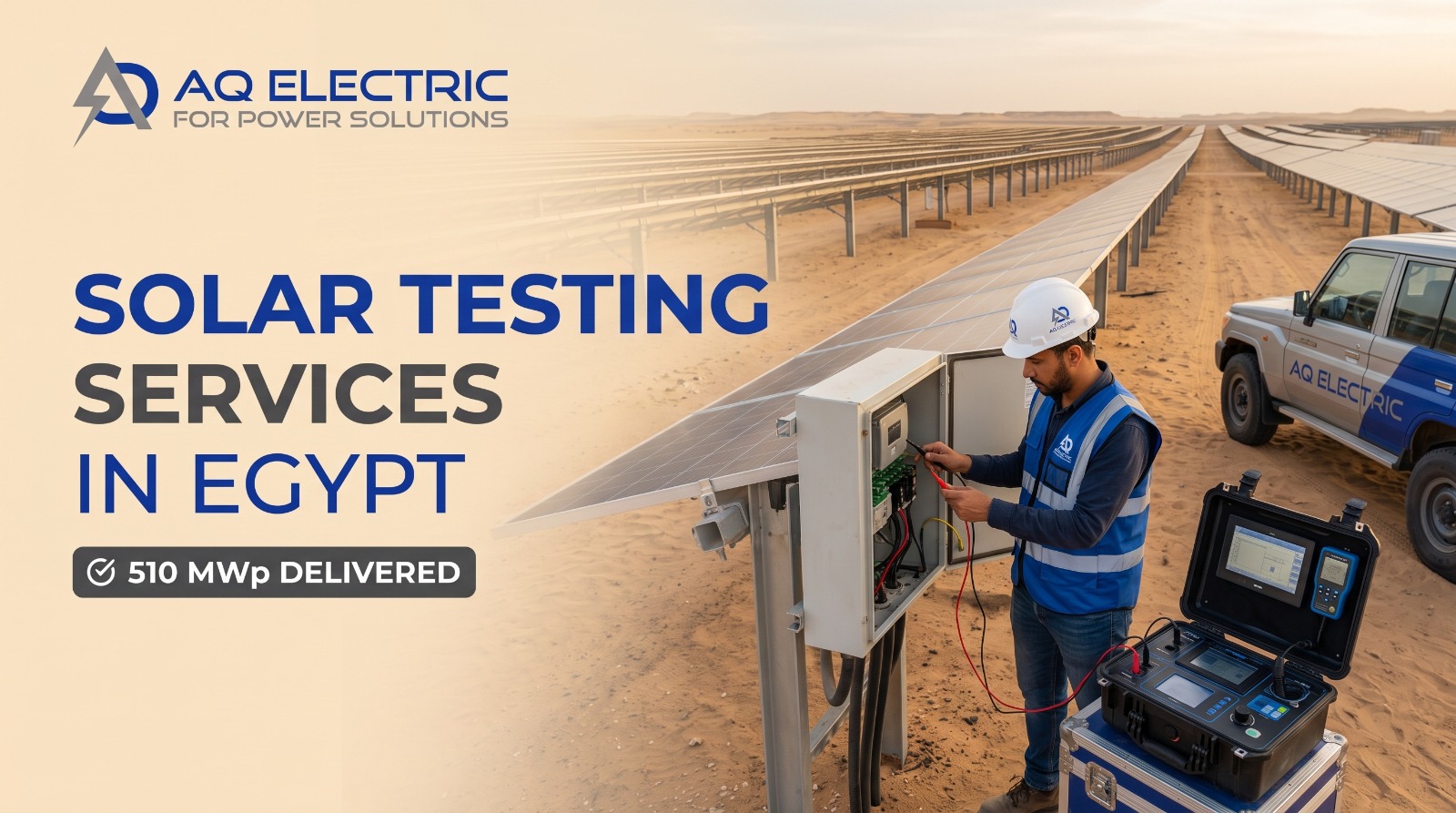
Egypt has become one of the most consequential solar energy stories of the last decade. In the space of eight years, the country has moved from a handful of pilot installations to hosting one of the world’s largest single-site solar developments, and to holding the third-largest renewable energy pipeline anywhere in Africa. For engineers, EPCs, IPPs, developers, and lenders active in the Egyptian market today, the question of who can be trusted to test, commission, and maintain those plants at international standard has become a first-order commercial decision — one that shapes bankability, insurability, and long-term asset value.
Solar Testing Services in Egypt
This guide is written from AQ Electric’s vantage point as one of the region’s specialist solar testing and technical services providers — a company that has delivered five projects totalling 510 MWp across the Aswan governorate, working alongside the biggest names in Egyptian and regional utility-scale solar. It covers what the Egyptian solar market actually looks like in 2026, what the regulatory and institutional landscape requires, where Egypt’s solar capacity is concentrated, why testing expertise matters especially in Egypt’s climate, and how to evaluate a testing and O&M partner for a project in the Egyptian market.
Egypt’s Solar Market Today: Numbers That Matter
Egypt’s ambition in the renewable energy space is now a matter of formal national policy. In September 2024, the Supreme Council of Energy approved an updated Integrated Sustainable Energy Strategy that increases the share of clean energy (hydro, wind, PV, CSP, and nuclear) from 12% in 2021/2022 to 42% by 2029/2030 and more than 60% by 2039/2040, explicitly removing coal from the energy mix and replacing it with renewables. This is not an aspirational number attached to a policy document that will quietly be missed — it is a target being actively funded and delivered against.
The numbers underneath the target confirm the pace. By the end of 2025, Egypt’s total installed renewable energy capacity reached 9.4 GW with the addition of 1.8 GW during the year, up from 7.52 GW in 2024. The country has announced plans to bring online 3 GW of solar energy in 2026 alone to meet electricity demand that is growing at 6–7% per year. Beyond that, the Ministry of Electricity has confirmed that the total capacity of renewable energy projects in operation, under construction, or in the final stages of contracting stands at 22.8 GW — a pipeline that represents the vast majority of MENA’s active solar development for the remainder of this decade.
Several recent transactions illustrate the scale of investor commitment. In late 2024, EETC signed 25-year power purchase agreements for 2 GW of solar PV capacity split between two 1 GW projects, with Egypt’s first battery energy storage capacity of 1.1 GWh integrated with these and a third under-construction project. A consortium of Hassan Allam Utilities and Infinity Power won contracts to develop two solar PV projects with a combined capacity of 1,200 MW, supported by 720 MWh of battery storage, while Amea Power and Japan’s Kyuden International Corporation recently reached financial close on a $700m project comprising a 1,000 MW solar plant and 600 MWh battery system in Aswan. In February 2026, the tender programme continued with EETC launching a 500 MW solar PV tender in the West Nile region, open to local and foreign developers under a build-own-operate model.
Renewable energy target by 2030
Installed renewable capacity end of 2025
Total pipeline (operational + construction + contracted)
Solar planned to come online in 2026
For any organisation planning to enter, expand within, or serve the Egyptian solar market, the implication of these numbers is straightforward: the market is not a speculative bet on future capacity growth — it is a mature, active, and internationally-financed sector that will require testing, commissioning, and O&M services at a scale that only a handful of specialist providers can credibly deliver.
The Regulatory and Institutional Landscape
Delivering a solar project into Egypt means navigating a well-defined institutional framework built up over the past decade. Anyone commissioning or maintaining a plant here will interact with several core institutions.
- MoERE — the Ministry of Electricity and Renewable Energy sets national energy policy, approves large procurement rounds, and coordinates the overall renewable-energy strategy.
- EETC — the Egyptian Electricity Transmission Company operates the national transmission grid, acts as the offtaker for utility-scale IPPs, and runs the competitive tender rounds that have driven Egypt’s solar procurement.
- NREA — the New and Renewable Energy Authority is responsible for renewable-energy resource assessment, land allocation for renewable projects, and technical standards development.
- EEHC — the Egyptian Electricity Holding Company oversees the state-owned generation and distribution companies and, in some project structures, is the contracting counterparty.
- ERA (EgyptERA) — the Egyptian Electric Utility and Consumer Protection Regulatory Agency is the independent regulator responsible for licensing and tariff oversight.
Egypt’s renewable procurement has evolved through three distinct mechanisms, each of which shaped a different generation of projects still operating today:
- Feed-in Tariff (FiT) — Nubian Suns programme. The first-round FiT programme launched in 2014 was the mechanism that ultimately produced most of the Benban Solar Park. Tariffs were pre-defined and offered to qualifying developers on a first-come, first-served basis.
- Build-Own-Operate (BOO) auctions. Established by Presidential Decree No 203/2014 and formalised in the 2015 National Renewable Energy Strategy, this mechanism established competitive bidding for BOO contracts run through EETC, with NREA responsible for land provision to selected projects for the duration of construction and operation. The 2024 2 GW+BESS PPAs and 2026 West Nile tender have followed this model.
- Direct proposal / MoU projects. Selected large developers have negotiated PPAs directly, particularly for projects integrated with green hydrogen or storage.
Regardless of procurement route, the technical standards required by EETC and by international project-finance lenders (EBRD, IFC, AfDB, and their commercial co-lenders) converge on the same reference: IEC-conformant commissioning, IEC 62446-1-compliant testing documentation, and ISO-certified quality-management systems from every technical services provider. Testing services in Egypt must be documented in a format acceptable to both local regulators and international lenders — a documentation fluency that only providers with sustained regional experience reliably deliver.
AQ Electric’s engineering team in Cairo delivers testing, commissioning, and O&M across Egypt — call +962 79 51 54 126 or use the enquiry form.
Where Egyptian Solar Is Concentrated
Egypt’s solar capacity is concentrated in a handful of high-irradiance regions that have combined excellent resource, available land, and grid capacity. Understanding where projects sit is essential to understanding what testing partners need to be equipped for.
Aswan Governorate (Upper Egypt)
The southern city of Aswan and its surrounding governorate is the epicentre of Egyptian utility-scale solar. Roughly 650 km south of Cairo and characterised by exceptional Direct Normal Irradiance (DNI) values, Aswan hosts the Benban Solar Park — the largest single-site solar development in Egypt — along with the Kom Ombo cluster, individual utility-scale projects, and the recent 1 GW Amea Power/Kyuden project. Nearly all of AQ Electric’s Egyptian portfolio is located in this region.
Gulf of Suez and Ras Ghareb (Eastern Coast)
While historically better known for wind resource (the Gulf of Suez is one of the world’s premier wind corridors, hosting hundreds of megawatts of wind capacity), the region is now attracting solar and hybrid solar-plus-storage development. Grid access to the Cairo load centre is straightforward from the Red Sea coast.
West Nile Region
The region west of the Nile has become the primary target for the next generation of utility-scale solar auctions, including the February 2026 500 MW tender. Land is plentiful, irradiance is high, and grid capacity is being expanded specifically to support renewable additions here.
Distributed Rooftop and Commercial & Industrial
Beyond the utility-scale concentration in Upper Egypt and the West Nile, a growing commercial and industrial (C&I) solar market has developed across the Cairo metropolitan area, the Delta, and Alexandria — serving banks, factories, universities, and shopping centres through net-metering and self-consumption structures. These installations are typically smaller (kW to MW scale) but numerous, and require the same disciplined testing regime as any utility-scale plant to satisfy insurers and financial lenders.
Inside the Benban Solar Park
No discussion of Egyptian solar is complete without a proper look at the Benban Solar Park — the flagship development that put Egypt on the global solar map and that continues to define what utility-scale solar delivery in the country looks like.
Located in Benban village, Aswan Governorate, approximately 650 km south of Cairo and 40 km northwest of Aswan, the park has a current installed capacity of 1,800 MW (1.8 GW), corresponding to an annual production of approximately 3.8 to 4.5 TWh. It sits on a site covering 37.2 km² subdivided into 41 separate plots arranged in four rows, with each plot ranging in size from 0.3 km² to 1 km². Site solar resource is 2,300 kWh per year per square metre — among the highest levels of solar irradiation recorded anywhere in the world.
Development Model and Financing
Benban was structured as a Feed-in Tariff programme (the Nubian Suns FiT), attracting more than 30 international and Egyptian developers to invest in individual plots. Each plot operates as an independent PV plant with its own EPC contractor, own O&M team, and own connection to a shared substation infrastructure built by EETC. The project involved 40 companies specialised in the production of energy in accordance with international standards, including 10 international and Arab companies and 30 Egyptian companies. Total investment across the park was approximately US$2 billion.
Financing was led by a consortium of development finance institutions — the International Finance Corporation (IFC), the European Bank for Reconstruction and Development (EBRD), the African Development Bank, and other multilaterals — alongside commercial banks. This lender diversity is directly relevant to testing services: each lender applies its own due diligence standards, and every commissioning report on a Benban plot has to satisfy multiple lender technical advisors before drawdown can proceed.
Technical and Operational Environment
Operating in Benban means operating in one of the most demanding environments in global solar. Ambient temperatures routinely exceed 45 °C in summer, module operating temperatures cross 70 °C, and airborne dust from the Western Desert imposes a soiling burden that requires structured cleaning programmes just to maintain nameplate output. Plants that were designed with global-average assumptions and were not adapted to these conditions have consistently underperformed their financial models — a lesson the O&M community has learned in real time over the plants’ operational life.
On the transmission side, the Egyptian Electricity Transmission Company built four new substations specifically to distribute Benban’s output, and the plants collectively contribute a meaningful share of southern Egypt’s electricity supply.
Why Benban still matters to any new Egyptian solar project
Benban is the single largest concentration of solar operating experience in the country. Every lesson learned about heat, dust, cleaning, testing intervals, module warranty behaviour, and inverter reliability in Benban informs how testing and O&M is now specified for new Egyptian projects. Any testing partner without direct field experience at Benban or a comparable utility-scale Aswan site is starting several years behind.
Kom Ombo and the Aswan Belt
Alongside Benban itself, the town of Kom Ombo (approximately 40 km north of Aswan) has become the anchor for a growing solar cluster. Egypt’s 2015 auction programme opened with the development of a 20 MW PV power plant at Kom Ombo, and the site has since seen substantial subsequent development, including AQ Electric’s own Komombo 230 MWp project.
The wider Aswan region also hosts the 1 GW Amea Power/Kyuden solar plus BESS project that recently reached financial close — positioned to be Africa’s largest single-site solar-storage installation. The concentration of grid-connected capacity in the Aswan belt now approaches or exceeds 3 GW when Benban, Kom Ombo, and adjacent projects are combined, making it one of the highest-density solar regions in the entire African continent.
For a testing and O&M provider, this concentration matters commercially. A field team based in or close to Aswan can support multiple projects simultaneously, share calibrated equipment and spare parts across sites, and respond to faults in hours rather than days. AQ Electric’s Egypt operations are structured around exactly this reality: an Egyptian branch in New Cairo for administrative and engineering coordination, and field capability specifically calibrated for the Aswan environment.
Why Testing Expertise Matters More in Egypt’s Climate
The generic global playbook for solar PV testing was written primarily around European and East Asian operating environments. Applied unmodified to Egypt, it leaves several risks unmanaged — risks that only become visible after months or years of operation, and that are among the most expensive to fix retroactively.
Extreme Irradiance and Module Operating Temperatures
Aswan’s DNI values exceed those of most solar sites globally, and module operating temperatures routinely reach 70 °C or higher in summer. These conditions:
- Accelerate degradation of module cell interconnects and encapsulants beyond what standard degradation rates assume.
- Push inverters closer to their thermal design limits, increasing the likelihood of derating and unplanned trips.
- Reduce transformer thermal headroom, especially where cooling systems were specified against reference ambients rather than actual site conditions.
- Stress cable insulation and junction-box seals at rates far higher than temperate-climate norms.
Standard IEC 62446-1 testing at STC-adjusted conditions catches some but not all of these issues. Enhanced testing regimes — particularly repeated thermographic imaging at multiple operational load points and I-V curve tracing at different times of day — are essential to detect thermal-stress-related faults before they cause outages.
Dust and Soiling Ratios Unique to Upper Egypt
Airborne dust from the Western Desert deposits on modules at rates that dominate the plant’s daily performance profile. Without a proactive cleaning programme, soiling losses can reach 15–25% within weeks in the dry season. Testing services in Egypt must include soiling ratio measurement, cleaning-cycle optimisation, and post-cleaning performance verification — not as optional add-ons, but as core deliverables.
Remote Sites and Response Time Logistics
An Aswan-based plant is 12–14 hours by road from Cairo, and even further from the manufacturing hubs of the Delta. A testing or O&M provider without genuine field presence in Upper Egypt is either dispatching engineers on multi-day trips or subcontracting the actual work — both of which erode the value proposition. AQ Electric’s field engineers routinely operate at Aswan sites and hold calibrated equipment locally exactly to avoid this trap.
Bankability and Lender Reporting Cadence
Because so much of Egypt’s solar sector is financed by international development finance institutions, project reports face a level of scrutiny that domestic markets typically do not impose. Test reports must satisfy multiple lenders’ technical advisors, insurers, and independent engineers — each of whom is looking for different specific data points. A testing provider that has produced reports for IFC, EBRD, and AfDB projects understands this cadence in a way that a purely-domestic contractor typically does not.
IEC 62446-1 in the Egyptian Context
Solar testing services in Egypt anchor on the international standard IEC 62446-1 — the international benchmark for grid-connected PV system testing, documentation, and commissioning. The standard is now referenced by name in EPC contracts, O&M scopes of work, and lender due-diligence checklists across the entire Egyptian sector.
For a complete walkthrough of what IEC 62446-1 requires and how its three test categories work, see our dedicated IEC 62446-1 guide. In the Egyptian context, three additional considerations shape how the standard is applied on the ground:
- Multi-lender documentation harmonisation. Egyptian projects typically involve several international development finance institutions as co-lenders. Each has its own preferred report format and its own technical advisor. IEC 62446-1 compliance is the baseline, but reports must also be structured to satisfy each specific lender’s conventions.
- Environmental adaptation of expected values. Voc, Isc, and PR expected values must be calculated using Egypt-specific irradiance and temperature profiles, not the STC assumptions that suffice in cooler climates. Reports that compare measurements against unadjusted STC values are not credible for Egyptian sites.
- Extended Category 2 coverage. Category 2 (I-V curve tracing and thermographic inspection) is the effective market baseline for Egyptian utility-scale projects — not the optional extra it remains in some other markets. Bankable projects increasingly expect Category 3 diagnostics as well, particularly EL imaging on module batches.
Testing Categories for Egyptian Solar Projects
IEC 62446-1 defines three progressive categories of testing. Industry practice in Egypt has settled roughly as follows across project types:
| Project type | Common location | Typical testing scope |
|---|---|---|
| Residential rooftop | Cairo, Alexandria, Delta cities | Category 1 (mandatory basic tests) |
| Small C&I (up to 500 kWp) | Industrial zones, universities, banks | Category 1 + selected thermography |
| Large C&I (500 kWp – 5 MWp) | Cairo metro, Delta industry | Category 2 (adds I-V curve tracing) |
| Utility-scale IPP | Aswan, Kom Ombo, West Nile | Category 2 (full) + selected Category 3 |
| Lender-financed bankable project | Benban, Aswan, Gulf of Suez | Category 3 (EL imaging, wet insulation) |
For how these categories extend into periodic testing during the operational life of the plant, see our solar O&M guide.
Common Testing Findings on Egyptian Sites
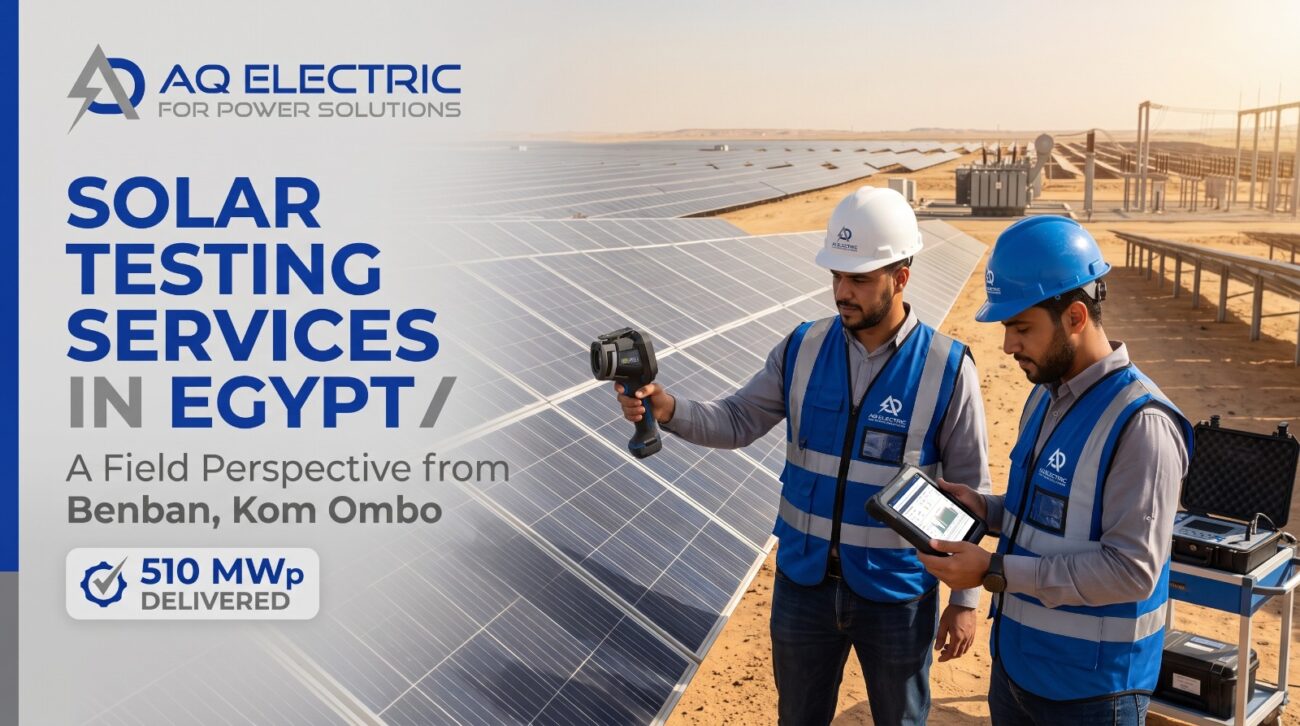
Across five years of testing and inspection work on Egyptian solar plants, AQ Electric’s field team has developed a pattern-recognition catalogue of the issues most likely to appear at Aswan sites specifically. These are not universal to every project, but they appear often enough that experienced local testing teams check for them by default.
Underestimated Cable Cross-Sections
Design assumptions made against European or East Asian temperature profiles frequently produce cable cross-sections that are technically compliant on paper but that operate under continuous thermal stress in Aswan. Post-commissioning thermographic scans routinely identify hot spots at cable terminations that would not be flagged as issues in a cooler climate.
Combiner Box Overheating
Combiner boxes located in unshaded positions on a Benban-scale plant reach internal temperatures that stress fuses, disconnectors, and monitoring hardware beyond their rated envelopes. Recurring nuisance-tripping of individual strings is often traceable to combiner-box thermal cycling rather than to actual string faults.
Cleaning-Related Micro-Abrasion
The cleaning methods that make economic sense in Aswan (typically dry brush or semi-dry robotic) can cause micro-abrasion of the module anti-reflective coating over years of repeated cleaning. EL imaging of older modules routinely reveals scratch patterns that would not appear in wet-cleaned installations elsewhere. This is not a maintenance failure — it is a real-world trade-off between soiling loss and abrasion loss.
Junction Box Moisture from Nile Fog
Overnight fog from the Nile occasionally reaches Aswan-region sites and, over years, contributes to slow moisture ingress in junction boxes and connectors even in a nominally arid climate. Insulation resistance trending catches this before it becomes a fault.
Module Batch Variability
Utility-scale projects that ordered modules across multiple manufacturing batches occasionally show batch-level performance variation that only becomes visible under systematic I-V curve testing. Documenting this at commissioning is essential for future warranty claims — a documentation exercise that AQ Electric’s reporting systems are structured around.
AQ Electric’s Aswan-experienced field team can support commissioning, third-party inspection, or diagnostic testing.
AQ Electric in Egypt: 510 MWp Delivered
AQ Electric extended into the Egyptian market in 2021, following its founding in Jordan in 2019. Since then, our Egypt branch has established itself as a specialist testing and technical services provider for utility-scale solar in the Aswan governorate, delivering across a portfolio of 5 projects totalling 510 MWp and building the operating experience that now underpins our wider MENA capability.
Egypt Portfolio
510 MWp of Egyptian Solar Delivery
Our Egyptian portfolio is concentrated in and around the Aswan governorate — the heart of Egypt’s utility-scale solar sector — where we have supported projects for clients including ACWA Power, ALCOM, SECI, and other regional and international developers.
| Project | Location | Capacity | Year |
|---|---|---|---|
| Komombo | Aswan | 230.0 MWp | 2024 |
| SECI Projects | Aswan (Benban) | 115.0 MWp | 2021 |
| ALCOM | Aswan (Benban) | 70.0 MWp | 2023 |
| ACWA | Aswan (Benban) | 67.0 MWp | 2023 |
| TK | Aswan | 28.0 MWp | 2023 |
Alongside our Egyptian portfolio, AQ Electric’s engineering team has delivered testing and technical services across the wider MENA region — including 7 solar projects totalling approximately 124 MWp in Jordan, the flagship Wadi Ad Dawasir 120 MWp plant in Saudi Arabia with SEPCO, and the pioneering Shabwa 53 MWp project in Yemen. See our complete project portfolio for the full list. For our Jordan-specific portfolio and market perspective, see our solar testing services in Jordan guide.
Our Egypt Operating Model
AQ Electric maintains a formal Egyptian branch in New Cairo (Fifth Settlement), staffed with engineering and administrative capability that coordinates project delivery across the country. Field capability is deployed from the branch to Aswan sites on project-specific mobilisation, with calibrated I-V tracers, thermographic drones, insulation testers, and EL imaging equipment held either in-country or drawn from our wider MENA equipment pool.
Our field engineers operate under an ISO 9001, ISO 14001, and ISO 45001-certified management system and work to IEC 62446-1 as the standard commissioning framework. We have supported projects for a client base that includes ACWA Power, NOMAC, Wärtsilä, Belectric, SEPCO, Philadelphia Solar, Power China, and other regional and international developers — the same names that dominate utility-scale delivery across the Middle East and North Africa.
Where We Add Value on Egyptian Projects
Working across five completed projects and multiple ongoing engagements, three practical advantages of AQ Electric’s Egypt operating model have consistently mattered more than the marketing:
- Aswan-specific pattern recognition. Our engineers know which module batches showed early-life micro-cracks in Benban, which combiner box designs fail earliest in Aswan summer, and which cleaning contractors have a track record of acceptable performance. This is field knowledge that only comes from repeated work in the same environment.
- Multi-lender documentation fluency. Reports produced for IFC-financed, EBRD-financed, and AfDB-financed projects are structured to satisfy each lender’s technical advisor from the first draft. Fewer iterations means faster drawdown and lower project risk.
- Regional equipment mobility. When a project requires specialist equipment on short notice — a wet insulation tester, an EL imaging system, a calibrated Class-A pyranometer for a PR verification — our regional equipment pool can be redirected from Jordan, KSA, or the UAE within days rather than weeks.
Solar Project in Egypt? Talk to Our Cairo & Aswan Team.
AQ Electric’s Egyptian engineering team delivers IEC 62446-1 testing, commissioning, third-party inspection, and O&M — from Benban utility-scale plants to Cairo C&I rooftops.
Choosing a Solar Testing Partner in Egypt
Not every provider offering solar testing services in Egypt is a serious operator. Between a genuine regional specialist and a rebadged sub-contractor arrangement, seven criteria consistently separate the two — and any procurement team building a shortlist should apply them systematically.
- Registered Egyptian presence. A local legal entity, a physical office, and an Egypt-registered engineering team — not a subcontractor relationship with a global brand.
- ISO certifications held under the local entity. ISO 9001, ISO 14001, and ISO 45001 at a minimum. AQ Electric’s certification package covers all three under a common regional management system.
- Documented Aswan-region project references. Not logos on a slide, but named projects and named contact people willing to speak to prospective clients.
- IEC 62446-1 sample reports. Ask for a redacted sample report in the exact format the provider will deliver. Its structure, completeness, and comparison-to-expected-value discipline reveal more about actual capability than any brochure.
- Multi-lender documentation experience. Track record of producing reports accepted by IFC, EBRD, AfDB, or their commercial co-lenders. Egyptian projects almost always involve at least one of these.
- Calibrated equipment held regionally. I-V tracers, EL cameras, thermographic drones, VLF sets, insulation testers, and torque tools with current calibration certificates — and clear ownership rather than rental-only arrangements.
- Reporting SLAs written into the contract. Specific hours-to-report and days-to-commission commitments, not vague “prompt reporting” language.
AQ Electric Services in Egypt
Delivered from our Cairo branch to Aswan sites and beyond.
⚡Testing & Commissioning🔧Operation & Maintenance🔍Third-Party Inspection✓Quality Assurance (FAT & SAT)📐Engineering Services🚁Drone Inspection🎓Training Services✉Speak to an Engineer
Frequently Asked Questions
Is IEC 62446-1 legally required for solar projects in Egypt?
There is no specific Egyptian law naming IEC 62446-1, but the standard is required in practice by EETC-recognised commissioning protocols and by every international lender financing solar projects in Egypt. For any bankable project — which effectively covers all utility-scale IPPs and most large C&I projects — compliance is mandatory.
Can AQ Electric support both utility-scale and C&I projects in Egypt?
Yes. Our Egyptian portfolio spans from 28 MWp (TK) up to 230 MWp (Komombo), and our field capability serves both utility-scale IPPs and smaller commercial installations. See our testing and commissioning services for the full scope.
How much do solar testing services cost in Egypt?
For utility-scale plants, commissioning testing typically runs at a modest single-digit percentage of total EPC cost. Ongoing periodic O&M testing is priced per kWp per year, in the range of USD 5–12 depending on plant size, scope inclusions, and site accessibility. Specific quotations depend on scope, location, and testing category.
Where is AQ Electric based in Egypt?
Our Egypt branch is located in Zizinia Resort, Fifth Settlement, New Cairo. Field engineering teams mobilise from Cairo to Aswan, the Gulf of Suez, and other project sites as required. Full contact details are on our contact page.
What is the typical timeline for solar plant commissioning testing in Egypt?
For a 50 MWp utility plant in Aswan, Category 1 and Category 2 testing typically completes within 3–5 weeks depending on site logistics, weather, and inverter block phasing. Full Category 3 diagnostics add another 1–2 weeks. Site accessibility and grid-connection readiness are usually the pacing constraints, not testing capacity.
What ongoing testing does a solar plant in Aswan need after commissioning?
A common schedule for an Aswan-region utility plant is monthly visual inspection, quarterly thermographic scanning (dust makes this more frequent than in cooler climates), annual full I-V curve tracing on all strings, three-yearly VLF cable testing, and event-triggered Category 3 diagnostics. See our solar O&M guide for the detailed schedule.
Does AQ Electric provide training for in-house O&M teams in Egypt?
Yes — both on-site and online technical training for solar operations, testing, and safety is available through our training services for developers and IPPs building internal capability.
Can AQ Electric support projects outside Aswan — in the Gulf of Suez or West Nile?
Yes. Our Egypt branch and MENA-wide equipment pool mobilise to any Egyptian site. As Egypt’s solar development extends into the West Nile region and the Gulf of Suez, we are actively supporting projects in those new geographies with the same standards and processes proven in Aswan.
Delivered in Egypt. Trusted Across MENA.
AQ Electric has delivered testing, commissioning, and technical services on 510 MWp of Egyptian solar projects, working alongside the biggest names in regional and international utility-scale solar. With ISO-certified processes end to end and over 1.0 GW of PV project experience across the MENA region, we are ready to support your next Egyptian project from day one.
Egypt portfolio delivered
MENA PV projects supported
ISO certifications9001 · 14001 · 45001
Egypt operations since