

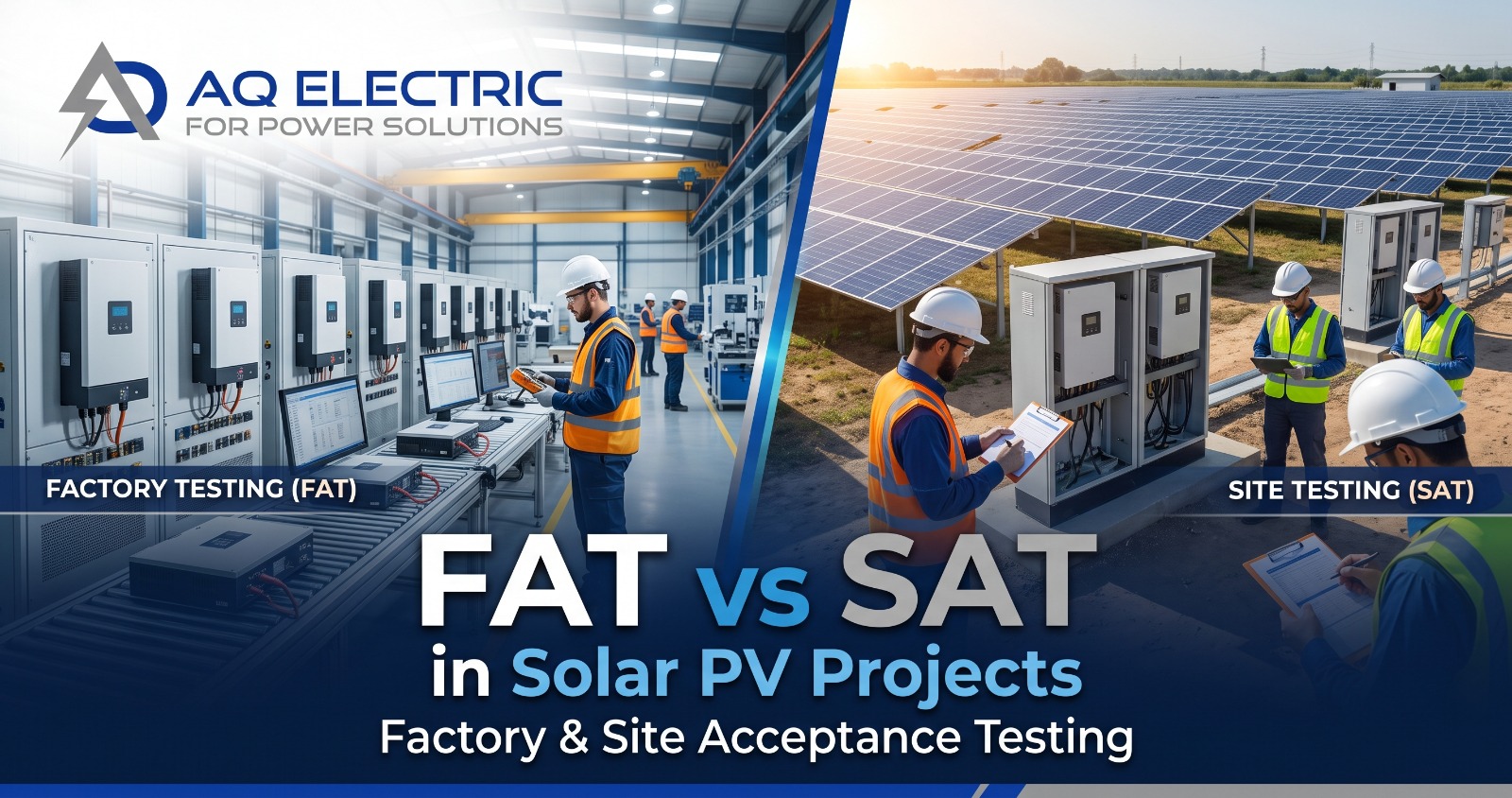
AQ Electric delivers factory and site acceptance testing for solar PV projects across the MENA region, and our engineers see the same pattern on project after project: equipment that passed its manufacturer’s checks arrives on site damaged, misconfigured, or not quite what the specification required. Understanding FAT vs SAT in solar PV projects — what each test proves, what each one misses, and why a serious project needs both — is one of the simplest ways to protect a plant’s schedule, its warranties, and its long-term yield. With more than 1.0 GW of PV project experience, AQ Electric’s quality assurance team acts as the owner’s independent witness at the factory and on site, so defects are caught at the gate rather than discovered after energisation.
This article explains the difference between a factory acceptance test (FAT) and a site acceptance test (SAT) in practical terms, then walks through what each test should cover for the four equipment groups that matter most in a solar plant: PV modules, inverters, power transformers, and medium-voltage switchgear. It covers the international standards behind each test, the different ways a FAT can be witnessed, what can go wrong between the factory and the site, the documentation both tests should produce, and the specific considerations for Gulf and MENA projects. Whether you are an EPC planning a quality programme, a developer protecting a procurement contract, or a lender’s advisor reviewing a project, this is a practical reference on FAT vs SAT in solar PV projects — and on how AQ Electric delivers both.
FAT vs SAT: The Core Difference
The simplest way to understand FAT vs SAT in solar PV projects is by location and purpose.
A factory acceptance test (FAT) takes place at the manufacturer’s facility, before the equipment is shipped. It proves that the specific units built for your project have been manufactured, assembled, wired, and configured according to the contract specifications and the applicable standards. If a FAT fails, the equipment does not ship until the non-conformity is corrected — which is exactly when correction is cheapest.
A site acceptance test (SAT) takes place at the project site, after the equipment has been transported, received, and installed. It proves that the equipment still meets specification after everything that happened on the way: sea and road transport, handling, storage, installation, and connection to the rest of the plant. SAT is also the point at which equipment is verified in its real environment, with its real interfaces, for the first time.
Put simply: FAT proves the equipment was built right; SAT proves it arrived and was installed right. Neither replaces the other. FAT cannot detect transport damage or installation errors, and SAT on its own discovers manufacturing defects only after the equipment has crossed the world — when replacing it means weeks of delay.
Why Solar Projects Need Both
The case for a disciplined approach to FAT vs SAT in solar PV projects rests on independent industry data about where defects come from.
Factory Quality Cannot Be Assumed
Intertek CEA, which has carried out more than 80,000 inspections in over 340 PV module factories, reported in its 2026 manufacturing quality report that 71% of the factories it audited in 2025 fell into its two lowest grades, C or D, and that none earned its top grade. The same report identifies soldering defects, grid breaks, and cell scratches as roughly three-quarters of the electroluminescence defects found at the pre-shipment stage. A factory certificate is a starting point; an independently witnessed factory acceptance test is evidence.
Defects Survive Into Operation
Raptor Maps’ 2026 Global Solar Report, based on 373 GW of inspection data, observed an average power loss of 4.46% already present at commissioning. Much of that loss is built in before the plant ever operates — in manufacturing, transport, and installation. FAT and SAT are the two formal quality gates that sit directly across that path.
The Cost Curve of a Defect
A defect found at FAT costs a correction on the factory floor. The same defect found at SAT costs shipping, replacement, and schedule delay. Found after energisation, it may cost lost generation, equipment damage, or a safety incident. Found years later, it becomes a disputed warranty claim. Every step down that path is more expensive than the last — which is the entire economic logic of acceptance testing.
The core principle
FAT protects the project from what the factory got wrong. SAT protects it from what happened after the factory. A quality programme that does only one of them leaves half the risk unmanaged.
FAT vs SAT Side by Side
| Aspect | Factory Acceptance Test (FAT) | Site Acceptance Test (SAT) |
|---|---|---|
| Location | Manufacturer’s facility | Project site |
| Timing | After manufacture, before shipment | After delivery and installation, before energisation |
| Proves | Equipment was built to specification | Equipment survived transport and was installed correctly |
| Catches | Manufacturing defects, wrong configuration, non-compliant components | Transport damage, storage damage, installation and wiring errors, interface issues |
| Conditions | Controlled, often with simulated interfaces | Real site environment and real connections |
| If it fails | Equipment does not ship until corrected | Repair or replacement on site, with schedule impact |
| Key output | FAT report and release-for-shipment certificate | SAT report and readiness for energisation |
How a FAT Is Witnessed
A factory acceptance test is normally performed by the manufacturer’s own test team. What changes from project to project is who watches, and how. That choice determines how much the results can be trusted.
- Manufacturer-only FAT with submitted reports — the factory tests the equipment and sends the results. This is the weakest form of assurance, because the party issuing the report is the party that wants the shipment accepted.
- Client-witnessed FAT — the buyer’s own engineers attend and observe the tests. Stronger, but dependent on the client having specialist test expertise available to travel.
- Third-party witnessed FAT — an independent inspection firm attends on the owner’s behalf, verifies the test setup and instrument calibration, observes the tests, reviews the results against acceptance criteria, and reports independently. For bankable projects, this is the standard lenders expect.
- Remote or virtual FAT — witnessing by live video. It saves travel cost and time, but it limits the witness’s ability to inspect setups, instruments, and physical workmanship. It is best treated as a supplement, not a substitute, for critical equipment.
On projects run under FIDIC-style contracts, the owner’s engineer typically plays the central witnessing role, reviewing procedures, observing results, and issuing acceptance reports. Independent witnessing is also a core part of AQ Electric’s third-party inspection for solar PV.
AQ Electric delivers FAT and SAT for modules, inverters, transformers and switchgear — call +962 79 51 54 126.
PV Modules: Pre-Shipment FAT and Arrival SAT
When it comes to FAT vs SAT in solar PV projects, PV modules are a special case: the factory acceptance test usually takes the form of a pre-shipment inspection, because a utility-scale order contains hundreds of thousands of modules that cannot all be retested individually.
Module FAT: Pre-Shipment Inspection
- Certification check — confirmation that the module type holds valid IEC 61215 design qualification and IEC 61730 safety certification from an ISO/IEC 17025-accredited laboratory, and, where the specification requires it, additional certifications such as IEC 61701 salt-mist corrosion (important for coastal sites), IEC 62716 ammonia corrosion, and IEC 62804 potential-induced degradation testing.
- Statistical sampling — samples drawn from finished, packed production according to ISO 2859-1, with acceptable quality limits (AQL) agreed in the contract. Some utility procurement specifications split production into batches of roughly 5 to 10 MW for inspection.
- Visual inspection — checking glass, frames, backsheets, junction boxes, cables, and connectors against the defect criteria in IEC 61215.
- Flash testing — independently measuring the maximum power of sampled modules at standard test conditions and comparing it with the manufacturer’s flash data and the nameplate rating. Many specifications require positive-only power tolerance.
- Electroluminescence imaging — revealing microcracks, soldering defects, and inactive cell areas that visual inspection cannot see. For the technique in detail, see AQ Electric’s article on electroluminescence testing for solar PV.
- Packaging and loading — checking pallet construction, edge protection, and container loading, because poor packaging is a leading cause of transport damage.
Module SAT: Arrival and Receiving Inspection
On arrival, the site acceptance test for modules verifies that the shipment survived the journey: container and pallet condition, a visual inspection of a statistical sample, and — for large projects — electroluminescence imaging of a sample to detect transport-induced microcracks. Comparing arrival EL images with pre-shipment EL images is the clearest way to establish whether damage happened in the factory or in transit, which determines who pays for it. Storage conditions on site are also checked, since modules left in the open or stacked incorrectly can be damaged before installation.
Inverters: Functional FAT and Grid-Ready SAT
Inverters are where most of a solar plant’s active electronics and control logic live, and they are among the most failure-prone components in operation. That makes them a priority in any FAT vs SAT programme.
Inverter FAT
- Verification that the delivered model, hardware revision, and firmware version match the approved design and the certificates on file.
- Visual and mechanical inspection of enclosures, cooling systems, internal wiring, terminations, and labelling.
- Insulation and dielectric tests and protective earthing checks.
- Functional testing of start-up, shutdown, and MPPT operation, and confirmation of efficiency and power ratings.
- Verification of protection functions and grid-support settings against the project’s grid-code requirements.
- For inverter stations and skids, verification of auxiliary systems, cooling, and integrated transformer and switchgear interfaces.
Inverter SAT
On site, the inverter SAT confirms that units are undamaged, correctly mounted and cooled, correctly connected on the DC and AC sides, and configured with the approved settings. Torque on terminations, polarity of incoming strings, earthing, communication with the monitoring system, and protection settings are all verified before energisation. For a fuller picture of how inverters fail and how they are tested, see AQ Electric’s article on solar inverters in utility-scale PV plants.
Power Transformers: IEC 60076 FAT and Site Re-Verification
Power transformers are among the most expensive and longest-lead items in a solar plant, and a transformer failure can take a large share of the plant offline for months. Acceptance testing is therefore non-negotiable, and transformers are where the value of FAT vs SAT in solar PV projects shows most clearly in the test data.
Transformer FAT
Transformer factory acceptance testing is based on IEC 60076. Routine tests performed on every unit typically include winding resistance, voltage ratio and vector group, short-circuit impedance and load loss, no-load loss and current, and dielectric tests such as applied and induced voltage withstand, along with insulation resistance measurement. Type and special tests — such as temperature rise or lightning impulse — are performed when the contract requires them. A witnessed FAT confirms that the losses and impedance match the guaranteed values, which matter directly for plant yield and contractual penalties.
Transformer SAT
After transport, the transformer is re-verified on site: inspection for transport damage and review of impact-recorder data where fitted, insulation resistance, winding resistance, ratio, and other diagnostic tests compared against the FAT values, oil sampling for oil-filled units, and checks of protection devices and accessories. A large deviation from FAT results is a warning sign that something moved or was damaged in transit. For more on transformer roles, testing, and failure modes, see AQ Electric’s article on solar power plant transformers.
MV Switchgear: Routine Tests and Site Checks
Medium-voltage switchgear protects and isolates the plant’s collection network and connects it to the substation, and it is often the last major item in a FAT vs SAT in solar PV projects programme. Its acceptance testing focuses on electrical integrity, protection, and correct operation.
Switchgear FAT
Factory routine tests for metal-enclosed MV switchgear are defined under IEC 62271-200 and include power-frequency withstand tests on main circuits, measurement of main-circuit resistance, mechanical operation tests of switching devices and interlocks, and verification of wiring, auxiliary and control circuits against the project drawings. Protection relays and control logic are checked against the approved settings.
Switchgear SAT
On site, switchgear is inspected for physical damage and checked against drawings, then tested: current and voltage transformer ratio and polarity, circuit-breaker timing and operation, contact and busbar joint resistance with a micro-ohmmeter, primary and secondary injection to verify protection, and a site high-voltage withstand test at the level appropriate to the equipment rating. Results are recorded and compared with the FAT data.
What Happens Between the Factory and the Site
The gap between the two tests is where the question of FAT vs SAT in solar PV projects is really answered. Between a passed factory test and installation on site, equipment is exposed to:
- Transport shock and vibration — long sea voyages followed by road transport to remote sites can crack cells, loosen connections, and shift transformer cores.
- Handling damage — forklift and crane handling, unloading, and repacking.
- Storage conditions — heat, sun, dust, moisture, and poor stacking while equipment waits for installation.
- Installation errors — wrong torque, reversed polarity, incorrect wiring, poor earthing.
- First-time integration — equipment connected to real cables, real protection schemes, and real control systems for the first time.
None of these can be seen at FAT. All of them can be caught at SAT — provided SAT results are measured and compared against the FAT baseline rather than treated as a formality.
The Documentation FAT and SAT Should Produce
However well the tests are run, FAT vs SAT in solar PV projects is only as valuable as the record it leaves behind. A complete FAT and SAT package should include:
- Approved test procedures and checklists — agreed before testing, defining scope, sequence, and acceptance criteria.
- Drawings and specifications — the references against which equipment is verified.
- Calibration certificates — for every instrument used, proving measurements are traceable.
- Test data sheets — recorded results for every measurement, with serial numbers.
- Non-conformance reports — every deviation logged, with corrective actions closed before release.
- FAT certificate or release note — formal approval to ship.
- SAT report — site results compared against FAT values, with confirmation of readiness for energisation.
This package is not just for the construction phase. Lenders’ technical advisors review it as evidence of construction quality, and owners rely on it for years in warranty claims and performance investigations. AQ Electric explains what lenders look for in its article on the lender’s technical advisor for solar PV projects.
How SAT Leads Into Commissioning
Site acceptance testing and commissioning are closely connected but not identical. SAT focuses on individual equipment items: has each module batch, inverter, transformer, and switchgear panel arrived intact and been installed correctly? Commissioning then verifies the plant as a complete system, string by string and function by function, under IEC 62446-1, before it is handed over and connected to the grid. Knowing where SAT ends and commissioning begins completes the picture of FAT vs SAT in solar PV projects. For the full commissioning framework, see AQ Electric’s IEC 62446-1 article.
In a well-run project the stages form a continuous chain: FAT, then SAT, then commissioning, each building on the results of the last. AQ Electric delivers the commissioning stage through its testing and commissioning services, so the same quality thread runs from factory floor to energisation.
FAT and SAT for Gulf and MENA Projects
The Gulf and wider MENA region raise the stakes on FAT vs SAT in solar PV projects for four reasons.
Long, Import-Dependent Supply Chains
Most modules, inverters, and many transformers installed in the region are manufactured overseas and travel long sea and road routes to desert sites. That makes witnessed FAT the only practical way to stop defective equipment before it ships, and SAT the only way to catch transport damage before installation.
Extreme Storage and Site Conditions
Equipment waiting for installation is exposed to intense heat, UV, and windblown dust. Receiving inspections and SAT should verify storage practices, not just the equipment itself.
Coastal Corrosion
Projects along the Red Sea, the Arabian Gulf, and the Gulf of Oman face salt-laden air. For these sites, module FAT should confirm IEC 61701 salt-mist certification, and enclosure ratings and coatings on inverters, transformers, and switchgear should be checked against the specification.
Gigawatt-Scale Schedules
The region’s largest projects, from Saudi Arabia to Kuwait’s Shagaya programme, run on tight timelines in which a failed SAT on a critical transformer can delay energisation of an entire block. Disciplined FAT reduces that risk at source. For the pipeline in one key market, see AQ Electric’s article on solar PV testing services in Kuwait.
How AQ Electric Delivers FAT and SAT
AQ Electric for Power Solutions, founded in Jordan in 2019 and expanded to Egypt in 2021, delivers factory and site acceptance testing for the four equipment groups that matter most in a solar plant: PV modules, inverters, power transformers, and switchgear. With an ISO 9001, ISO 14001, and ISO 45001-certified management system and more than 1.0 GW of PV project experience, AQ Electric acts as the owner’s or lender’s independent witness, verifying compliance with project specifications, detecting transport damage, and confirming operational readiness.
Our acceptance testing draws on hands-on field experience across the region: testing and commissioning support for China Energy Engineering Group (CEEC) on the 230 MWp Komombo plant in Aswan, Egypt; testing and commissioning support for SEPCO – Power China on the 120 MWp Wadi Ad Dawasir plant in Saudi Arabia; and thermal drone inspection for ACWA Power and NOMAC on utility-scale plants in Aswan. The full list is on AQ Electric’s projects page.
Because AQ Electric also performs electroluminescence imaging, IV curve tracing, thermography, and full commissioning in-house, our FAT and SAT findings can be verified with measurement, and the results carry straight into commissioning. To scope acceptance testing for your next project, explore AQ Electric’s solar PV quality assurance FAT and SAT services.
From Factory Floor to Energisation
AQ Electric’s quality assurance services across the MENA region.
✓Quality Assurance (FAT & SAT)🔍Third-Party Inspection⚡Testing & Commissioning🔬EL Testing📊IV Curve Tracing📐Engineering Services🚁Drone Inspection✉Speak to an Engineer
Frequently Asked Questions
What is the difference between FAT and SAT in solar PV projects?
A factory acceptance test (FAT) is performed at the manufacturer’s facility before shipment and proves the equipment was built to specification. A site acceptance test (SAT) is performed at the project site after delivery and installation and proves the equipment survived transport and was installed correctly. Solar projects need both.
Which solar PV equipment needs FAT and SAT?
The highest priorities are PV modules (through pre-shipment inspection and arrival inspection), inverters, power transformers, and medium-voltage switchgear. Protection and control panels, trackers, and battery systems may also be included depending on the project.
How are PV modules tested before shipment?
Modules are sampled from finished production according to ISO 2859-1 with contractually agreed AQL levels, then visually inspected, flash tested at standard test conditions, and imaged with electroluminescence. Certification under IEC 61215 and IEC 61730 is verified, along with packaging quality.
Which standard applies to transformer FAT?
Power transformer acceptance testing is based on IEC 60076. Routine tests include winding resistance, ratio and vector group, impedance and load loss, no-load loss, dielectric withstand tests, and insulation resistance. Type and special tests are added when the contract requires them.
Can a remote FAT replace an in-person FAT?
Remote FAT by live video saves travel time and cost, but it limits the witness’s ability to verify test setups, instrument calibration, and physical workmanship. For critical equipment on bankable projects, in-person independent witnessing remains the stronger form of assurance.
Is SAT the same as commissioning?
No. SAT verifies individual equipment items after delivery and installation. Commissioning then verifies the complete plant as a system under IEC 62446-1 before handover and grid connection. SAT is a step on the way to commissioning.
Does AQ Electric provide FAT and SAT across the MENA region?
Yes. AQ Electric delivers factory and site acceptance testing for PV modules, inverters, transformers, and switchgear for projects across Jordan, Egypt, Saudi Arabia, and the wider Gulf and MENA region, backed by ISO-certified processes and more than 1.0 GW of project experience.
Stop Defects at the Factory Gate, Not After Energisation
AQ Electric delivers independent factory and site acceptance testing for PV modules, inverters, transformers, and switchgear — with the in-house EL, IV curve, and commissioning capability to verify every finding. Proven across 1.0 GW of MENA projects with CEEC, SEPCO, Power China, ACWA Power, and NOMAC.
PV projects supported
MENA countries covered
ISO certifications9001 · 14001 · 45001
Founded in Jordan