

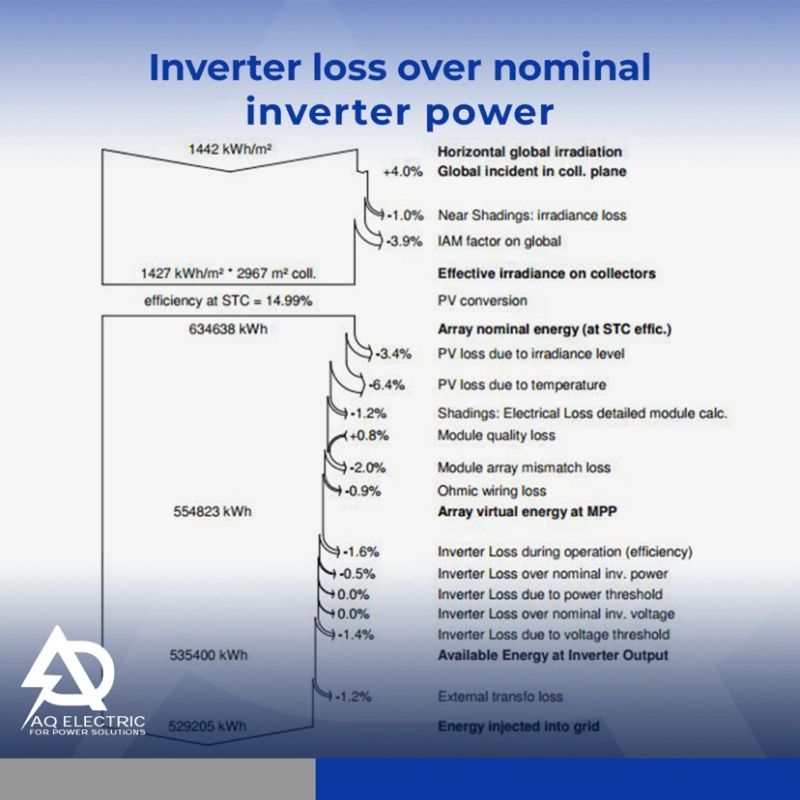
When your solar panels produce more power than your solar inverter can handle, it causes an overload. In simpler terms, you’re using your inverter at a level higher than it’s designed for.
Solar panels rarely generate their complete power output. A module with a power rating of, say 500 W, will only generate 500 Wp of energy in standard test conditions (STC).
But, real-world conditions are different, depending on your geographical location, the temperature and amount of sunlight falling on solar panels could be higher or lower. As a result, the amount of electricity your solar panel generates will be less as compared to the Standard Test Conditions, to compensate these losses, some inverter manufacturers give you the option of overloading your device, i.e. the ability to connect a higher capacity array.
Studies show that overloading your inverter can raise PV efficiency and generation.
if the solar panel production exceeds the inverter’s output rating, it will lead to power clipping. What is that? Power clipping happens when the solar inverter reaches its peak performance, which is typically its power rating. When your solar panels are generating more power than what your solar inverter is designed to create, the device will clip the electricity.
Solar inverter overloading is a good way to bring inverter input and output levels close to each other and raise efficiency. However, it is never recommended to overload your inverter too much.
Moreover, it is crucial to acknowledge the geographical area to determine how much overloading is possible. This will help reduce power losses and maintain your system’s health.
For more information and requests you can reach us,,
– Email: Aqatawneh@aqelectric.net
– Mobile: +201151006630
+962795154126