

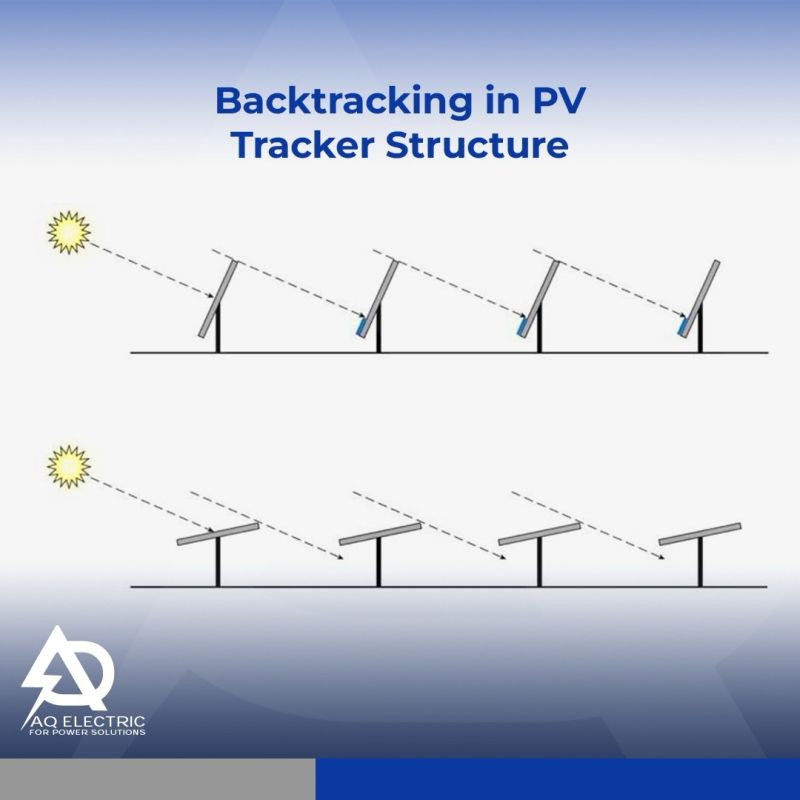
Solar backtracking is a tracking control program that aims to minimize PV panel-on-panel shading, thus avoiding production losses. When a tracker, or a linked tracker row, is used near another, it shades the adjacent tracker during early morning and late afternoon hours.
Backtracking is now a widely used strategy for tracking arrays: when the mutual shadings begin, the tracking angle does not follow the sun anymore, but it instead goes back (decreases) so that no shading occurs.
The backtracking algorithm is implemented to drive the panels’ position during these periods of low solar height, though the angle of the panels is not optimal, the loss from the off-angle is typically less than the loss that would result from shading the panels.
When a single cell in a crystalline module is shaded, it affects the power production of the entire module، this increase in power production widens the “shoulders” of the power production curve for any given day, and results in a better LCOE.
There are no additional costs to enable backtracking, but it’s small in comparison to the benefits gained from shade prevention.
The amount of backtracking performed on average should be minimized for a site to produce the maximum amount of power, however. When laying out a site, it’s important to keep the field density to a minimum to allow for greater spacing between rows, which means less backtracking.
For more information and requests you can reach us,,
– Email: Aqatawneh@aqelectric.net
– Mobile: +201151006630
+962795154126