

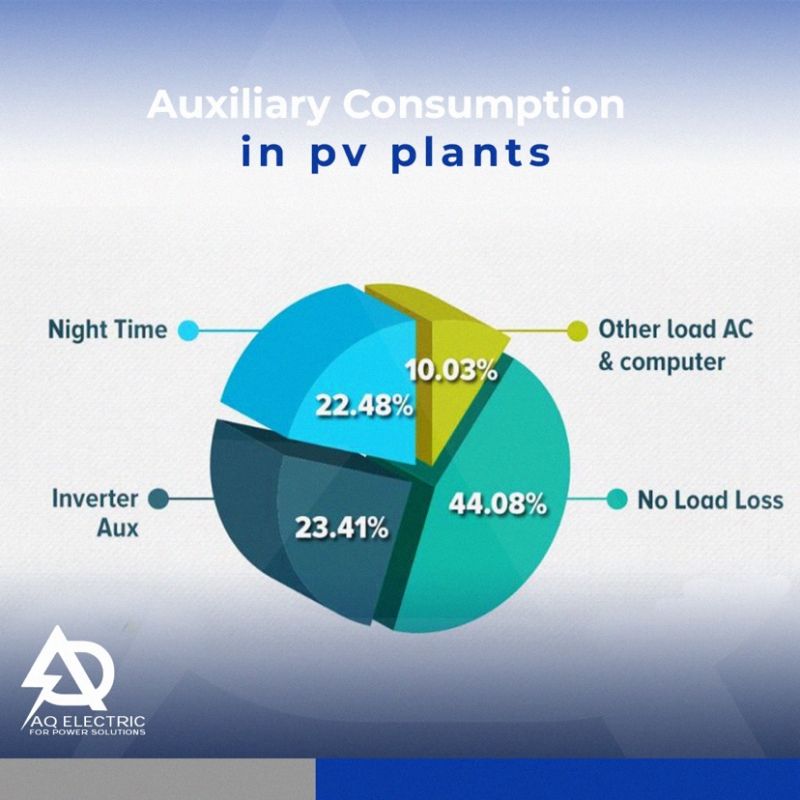
A power plant is required to supply not only the grid but also the auxiliary systems necessary to keep the plant operational for a specified period. In the case of a photovoltaic (PV) plant, these auxiliary systems encompass the inverter control circuitry, transformer magnetizing circuitry, cooling fan, air conditioner, lights, computers, and nighttime auxiliaries like streetlights and servers. The total auxiliary consumption of the plant is categorized into two main groups: plant-generated auxiliary (daytime consumption) and total import (nighttime consumption).
Both plant-generated auxiliary and total imports are further subdivided into four components, with each component represented as a percentage of the total auxiliary consumption. The representation of Auxiliary Power Consumption in PV Plants can be outlined as follows:
– Inverter Efficiency: The efficiency of inverters has a direct impact on auxiliary power consumption. Investing in high-efficiency inverters can substantially reduce energy losses.
– Monitoring and Control Systems: Advanced monitoring and control systems play a vital role in ensuring optimal performance by tracking individual panel output, detecting faults, and adjusting operating parameters. However, it’s essential to acknowledge that these systems consume additional power.
– Cooling Systems: Employed to maintain the ideal operating temperature, cooling systems contribute to auxiliary power consumption. Exploring energy-efficient cooling solutions can help minimize the impact on overall power usage.
– Transformer Losses: Transformers are crucial for voltage conversion and power distribution but introduce losses due to core and copper losses. Selecting efficient transformers and optimizing their design can mitigate these losses.
Additionally:
– BOS (Balance of System): Lighting and CCTV systems are considered auxiliary loads, counted from the power generated.
– Tracker Structure: Certain types of tracker structures are powered by the electricity generated by PV Module strings and are accounted for as auxiliary loads.
The critical consideration of auxiliary power consumption in PV plants is imperative as the solar industry advances. Addressing the factors influencing energy usage in auxiliary components is key to enhancing the overall efficiency and sustainability of solar power systems. As the industry matures, a concerted effort to reduce auxiliary power consumption will undoubtedly contribute to the long-term success of photovoltaic technology.
For more information and requests you can reach us,,
– Email: Aqatawneh@aqelectric.net
– Mobile: +201151006630
+962795154126