

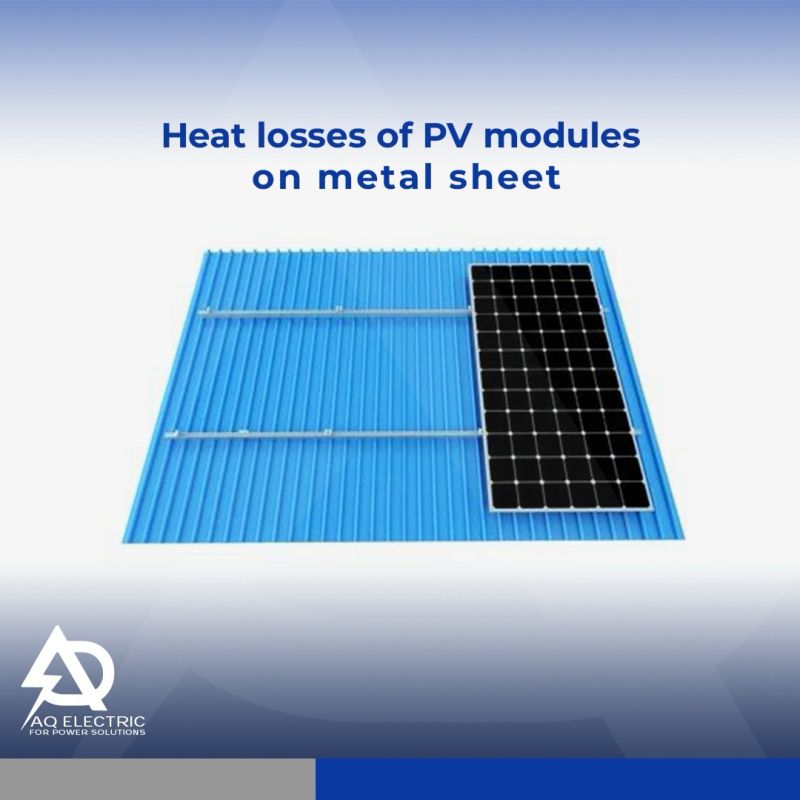
The Solar PV Module panel efficiency is affected negatively by its temperature increase. On the PV Modules installed in open atmosphere for power generation, Natural cooling effect benefits considerably to maintain panel efficiency & hence improve plant generation output.
The heat loss from the PV Module is through conduction to roof, heat carried away through convection by surrounding air & radiation to roof sheet or to sky. Here the module to sheet-roof gap plays an important role to ensure convective cooling on lower surface of modules.
All Solar PV Modules have a parameter indicated by the manufacturer called the “temperature coefficient”. The temperature coefficient represents the percentage at which the panel efficiency reduces at each increase in degree Celsius (°C). As the temperature of the solar panel increases, its output current increases, while the voltage output is reduced.
When solar panels are installed on a sheeted rooftop, they experience greater temperatures than the ambient temperature. Panels that are fixed parallel to the roof with little to no air-gap between the rooftop and panel are the least efficient and experience the greatest rise in temperature, leading to lower power output.
A typical solar mounting system of roof-top installation will allow for a sufficient air-gap between the roof surface and the panel, allowing airflow to have a cooling effect on the panel.
The installation of Solar PV modules on sheet roof is most ideal to have an air gap. Lower air gap will lead to increased module temperature, which will result in lower generation output. Higher than this dimension will have negligible cooling impact, but will have adverse effect of increased moment loads of fixing.
For more information and requests you can reach us,,
– Email: Aqatawneh@aqelectric.net
– Mobile: +201151006630
+962795154126