

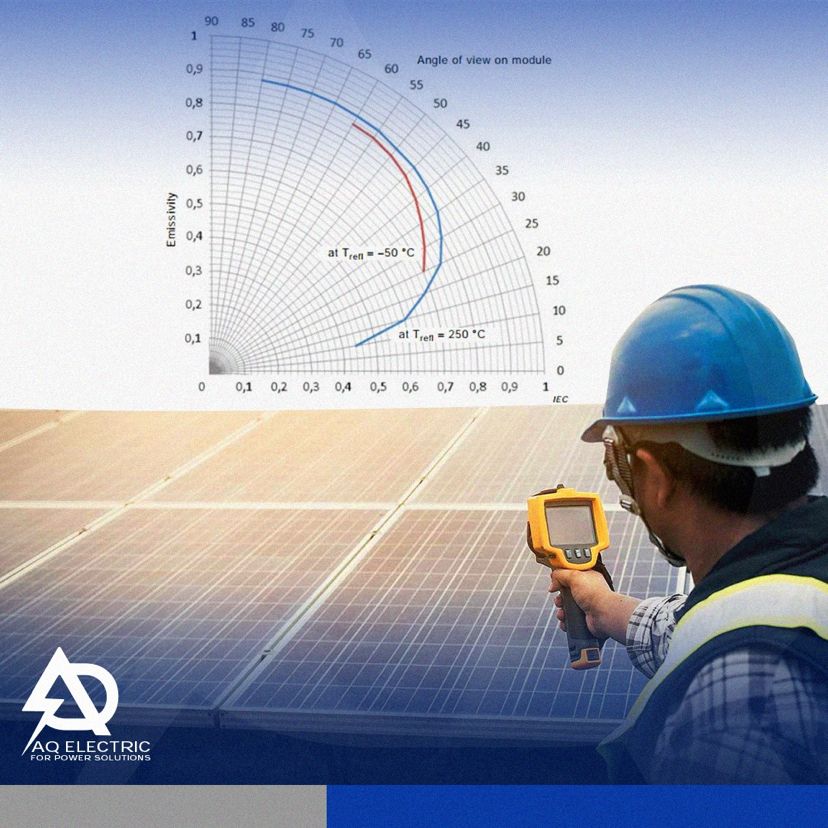
During the inspection of PV Plants using IR cameras, did you consider the concept of emissivity?
Emissivity, a property of surfaces, is influenced by various factors. Many of these factors are less pertinent to the specific task at hand, such as the precise spectral range of the LW-IR camera, surface and ambient temperatures, and surface geometry.
For the sake of simplifying the inspection process, we will focus on the most crucial dependencies and some commonly encountered values, particularly for surfaces with no holes, LW-IR cameras (note that less common MW-IR cameras differ notably):
When conducting thermography on PV modules and Balance of System (BOS) components, it’s essential to grasp the following three dependencies: the material, the surface (including soiling), and the angle of view. Below are examples of these dependencies and associated values:
a) Materials like unoxidized metal (such as stainless-steel parts), polished aluminum components, and certain BOS elements exhibit very low emissivity levels ranging from ε = 0.1 to ε = 0.3, making precise temperature determination challenging.
b) Most insulation synthetics and ceramics tend to have a high emissivity around ε = 0.9.
c) The rough, oxidized aluminum used in module frames, mounting clamps, and some BOS components usually demonstrate emissivity values higher than unoxidized metal but lower than glass, typically ranging from ε = 0.4 to ε = 0.7
For more information and requests you can reach us,,
Email: Aqatawneh@aqelectric.net
Mobile: +201151006630
+962795154126